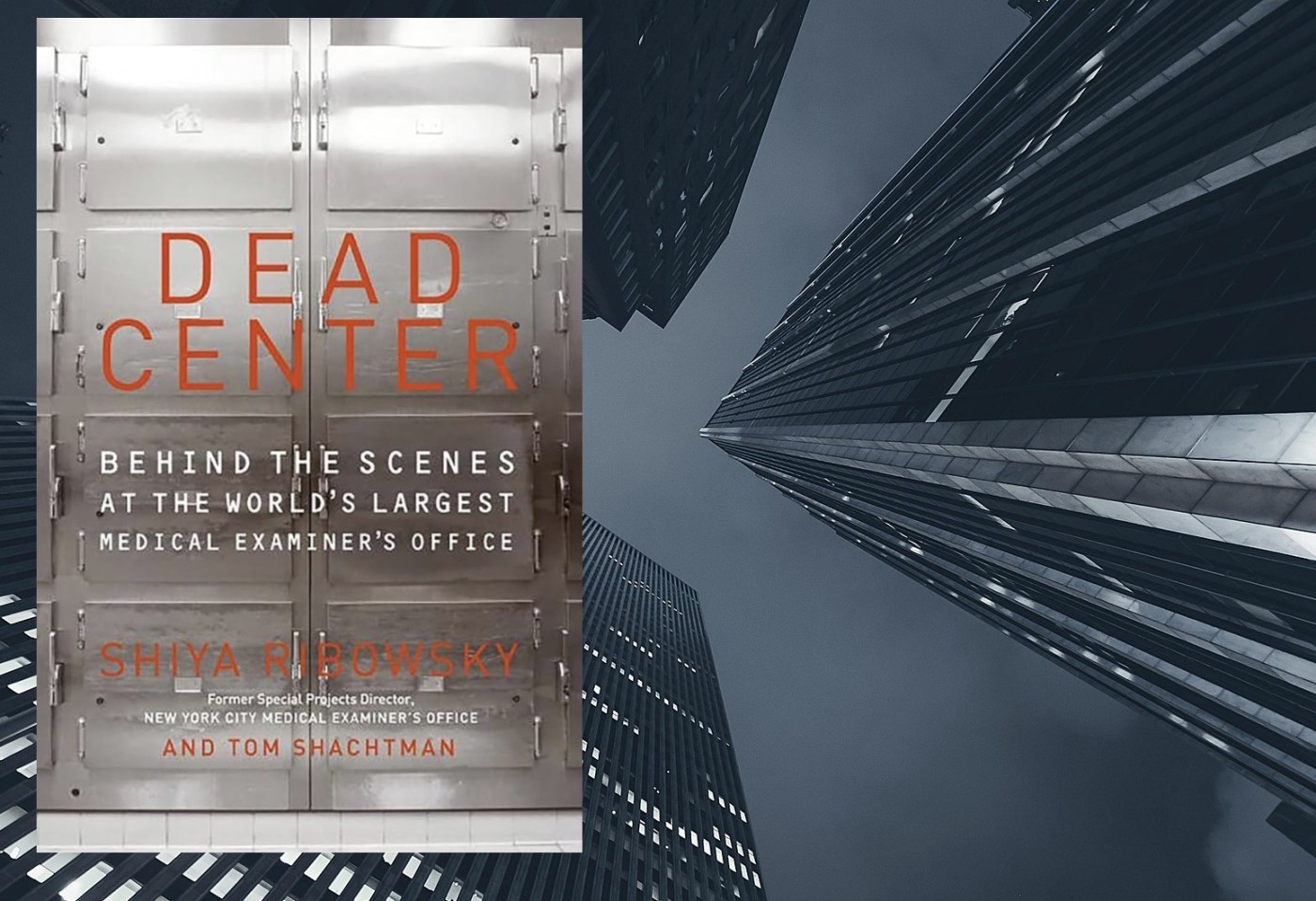
How does one end up working with corpses? What twisted and peculiar path can possibly lead a person with an inclination for the medical profession to switch sides from helping the living to dealing with the dead?
In his book, “Dead Center: Behind the Scenes at the World’s Largest Medical Examiner’s Office”, Shiya Ribowsky provides us with the answer. “If your patients were dead, Shiya, you could probably sit through a concert without interruption.”
Working crazy hours as a physician assistant, contemplating a career change but reluctant to take the plunge because of a decrease in pay and other reservations, Shiya Ribowsky received his wake-up call – literally, fifteen of them – during a concert. That night, he went to enjoy the music and a few peaceful hours, only to be pulled out of his seat fifteen times by his work pager. The decision was made. He replied to an advertisement in the New York Times, applying for a medicolegal investigator (MLI) position in the Office of the Chief Medical Examiner (OCME), was accepted, and his life took a sharp turn for the next few decades.
“Though it was this fascination with death that led many of us to the industry, in reality our days are filled not with death itself or the struggle to know death, but with cleaning up after it.” The author goes into fascinating detail describing what ‘cleaning after death’ entails in his job.
The author’s words that people shouldn’t view dead bodies and the autopsy process as icky made me smile. He expands on his opinion, stating that a dead body isn’t a person who used to inhabit it; thus, it should be viewed as an inanimate object, an artifact. While I certainly see the logic here, there still should be a distinction between people in terms of their ability to keep their composure at the sight of human remains. First, there is an inherent resilience. Second, an acquired habit. And third, which is the most important, I think, is the impossibility of staying indifferent or at least reasonably objective upon seeing the dead body of someone familiar. For most people who aren’t exposed to encountering dead bodies professionally – policemen, medical personnel, etc. – if they happen to find themselves in the company of a deceased person, it is likely that they have had some connection to them.
I admit that my ickiness level is extremely low. Nevertheless, I found the meticulous description of the autopsy process totally engrossing. I would never consider witnessing it in person, but reading about it, I didn’t skip a single line.
Still, the part of the book that absorbed my attention in full is where the author shares about the effort in identifying the victims of the 9/11 attack. I recently read a memoir by the New York City firefighter Joseph Pfeifer, who was the first firefighter chief to arrive at the World Trade Centre, minutes after the first plane hit. This book affected me deeply, and I still carry the story within me. So, I was drawn to learn about the tragedy from a different perspective. Now, to have the complete perspective, I have to read a memoir written by an NYPD officer.
In 2001, the author was a director of identifications at the OCME. By then, he had more than a decade of experience. He had seen bodies in all possible stages of decay. For him, every possible cause of death was not simply the words in the form; for each, he could draw a picture from his memory. He was in the middle of the avalanche of homicides that swept over New York City at the beginning of the 1990s. If Shiya Ribowsky had not considered that he had seen it all, he must have realised that he had seen much more than an average person. And yet, what he had to work with and experience at his job after 9/11 paled in comparison.
No need for many words here. One quote suffices. “How do you tell a grieving, frightened widow, “No, we haven’t seen him. I have seen only pieces of what used to be people”?”
The WTC victim identification effort lasted for several years. Being as busy as he and the team involved were, the author had not noticed when the rest of the world, including his own organisation, became impatient to move on. In 2005, one of the senior members of OCME’s administration told him: “I hate the families,” meaning the families of the 9/11 victims. I understand why the author chose to move on and leave the OCME. He realised that people felt tired and stuck in the situation created by the aftermath of 9/11 for the city services like theirs: the police, the fire department and others. Regardless, he himself, as I imagine, could not simply discard something that constituted his life for years like trash. Especially not something as tremendous as helping thousands of people to find peace after the biggest tragedy of their lives.
I am glad that the author found ways to go on with his life and career, including an exciting and satisfying role as a consultant for the ‘Law & Order’ series.
This memoir was a truly fascinating read. My only, not really a complaint but a subjective remark, is that I’d have preferred it to be two separate books. One dedicated to the author’s work as an MLI and the other focused solely on the 9/11 victim identification effort.


Leave a Reply