Criel-sur-Mer
As a base for exploring the coast, I chose Criel-sur-Mer, a tiny town with only about 2.5 thousand inhabitants. Through Airbnb, I found a perfect apartment that fitted our needs, reasonably priced and with an excellent view. A hiking trail that looked pretty started almost from our doorstep. The town also boasted a small pebbled beach. And there were a few restaurants within walking distance of the house.
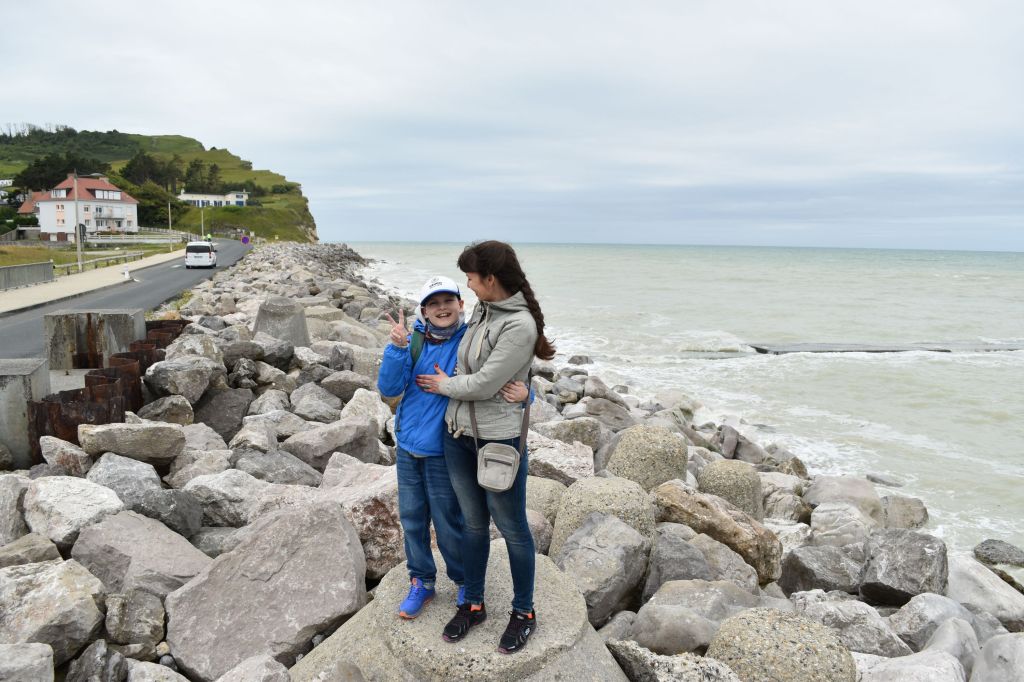
We arrived early, and, while waiting for our hosts, who were kind enough to agree to get the apartment ready for us an hour before the check-in time, we went to explore the beach. The information tableau placed at the entrance listed the quantities of the maritime fauna you were allowed to collect on the beach and take home. 2 kg of mussels surprised us. When my husband found one mussel, our son joked that it was our dinner. “You said that we’d eat mussels when in France, Dad,” he said. “You didn’t lie. We can gather them now and then cook them.”
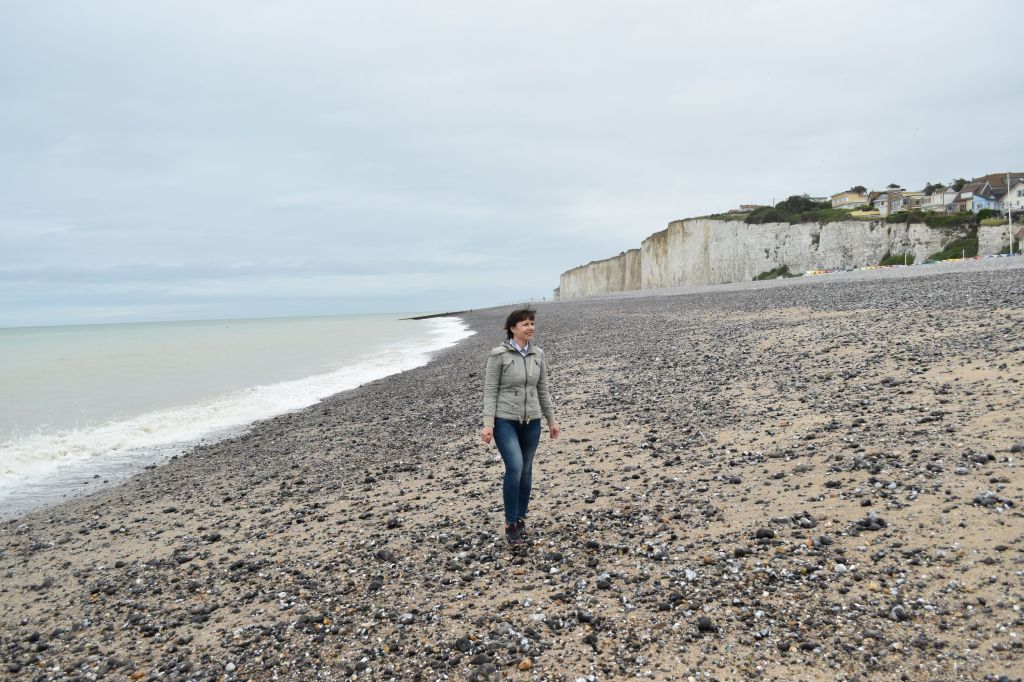
The coast met us with chilly and cloudy weather. It didn’t stop us from setting out on a hike up the hill once we settled in the flat. We saw the trail from our window, and it was one of the factors why I chose this place.
The apartment that we rented through Airbnb lived up to our expectations. The view alone was worth staying here. From our living room window, we could see the hill where we hiked up every day and the sea – La Manche or the English Channel.
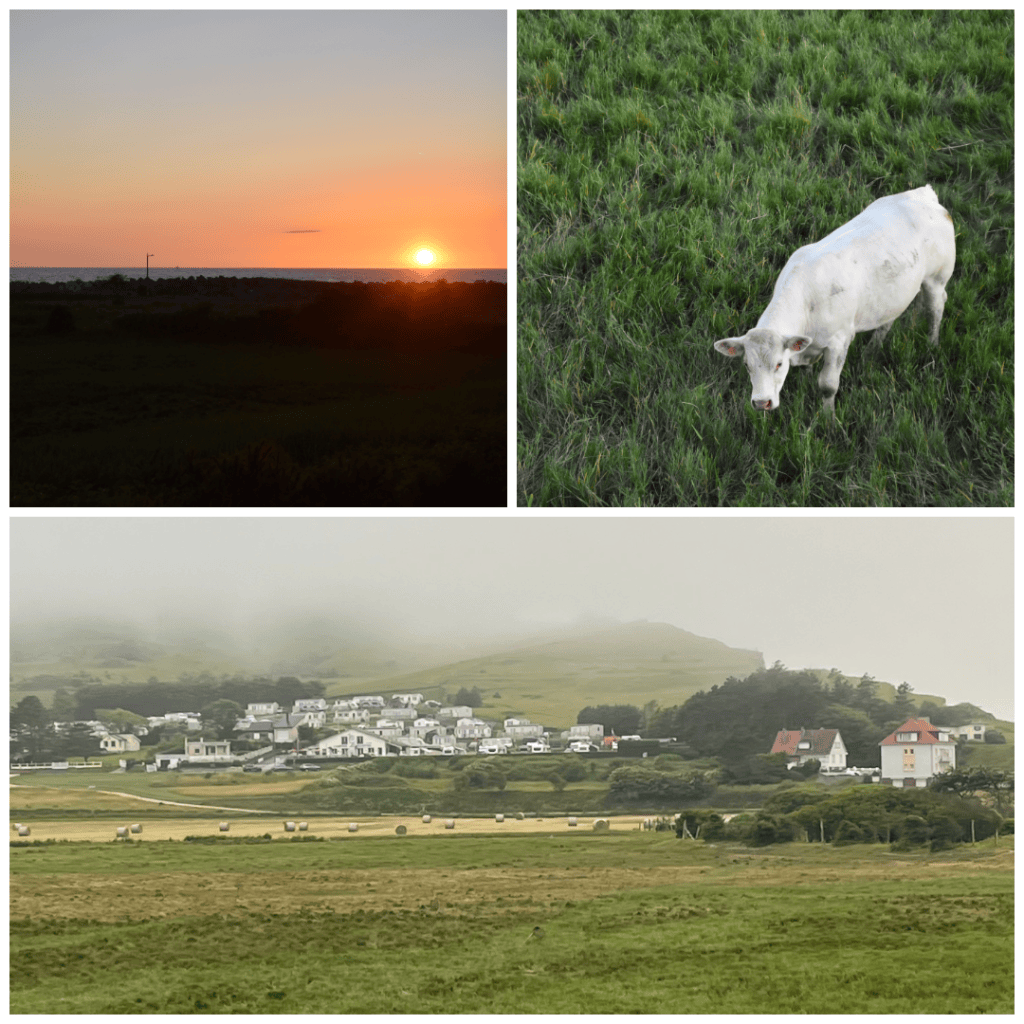
Besides, we had the lovely mooing company every evening. Our building faced the field protected by environmental laws. Which means you can’t build there, and you also can’t walk there. The green area is reserved solely for the cattle and the birds. A herd of cows moved around the field, occupying different parts of it depending on the time of day. In the evening, they were all under our balcony. I’m not particularly familiar with cow habits, but these French cows were very quiet and didn’t disturb us in the least.
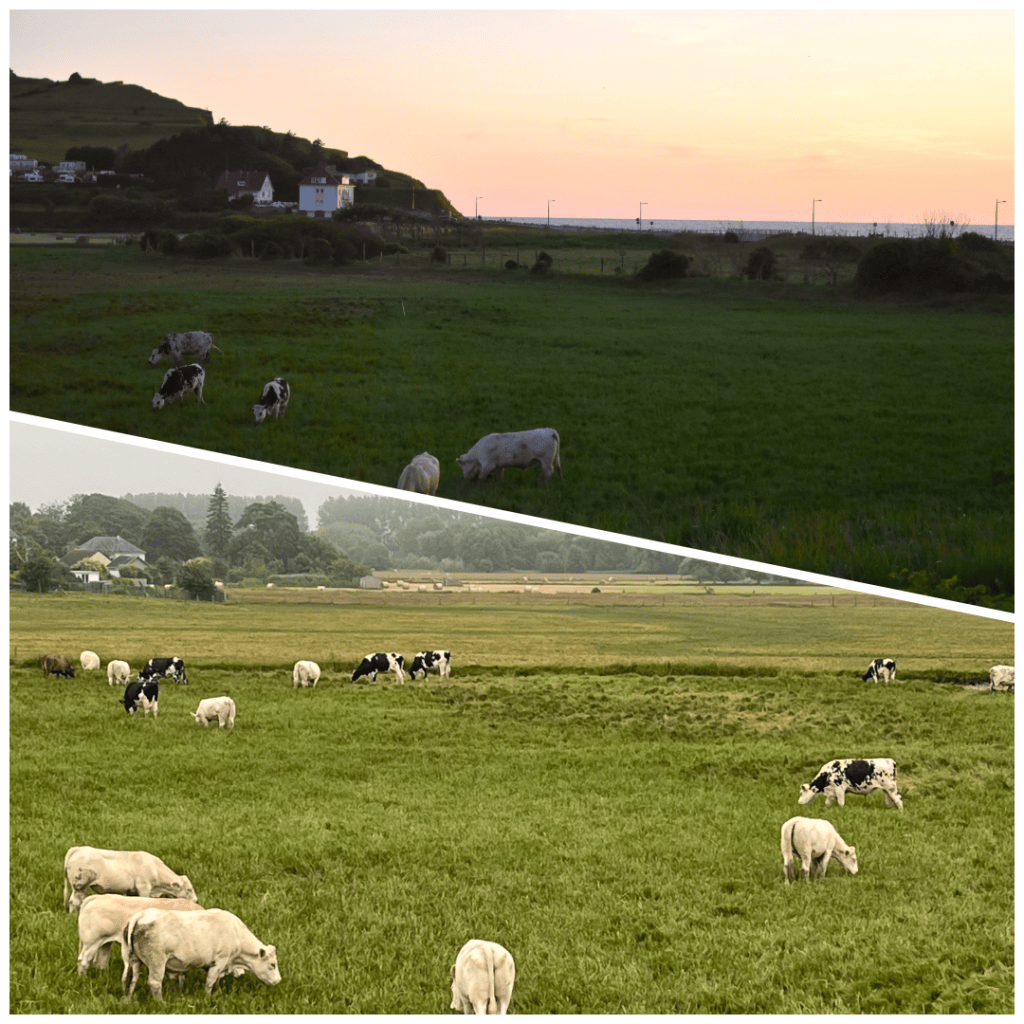
Hiking up the hill trail for the first time, we followed the Google Maps directions. Only when we climbed there did we realise that we didn’t have to go the route ‘through the bushes.’ It was a fun adventure anyway. In the pictures, you can see the building where our apartment was located (right behind the cows).
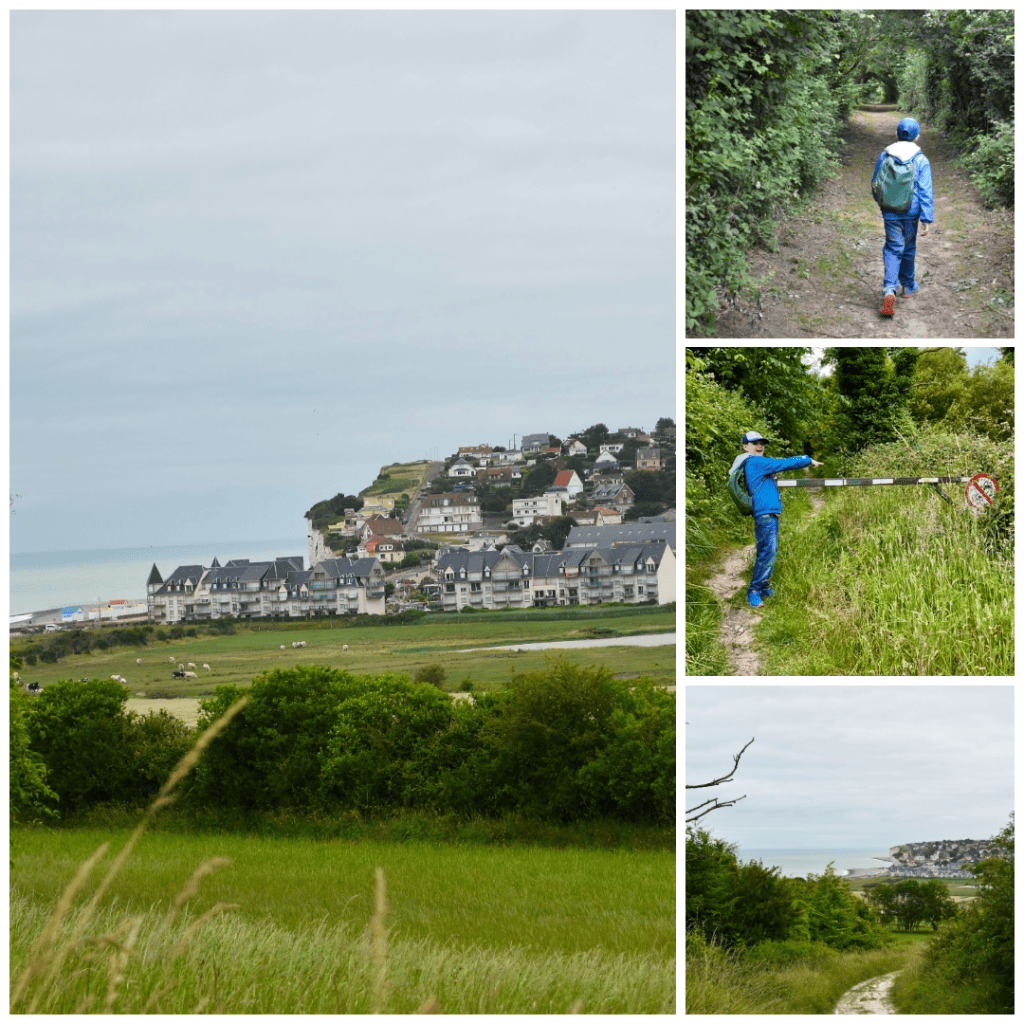
The only cons were the weather, which remained capricious throughout our stay in Normandy, and the fact that the trail was closed after the top of the hill due to the cliff corrosion. If you wanted to follow the GR21 – a 190 km long Great Hiking Trail along the Normandy coastline, also known as the Alabaster Coast – you had to turn inland and return to the sea somewhere further down the coast. It didn’t really fit our schedule, so we limited our local hiking exploits to the short trail up the hill and back to the Criel-sur-Mer beach. Since we planned to drive around quite a bit, it didn’t upset us much.
The same view, but what a difference because of the weather!
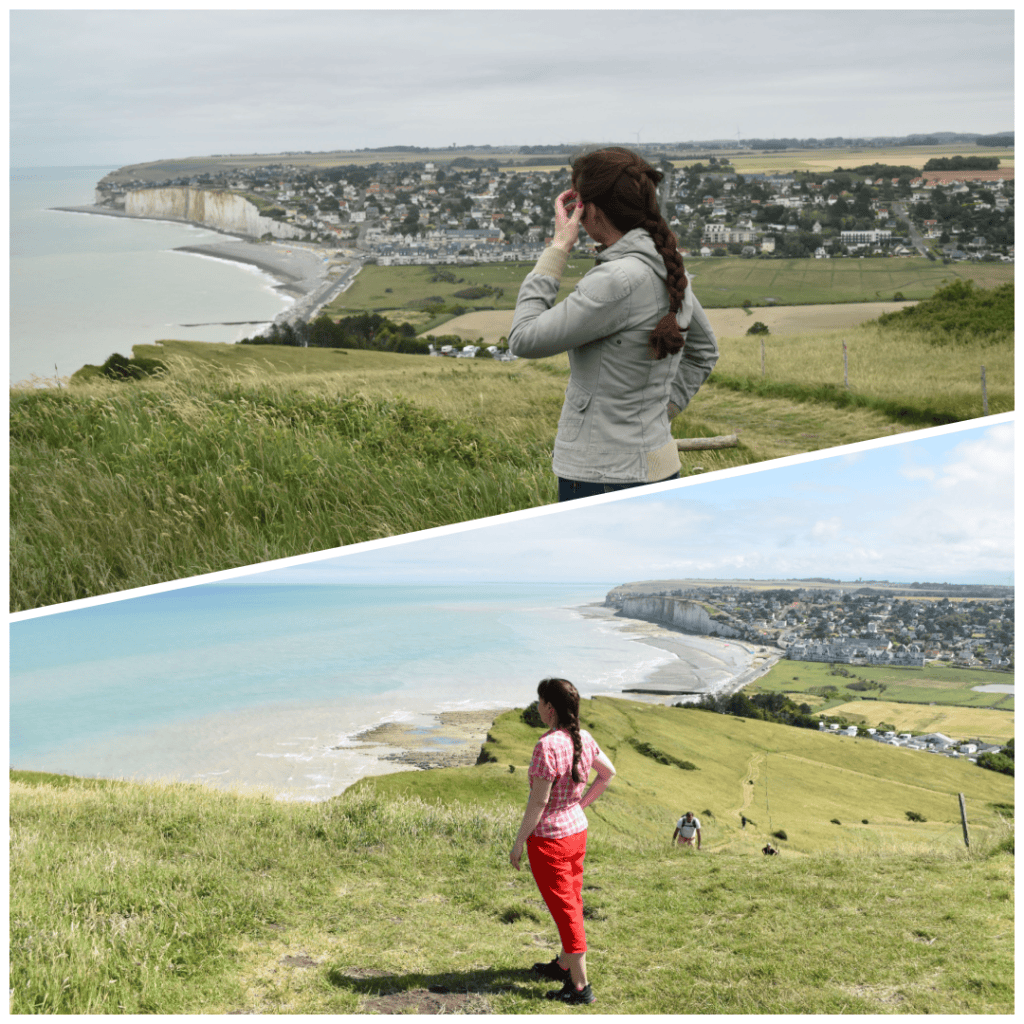
After the first time when we followed the Google maps instructions, we realised, watching the hill from our apartment window, that there was another trail leading to the top. The one that wouldn’t lead us through the undergrowth. It did require a bit more stamina and effort, but such a trifle could never deter us.
Once, we met a group of tourists who stopped at the ‘crossroads’ of sorts where the path split, clearly unwilling to dive into the bushes. After watching how cheerfully we turned right, instead of into the forest, they followed us. I’m not sure that they were happy with that decision, considering how many stops they made on the way up the slope. It wasn’t easy for us, known for our lack of fear of climbing all kinds of rocky trails. I can only imagine how strenuous the climb felt for some of the members of that group.
Anyway, we were very happy to catch a glimpse of the sun now and then. It proved to be a luxury in Normandy, at least when we were visiting it.
Saint-Valery-sur-Somme
Due to our love for nature, history and architecture, our next destination on the Normandy coast was Saint-Valery-sur-Somme. From its description – the medieval part of the town has ramparts, a Gothic church and a long boardwalk running along the river – I understood that this is our kind of place.
In truth, our main interest was visiting the Baie de Somme Picardie Maritime Regional Nature Park, and I read that Saint-Valery-sur-Somme had the best Tourism Information office in the area, with their staff speaking good English. Now, I’m not implying that everyone in France must speak English. It’s just for us, who do speak it somewhat better than French, it was a huge plus.
The Baie de Somme is a huge estuary that drains six rivers into the English Channel, the largest portion of water coming from the River Somme. As one of the Grand Sites de France (a prestigious, state-awarded label for protected natural sites of exceptional beauty), it promises the whole array of delights for nature lovers like us. It is said that three hundred bird species reside in the area.
Alas, due to the difficulties in planning ahead, we didn’t get to watch many birds. Nor did we see the seals at the site, which is popular because of these cute sea dwellers. Despite that, we still had some lovely walks around the Baie de Somme and took away loads of impressions we indulge in sharing and discussing months after returning home.
Saint-Valery-sur-Somme has a long and turbulent history dating back to before the Roman invasion era. It started as a small hamlet, growing under Roman rule into a village. Then, the Franks took the place of the Romans. During the 10th and 11th centuries, the village continued to grow. It is the very site where William the Conqueror assembled his fleet before sailing to invade England in 1066. The Hundred Years’ War was when the village suffered from being thrown between the French, the English and the Burgundians. Moreover, the English destroyed its abbey and cloister.
Saint-Valery-sur-Somme is also known as the place where Joan of Arc was held prisoner before being taken to Rouen and burnt at the stake in 1431. The cell in the local prison where the martyred Maid of Orléans was held can still be found near part of the old village walls.
So, it is logical that we began exploring the town by walking down the promenade Quai Jeanne D’Arc. Apart from the historical significance, the views of the Baie de Somme from there are wonderful, whilst the bay itself is considered one of the most beautiful bays in France.
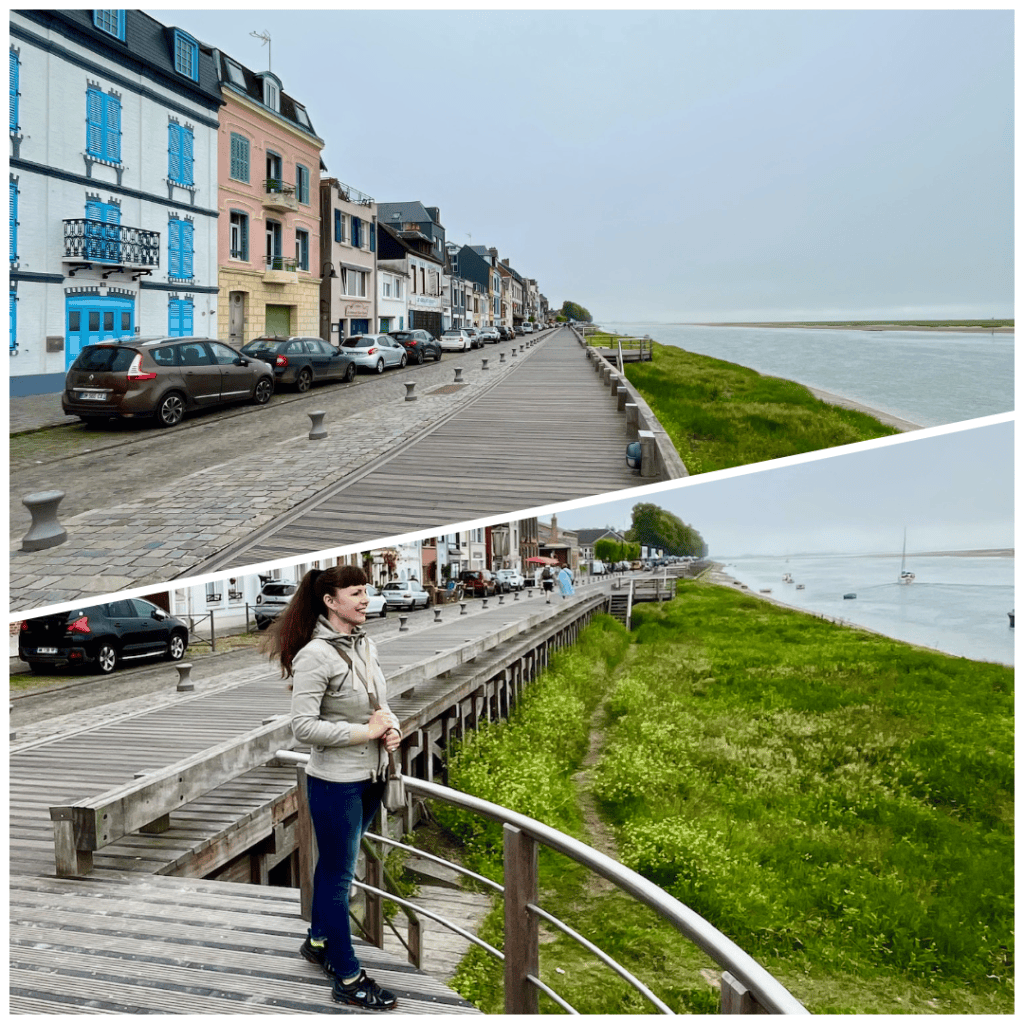
Saint-Valery-sur-Somme comprises the name of a man who played a significant role in the foundation and development of the village and a reference to its location on the river Somme.
Valery was a Christian hermit who lived in the 6th century and is said to have founded a monastery in the region. This monastery attracted many pilgrims and was an important religious centre. Valery was buried on its grounds in 622, and over his burial place the “Chapelle des marins” was erected. It survived the French Revolution and other tumultuous events and was rebuilt. The abbey wasn’t as fortunate. While the chapel still stands proudly on the hill overlooking the medieval town and the bay, only fragments of the abbey remain. During the 8th and 9th centuries, the Vikings, known for their ferocity and zeal to spread devastation, ravaged the abbey and village.
After strolling along the river promenade, we climbed the stairs and found ourselves in a fairytale-like medieval town. It didn’t feel that we needed a destination. It was enough just to wander the cobbled streets and gaze at the facades that witnessed different periods in history and are still there to silently whisper their stories to us.
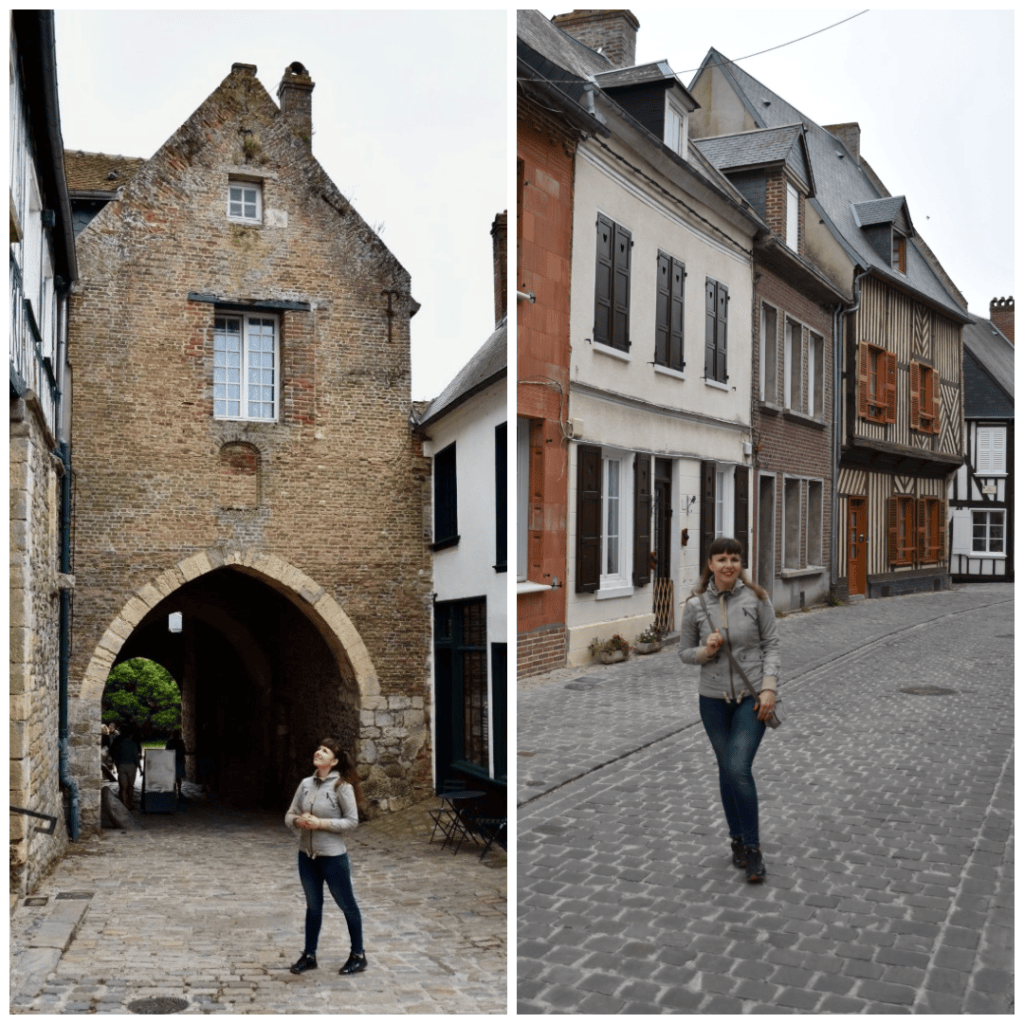
During the 15th, 16th and 17th centuries, peace and prosperity settled in the area, ravaged by everyone who was on a ravaging spree in those days. The trade flourished in the port, mainly due to the export of the wines and the growing herring industry.
The history of France, in a peculiar way, has found its reflection in the history of Saint-Valery-sur-Somme. It was where the scenes brought on by religious conflict between Protestants and Catholics played out. But later, it suffered again during the French Revolution.
Still, while its advantages hadn’t always worked in favour of this charming town, the day came when the scales tipped. During the 19th century, artists and writers flocked here, bringing with them the beauty and inspiration of art. The atmosphere of the place irrevocably changed when such legends as Victor Hugo, Jules Verne, Alfred Sisley and Edgar Degas started taking up residence here.
Until today, this dreamy, slightly giddy atmosphere is there, whirling in the gusts of air coming from the river, echoing among the old facades staring out at the people trudging the cobbled streets.
Église Saint-Martin
Along with its many wonders, Saint-Valery-sur-Somme has a unique church. It isn’t known when the very first church appeared at this place, but there are mentions of one standing here as early as the 12th century. Sadly, it was burnt during one of the many brawls that raged over the possession of this lucrative land. The current building has a long construction history. The works began as far back as 1488 but weren’t completed until 1559, even though the church was consecrated in 1500.
Several things make Église Saint-Martin special. First, it has not one but two naves, which are separated by seven arcades. The pillars were built atop the original base dating back to the 12th century. And second, since the oldest of chapels, from the 15th century, is devoted to two saints who were fishermen, the influence of the sea is felt greatly in the church. One of the signs of its connection to the profession is the frigate that hangs from the ceiling. It is several centuries old.
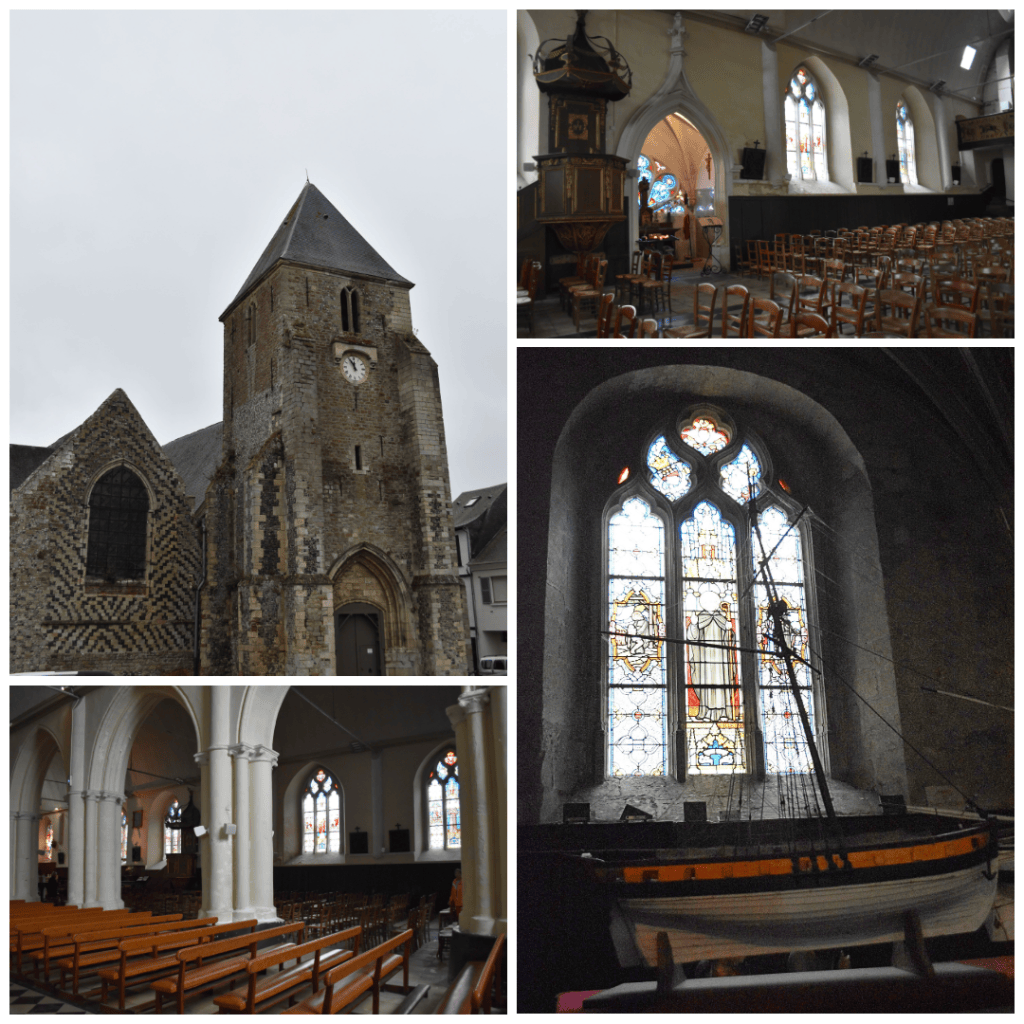
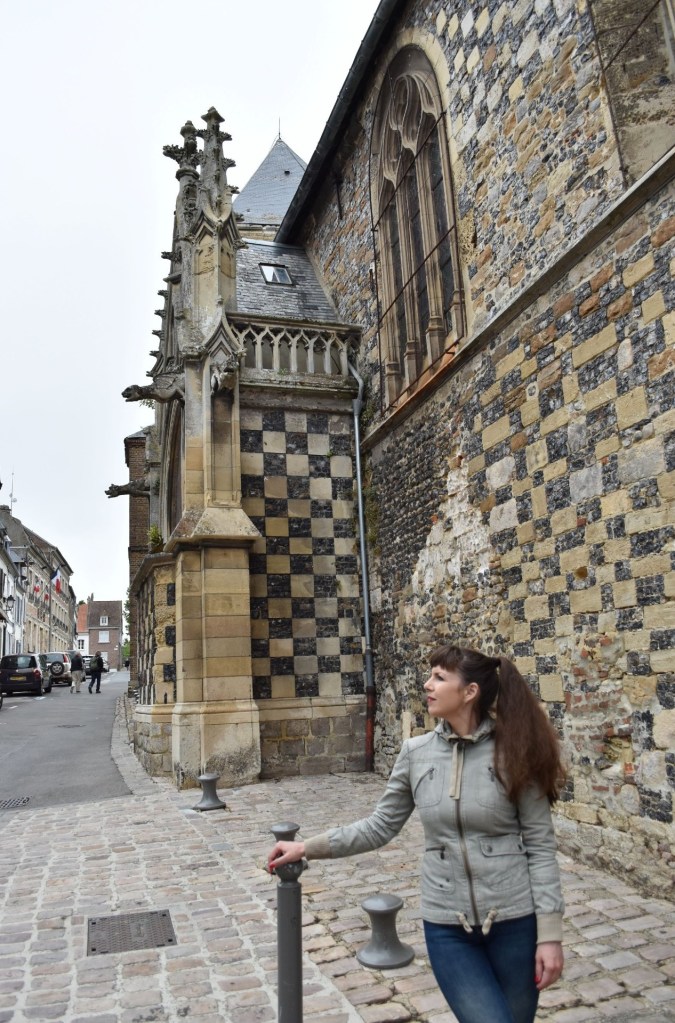
Shingle and flint, the materials that the church is built from, give it an elegant chequerboard appearance. The place is guarded by fantastical gargoyles. My son loves going into churches, so we entered Église Saint-Martin and got lost in its atmosphere of a treasure chest.
Le Nicol’s
According to my son, the best lunch experience during our trip to Normandy was in Le Nicol’s in Saint-Valery-sur-Somme. There he tasted oysters and escargot (I’d call them snails, but okay) for the first time. For the record, he wasn’t impressed by the first and absolutely loved the second.
Knowing about the strict lunch times in France, we started in the direction of the restaurant street just in time to have our meal without haste. We’d chosen Le Nicol’s beforehand to avoid dashing nervously between different restaurants. My son picked it from the options I offered, and I must say he was spot on. The service was excellent, as was the food. Besides the seafood we all shared, my husband and my son had some meat dishes.
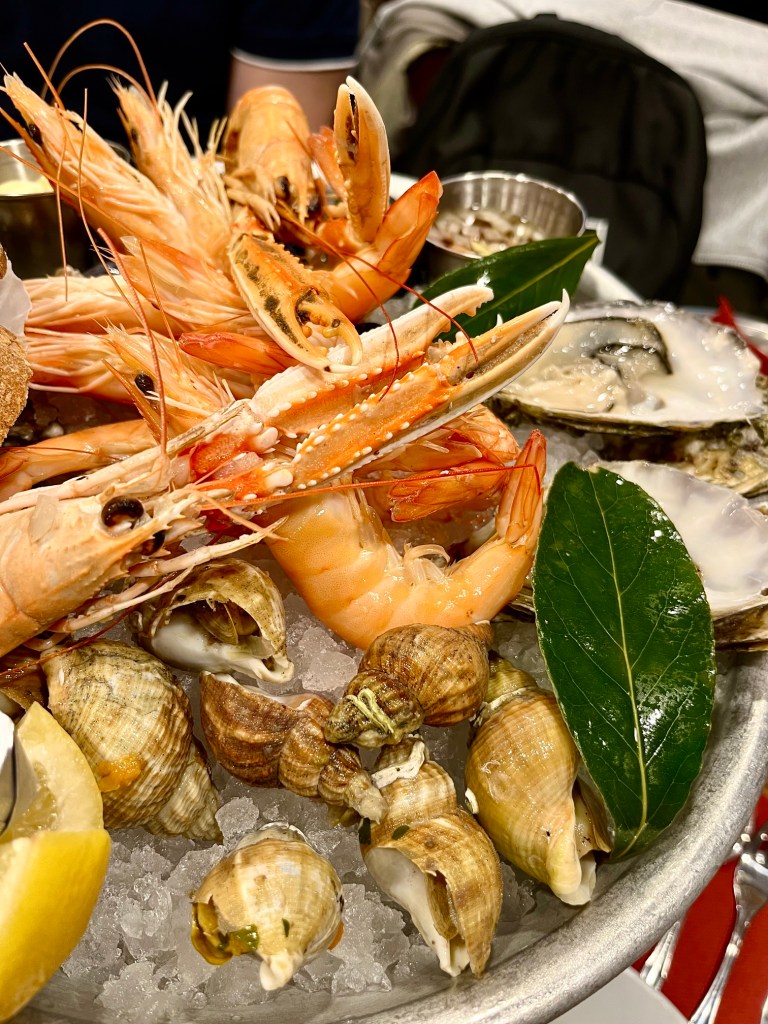
The lovely older couple seated at the next table had a grand time watching my son taste oysters and escargot. While enthusiastic about new foods, he doesn’t hide his emotions, be it appreciation or otherwise.
Emerging from the restaurant, ready to keep exploring, we found that the weather had changed. The sun had chased away the gloom of morning clouds, and the atmosphere, as if by magic, turned from solemn to cheerful.
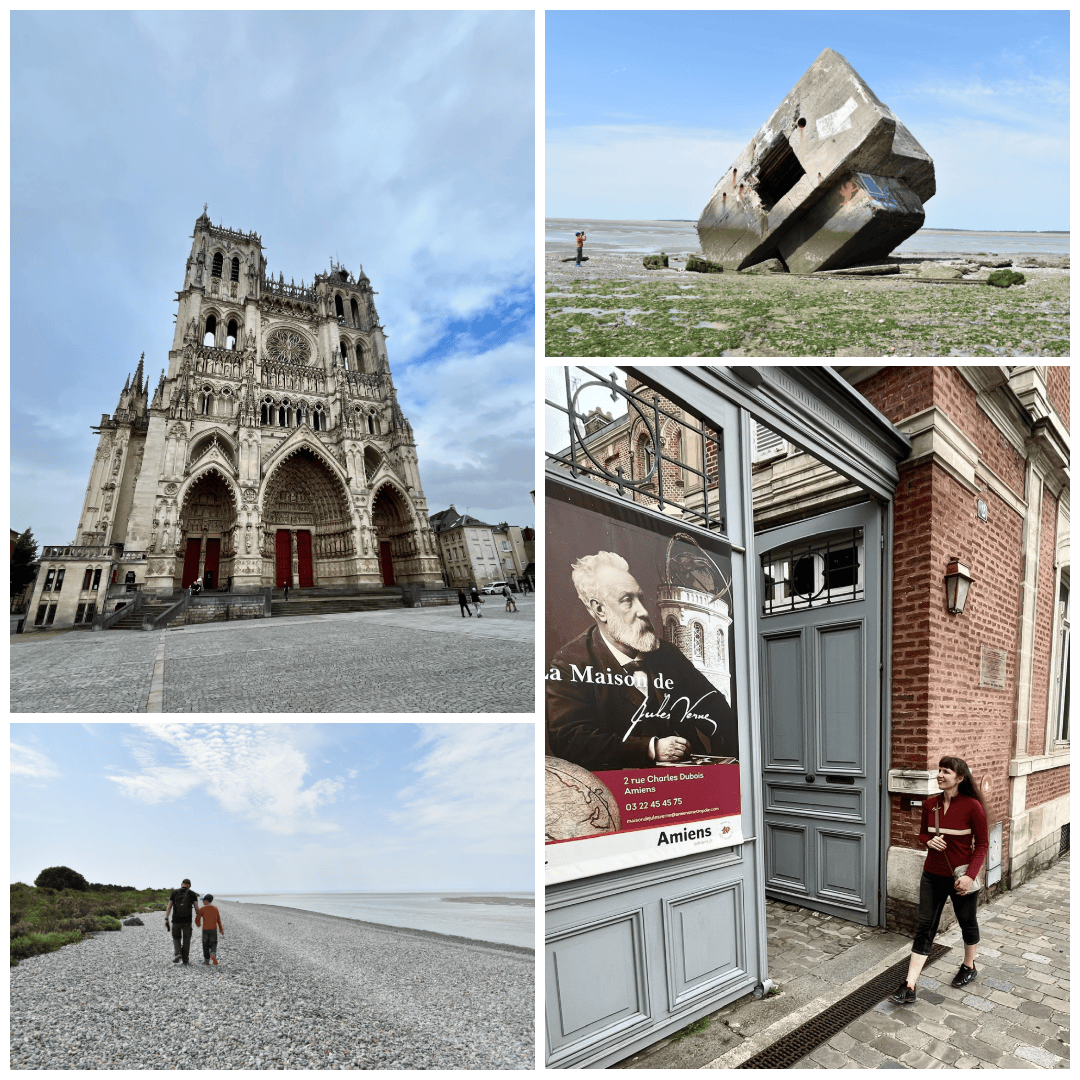
Next on our list of places to visit was Pointe du Hourdel, where we wanted to see seals but ended up walking up to the WWII German bunker that was a part of the Atlantic Wall.
Pointe du Hourdel
Next on our agenda was Pointe du Hourdel. It is conveniently located a mere 20-minute drive away from Saint-Valery-sur-Somme. A pebbled stretch at the very tip of the Bay of Somme, it’s a popular tourist destination for two reasons: seals and a WWII bunker, one of the D-Day witnesses.
We were more interested in seeing the seals, but when we saw that the tide was not low enough for the animals to venture nearer the coast, we settled for a hike toward the bunker. When we started, the concrete monstrosity was still partly in the water. Yet, when we reached it, we could walk to it without making our feet wet.
By the way, the changing tides were one of the things that fascinated us in Normandy. We aren’t used to seeing the sea changing levels so dramatically every single day. The Baltic Sea and the Gulf of Riga are more ‘stable’ in this respect.
So, we arrived at Pointe du Hourdel and found the parking easily. But there was an issue with the parking meter. I read tourist reviews that even if the parking meter was out of order and they physically couldn’t make the payment, they still found a fine ticket on their windshields. So, my husband, with the help of other people having similar troubles – all French – spent quite a moment trying to force the device to accept his money and spit out the ticket.

The bunker, if anyone is interested, is a R612 casemate once housing a 7.5cm assault gun. It is one of many similar bunkers once dotting the coast. We noticed a lot of remnants of concrete structures in the shrubs bordering the beach. The hike to the bunker along the pebbled beach of Le Hourdel was far from effortless. First, it took longer than you expected, looking at the straight stretch ahead of you. And second, the stony surface isn’t easy to traverse. Anyway, enthusiastic if not really tough and experienced hikers as our family is, we trudged to the popular attraction, and my son forgot about the hurting feet the moment we came close to the concrete monstrosity. He decided to make a video to show his friends what he had seen on the Normandy coast.
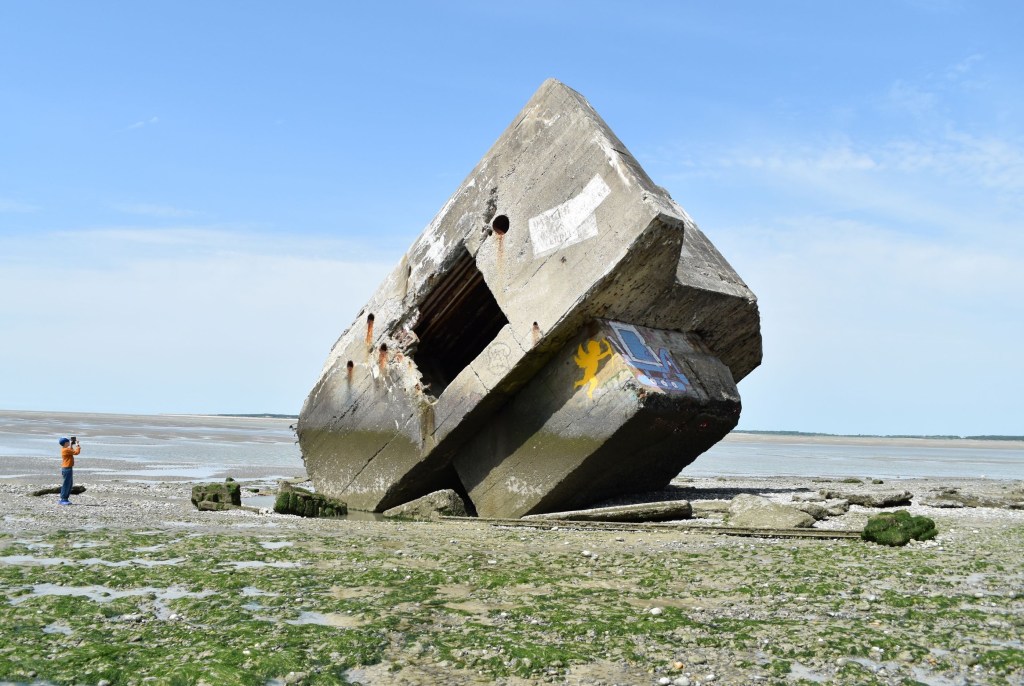
This bunker had stood higher, in the dunes, but, submitting to the coastal erosion and the elements, toppled down onto the beach. Considering that part of the time, when the tide is high, it is submerged in the water, the day will come when the sea will claim it. I cannot say that I was in awe or felt something spectacular about the bunker, but I’m glad we did venture there to see it from up close.
Overall, we enjoyed the hike. If you enjoy walking as much as we do, this is definitely the place to visit while in the Baie de Somme Picardy Maritime Natural Regional Park. It is said that the Hourdel loop is 8 km / 5 miles long. We didn’t do the loop. Instead, we just walked along the pebbled beach to the bunker and back. The official hiking route takes you through the dunes and the countryside as well. There is also a path for cyclists and guided tours. Local guides take groups to watch the seals at low tide and across the bay to Saint-Valery-sur-Somme.
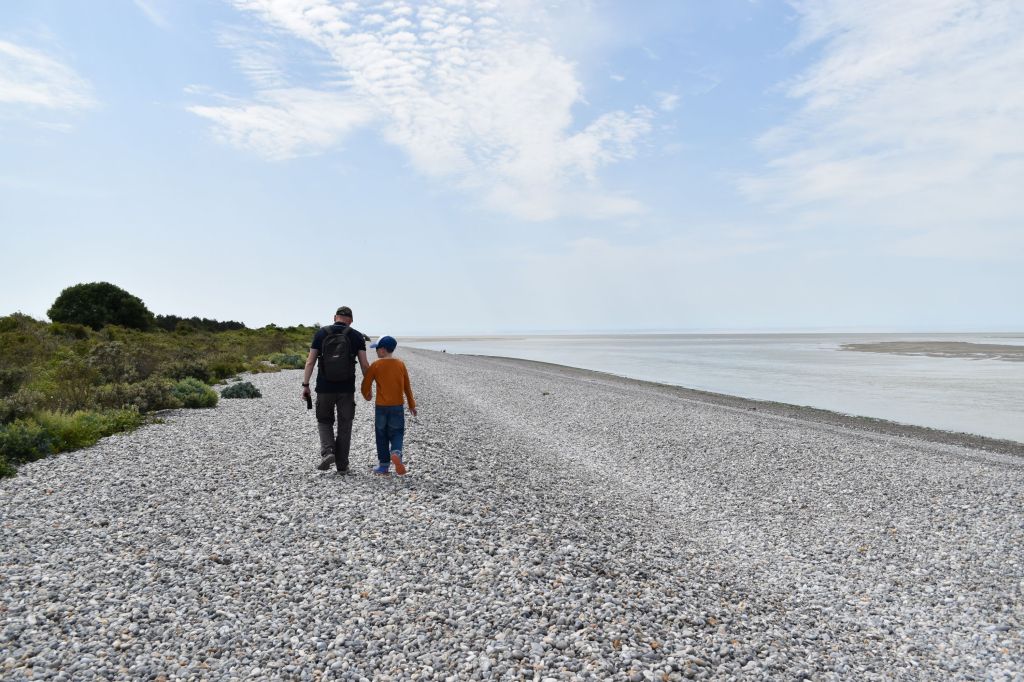
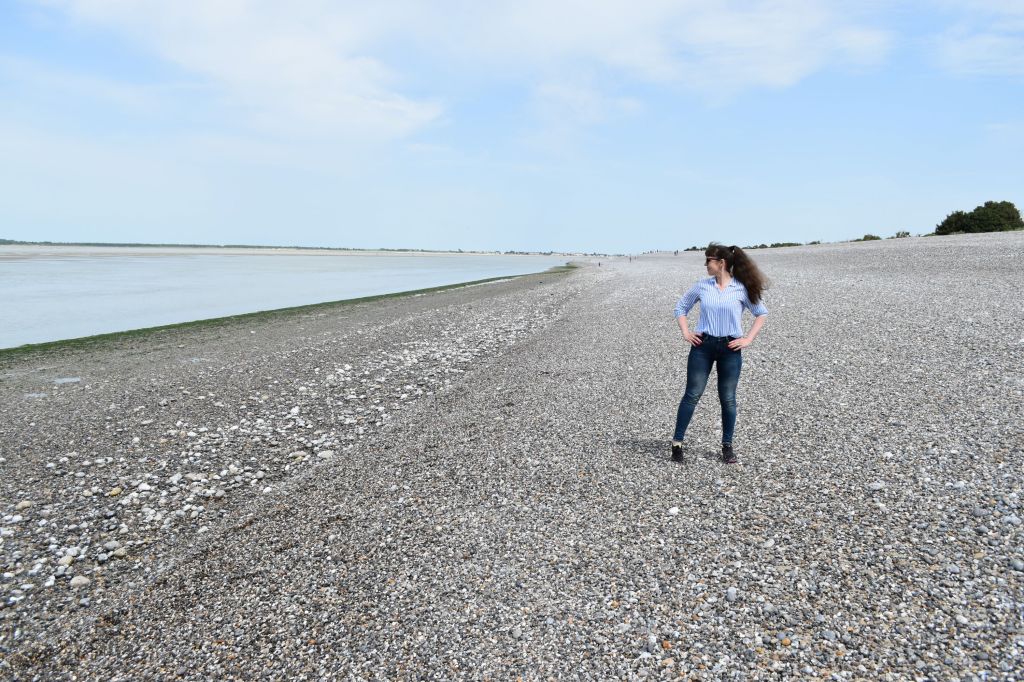
After walking back from the bunker, before going to the car, we sat on the beach for a while, taking some rest and also hoping to catch a glimpse of those famous local seals. We did see them, alas, only as black dots quite far in the bay. They lay on the sandy strip that emerged when the water retreated. We also saw the guided tour group crossing the bay. It looked like an exciting experience. Since my son loved Normandy, we might do it during our next visit.
I can mention only one minor downside about visiting Le Hourdel. The trouble with the parking meter doesn’t count since we did manage to pay and get a ticket. It was impossible not to notice that people used the ‘dents’ in the thicket running along the beach to answer the call of nature. While understandable – the beach is long, and there were no restrooms other than a few at the entrance to the hiking area – it wasn’t pleasant.
Amiens
The day started well but didn’t go as smoothly as we might have liked.
We set out from our base on the Normandy coast in Criel-sur-Mer early as usual. My husband wanted to try one of the speed paid highways, known as autoroutes, so we adjusted our route accordingly. It was nice, with not so many cars to make it uncomfortable. The payment system was easy and straightforward. The problems began when we reached our destination.
Our first stop in Amiens was the zoo. One of its advantages is a huge and free parking lot. I chose to start from there mainly because of the fact that it solved the issue with parking – always a headache in unknown places. I thought that, enthusiastic walkers as we are, we could leave the car there and walk to the city centre afterwards. To save time. As it happened, that’s where we lost time.
The whole zoo parking lot was turned into a temporary amusement park. An enormous parking lot, all packed with portable rides, game booths, food stalls and whatnot, without a single patch of asphalt left for zoo visitors to park their cars.
I won’t pretend to be an all-around happy-go-lucky type. I’m not a pessimist, but I was upset, and the mood was spoiled. We had a single day we could spend in Amiens. I’m not an irrational overplanner, but when somewhere interesting, I don’t like wasting time. So, with no other choice, we drove through the city while monitoring the navigator for available parking. Lucky for us, a totally free one was not that far from the zoo. Anyway, it robbed us of some precious time, which cost us a part of our plan later in the day.
The Amiens Zoo
As if to make up for our earlier trouble, the zoo turned out to be an absolutely charming place. Even though we felt a little flustered and on edge when we arrived, once we saw the first inhabitant of the zoo, all was forgotten. It was an exotic bird, by the way, that emitted the most peculiar sounds. Moreover, it seemed that it did so to attract visitors’ attention.
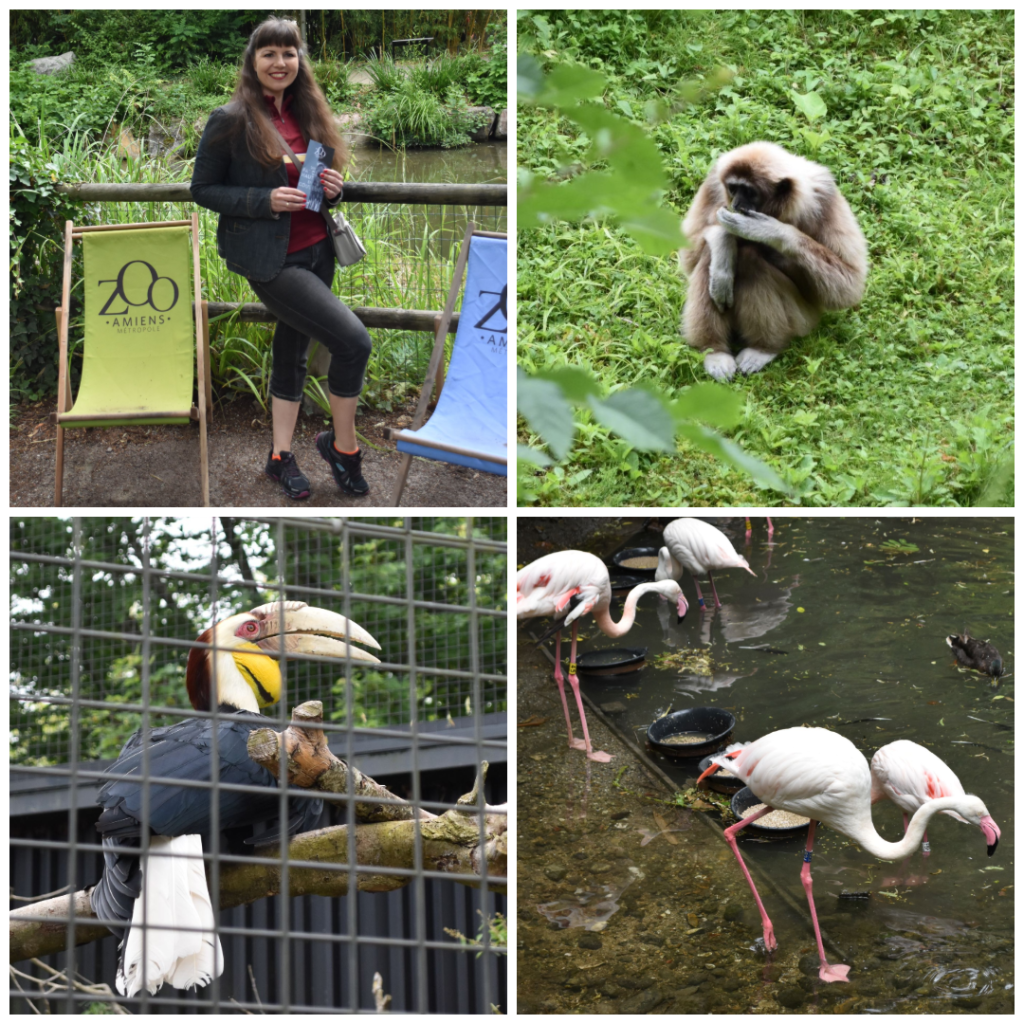
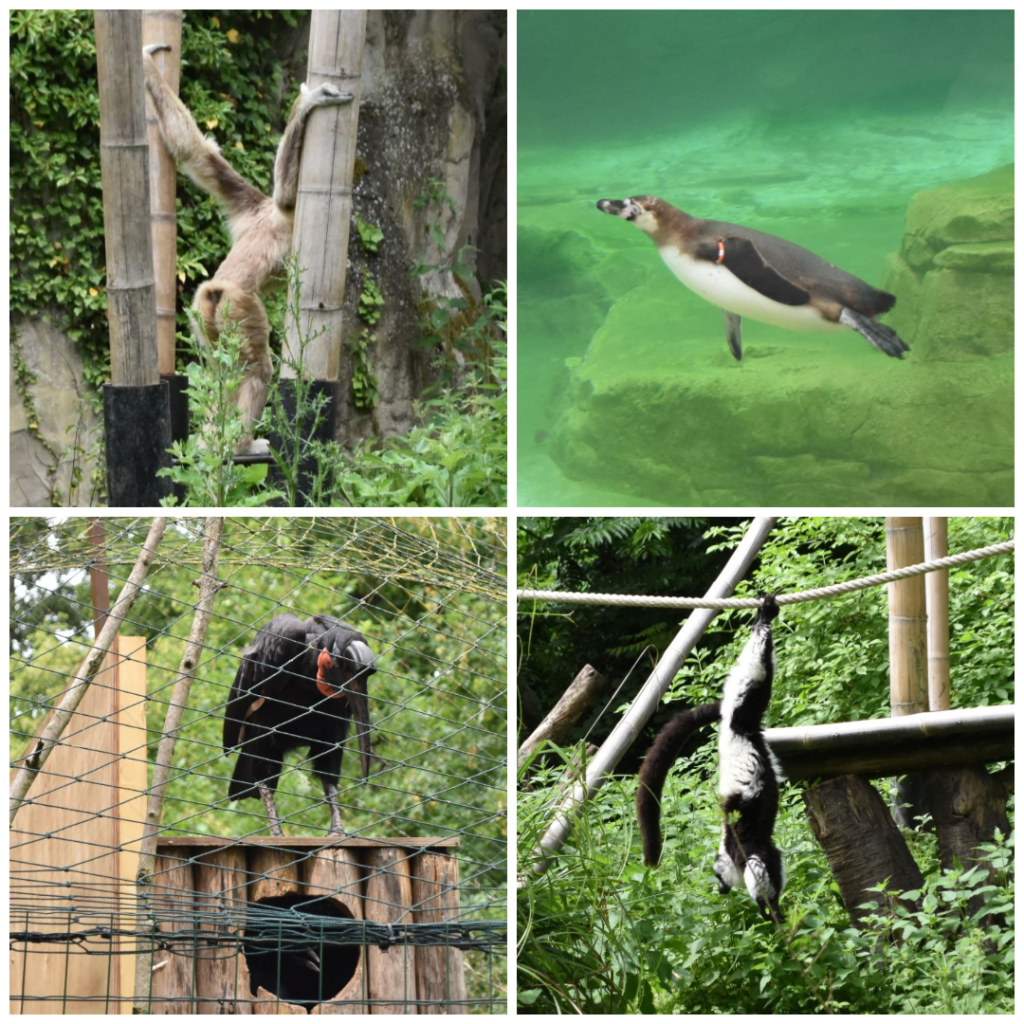
The Zoo d’Amiens, also known as Zoo Amiens Métropole, is centrally located in the city. It ranks number two among tourist destinations in the Somme department, and I can totally understand why. While not large, the fauna diversity is incredible. Here, we saw some animals that we haven’t seen in any other zoo. Understandably, it’s a popular place, and more than 250,000 visitors flock here every year.
One hilarious episode involving one salacious cockerel and a shocked ten-year-old – my son – will stay in our family history forever. Every time we remember it, we erupt in laughter.
The Amiens zoo has a contact zoo section where goats, hens, guinea pigs, and even an alpaca roam freely, interacting with visitors. We loved it there and saved it for last. My son was filming a video to show his friends back home when a fluffy white cockerel gingerly jumped an indifferent-looking hen and performed an act of procreation. My son was speechless. He didn’t expect nature to be so, well, natural. He kept repeating: “What was he doing? Did he want to take a ride on that hen?”
I’m sorry, but I couldn’t refrain from laughing out loud. It was so unexpected and outlandishly, brutally direct that the episode settled itself firmly into our family folklore. We quickly came up with the name for the horny guy – Rooster Yeti, see the pictures of the scoundrel to see why – and dig out this episode of indecent behaviour whenever we need a good laugh.
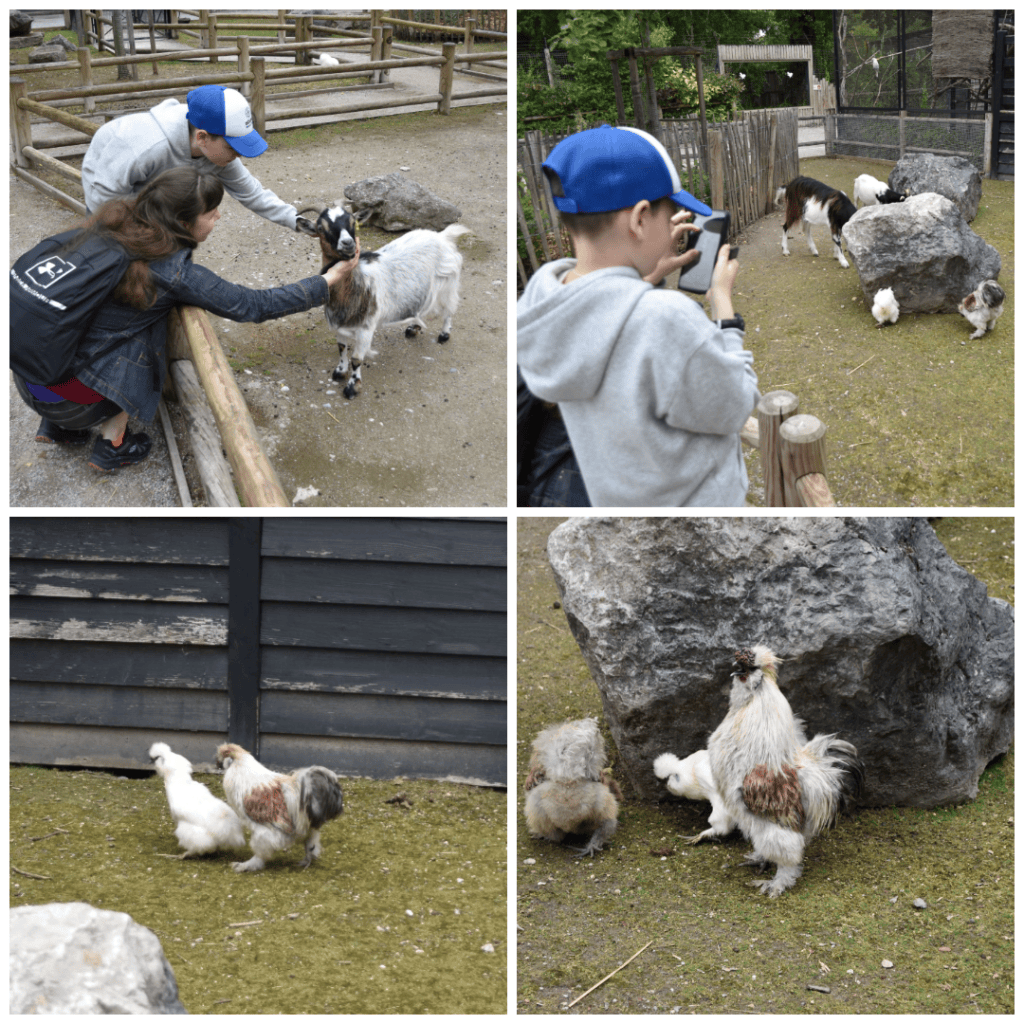
After the dust settled, my son indignantly declared that he’d been traumatised for life, visibly proud to have a ‘grown-up’ experience. Again, I apologise if it came out as disrespectful towards those who suffered any kind of trauma. As a person who’d suffered several too many, each deserving a stay in a clinic or penning a book, I humbly reserve the right to joke about it as a form of therapy.
To sum up, visiting the zoo in Amiens was a success. My son made us buy him a little stuffed bee, which he named Amelie. For the past year, every night French Amelie snuggles into the side of Shark MacSqueeze, whom we brought from the Monterey Bay Aquarium in the US.
Jules Verne House
As long as I remember myself, my life has been centred around books. First, having allowed others to read them to me for only a brief moment, I read them. Then, I attempted to write them. Until finally, I made writing a part of my life.
So, it’s not surprising that literature became a part of my family’s travelling habits.
During our 2024 trip to the USA, we visited the National Steinbeck Centre (I shared about it here https://evekoguce.com/2025/09/22/our-big-american-adventure-a-road-trip-across-nevada-arizona-california-part-3/). Last year, while visiting Normandy, we made sure to include Jules Verne House in Amiens in our agenda.
Jules Verne was a household name back when my husband and I were growing up. My son listened to several of his most famous novels as audiobooks and, once he was able to consume longer texts, read “Twenty Thousand Leagues Under the Seas.” At the ticket desk in the writer’s museum, he proudly announced that Jules Verne is his favourite writer.
Having lived for 77 years, almost half of his life Jules Verne spent in Amiens. And of those 34 years that he lived in this town, he lived for 18 years in the beautiful mansion that reflected his personality and interests. Now this place is a museum, where people from all over the world can catch a glimpse of a legendary writer’s dream and vision.
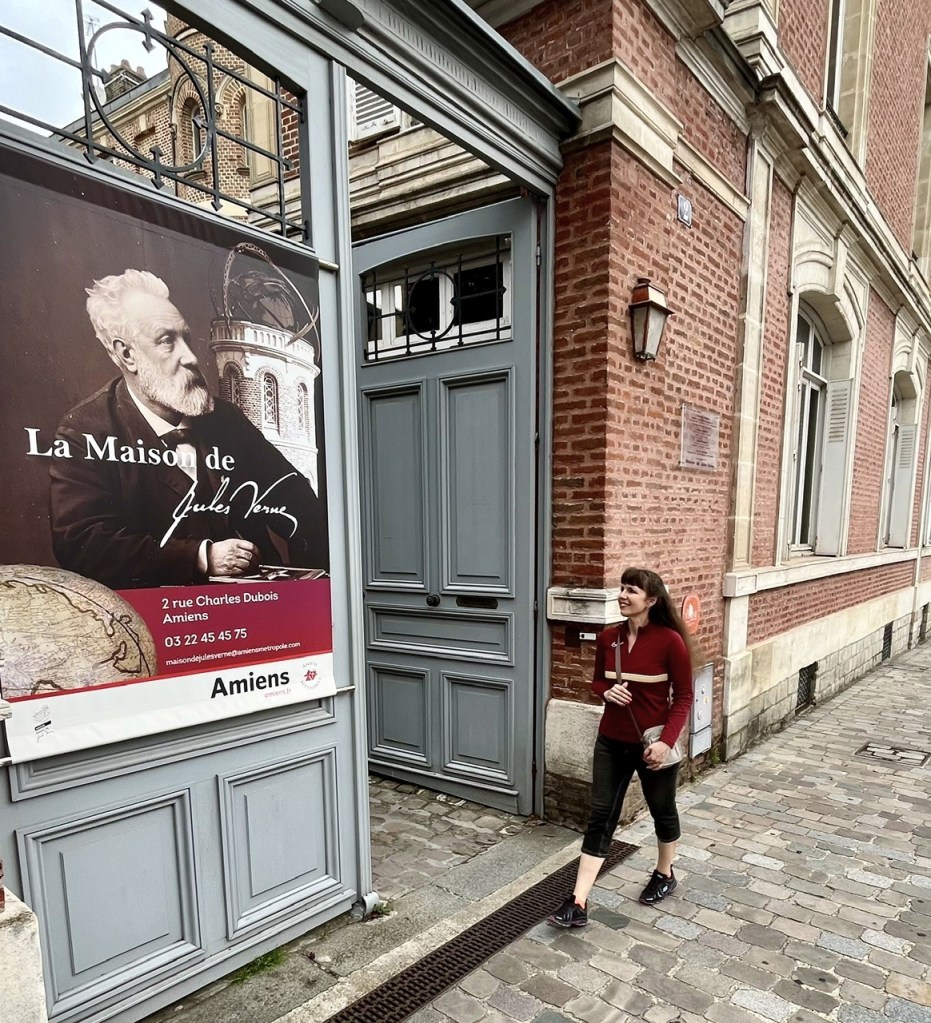
The father of science fiction, a title Jules Verne shared with H. G. Wells and Hugo Gernsback; the second most-translated author in the world since 1979, below Agatha Christie and above William Shakespeare; the most translated French author in the world in the 2010s, Jules Verne is still loved by generations of readers.
Jules Verne was widely popular in the Soviet Union; his books were translated and published across the republics, but film adaptations became classics. Probably the most popular and iconic film adaptation is the 1986 miniseries “In Search for Captain Grant” based on Verne’s novel “In Search of the Castaways.” I must admit that I’ve never particularly liked it, but every hit shouldn’t be for everyone. And the music, maybe even more popular than the film itself, is amazing.
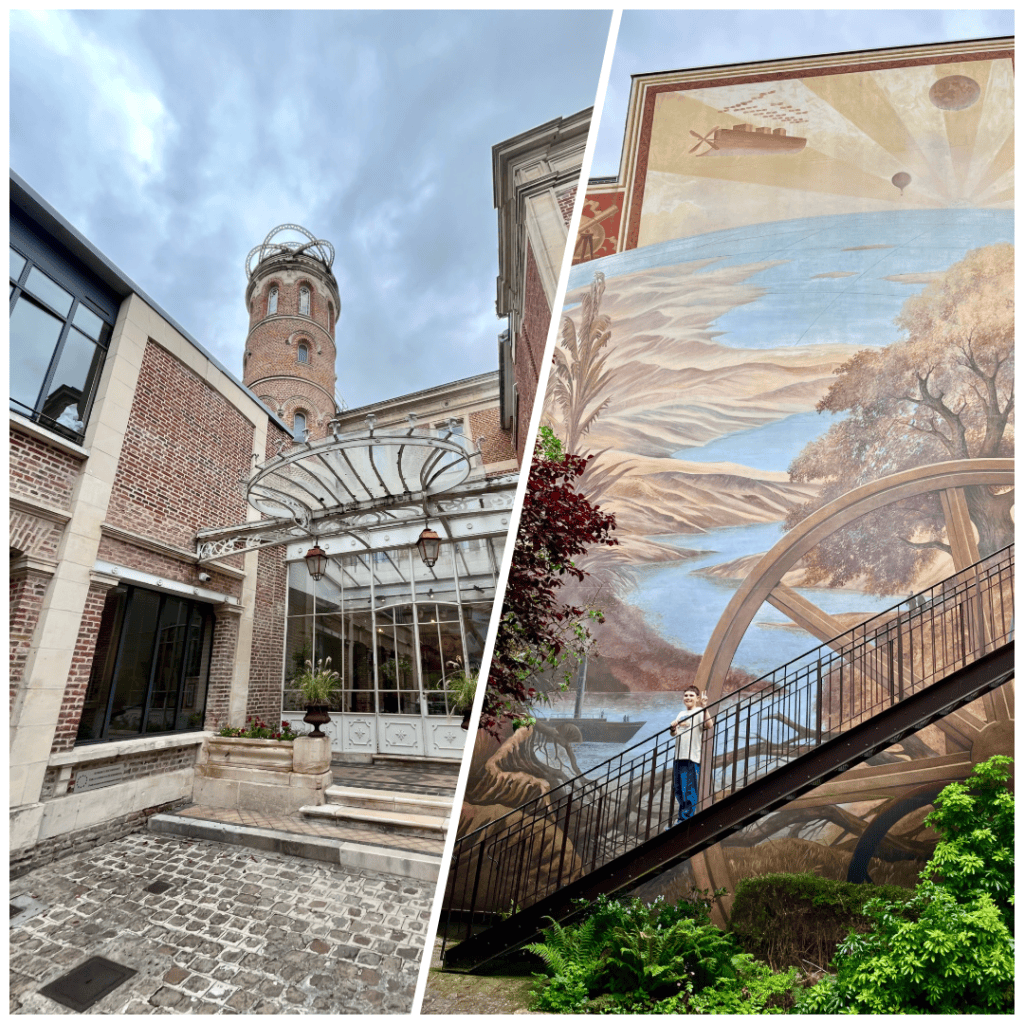
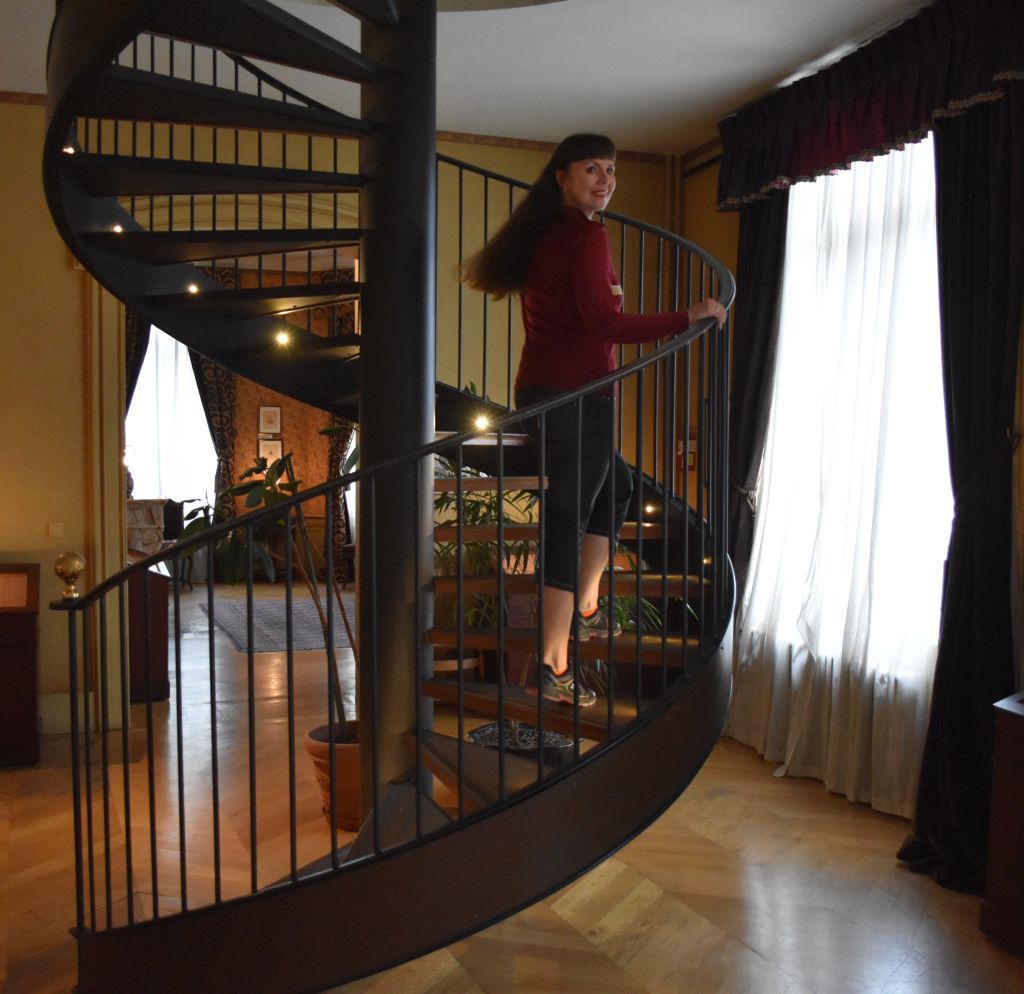
Jules Verne lived in Amiens for 34 years, 18 of which he spent in the rue Charles-Dubois house that is now a museum. Entering the townhouse built between 1845 and 1854 is like stepping into the mind of the famous author. The spiral tower staircase alone (see the picture) makes this place unique and worth visiting. The creaking floors spooked my son a little, but the feeling of wonder that struck us in every room helped to overcome the discomfort.
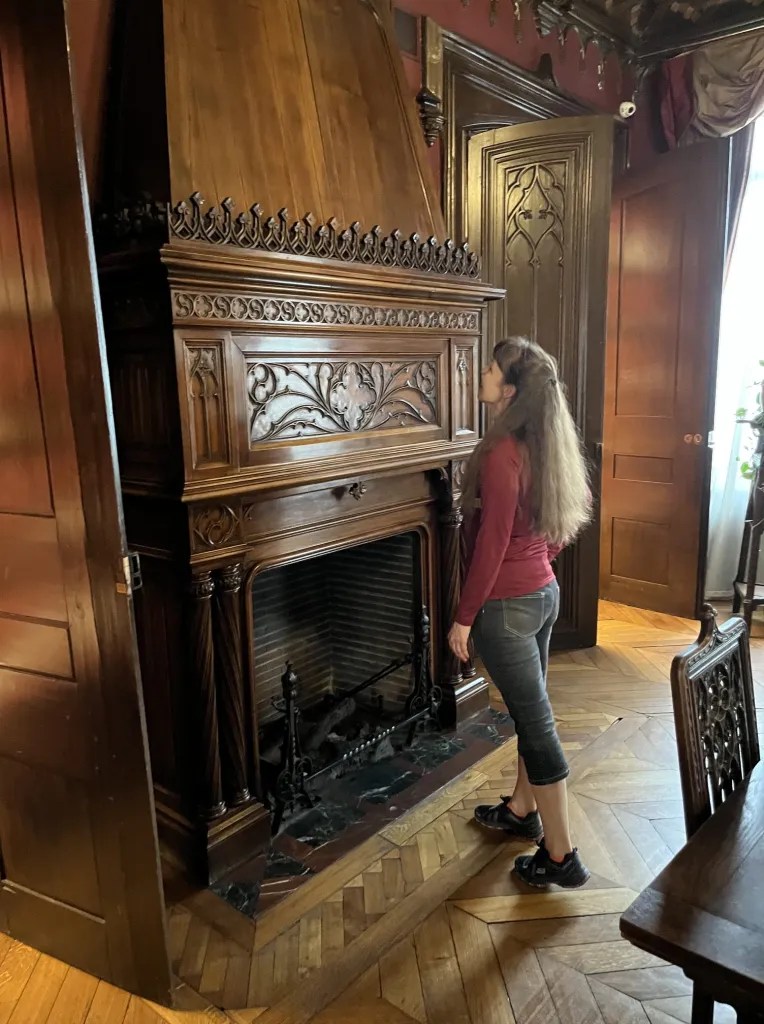
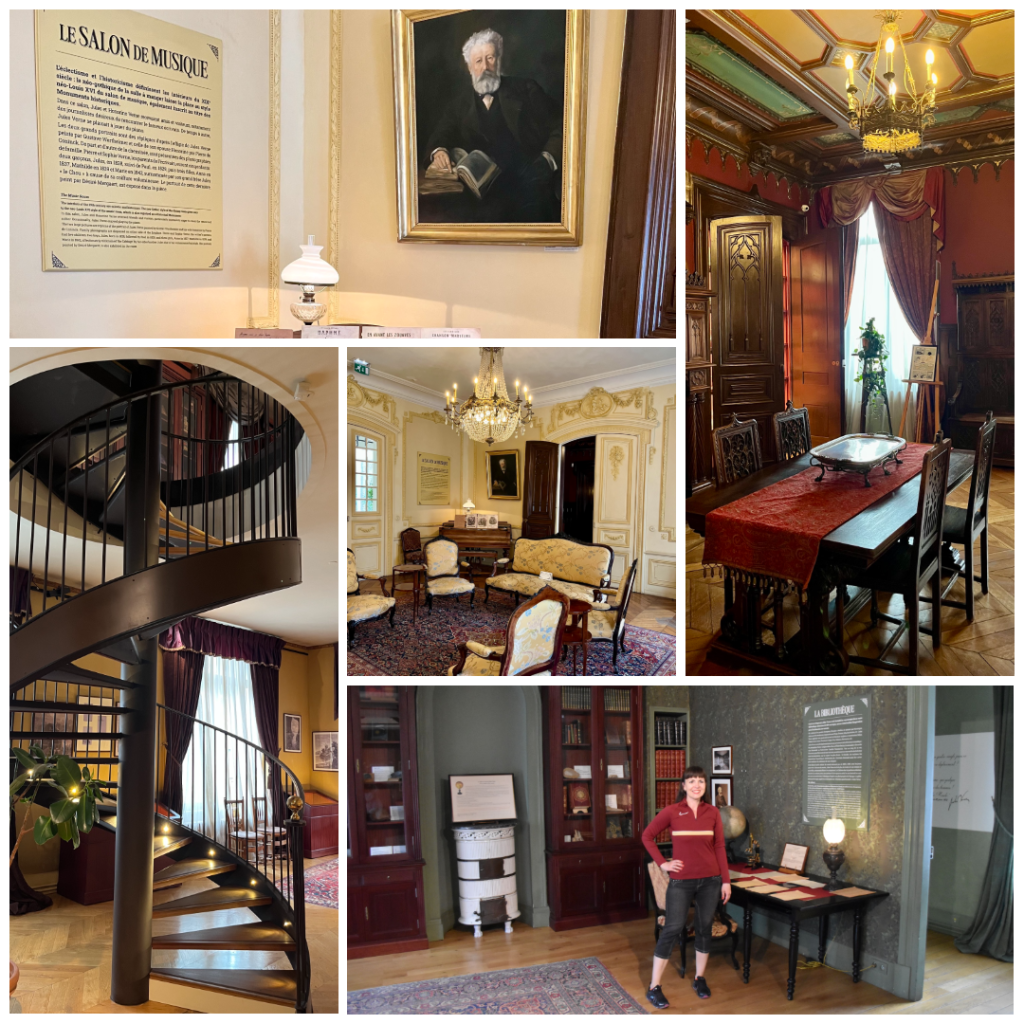
Jules Verne didn’t own this house but rented it, so it was only in 1980 that the city bought it and turned it into a museum. It isn’t simply a collection of objects; apart from period furniture, family photos, documents, a library of about 12,000 books, and other things, visitors have an opportunity to see the writer’s office, where he completed roughly 40 of the books of his “Extraordinary Voyages” (Voyages extraordinaires in French) that brought him fame. The room has been reconstructed in meticulous detail, as was the cabin of Verne’s yacht Saint Michel III. Besides, here one can see scale models of his imaginary machines: Nautilus and Albatross.
Despite feeling on edge when we arrived – yes, for the second time during our day trip to Amiens – Jules Verne House erased our frustration as the Amiens zoo did previously.
Standing in the library in Jules Verne House, I was thinking that I made a grave mistake. I should have worn a dress. It would be more fitting attire for visiting this elegant museum. Alas, while travelling we are seldom at liberty to follow the 19th-century etiquette where upper-class representatives were required to change dress several times a day. I sometimes think that those rules, which, I’m sure a lot of contemporaries found ridiculous, weren’t completely absurd. Every time I visit a theatre, I regret that the dress code for attendance is a thing of the past. It does steal some of the atmosphere and mood when people occupying the velvet seats are wearing jeans and t-shirts.
I mentioned that we arrived at the Jules Verne museum upset again. This time, it was because of the French lunch times in restaurants. Since we wasted time looking for parking, we missed the narrow lunch window (roughly from 12 to 14:30, usual for French restaurants), so we had to run around looking for a decent place. Desperate, my husband offered that we buy sandwiches in a supermarket and eat them on the bench. Luckily, I located a pizza place, which, being a fast-food place, didn’t close after 14:30. The pizza there was absolutely delicious. My son praised the freshly squeezed apple juice, and my husband and I had our after-lunch coffees. Eating that pizza, we reminisced about having a similarly delicious pizza in Santa Cruz, California a year before, happy to have these memories to lift our spirits.
Amiens Cathedral
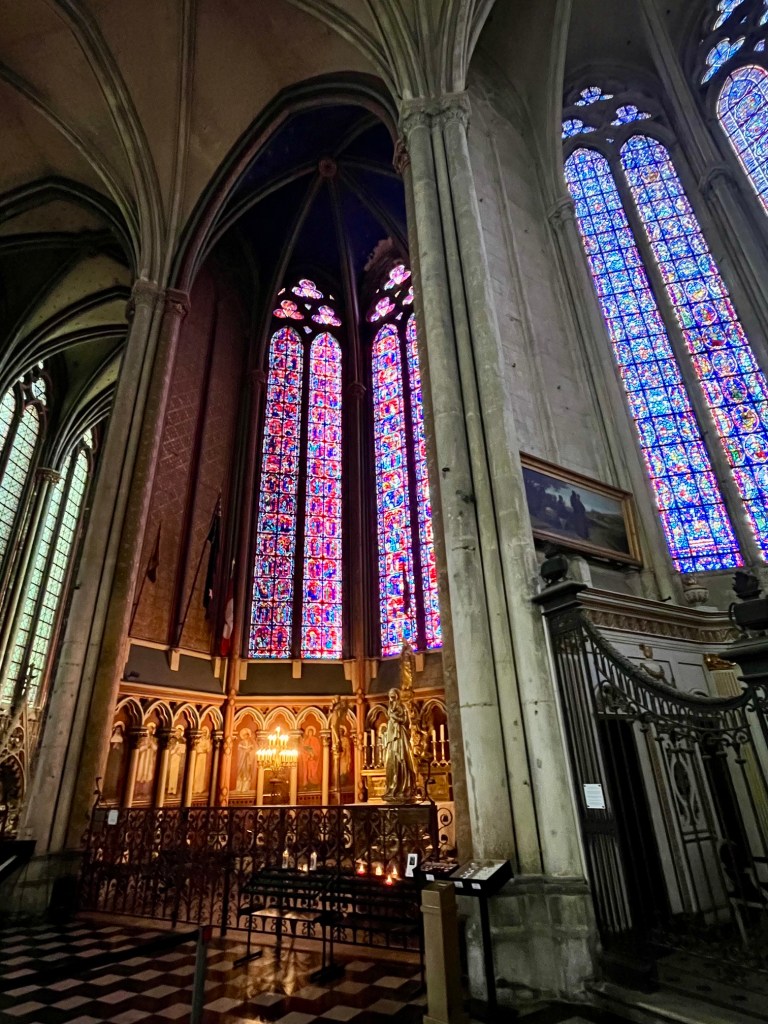
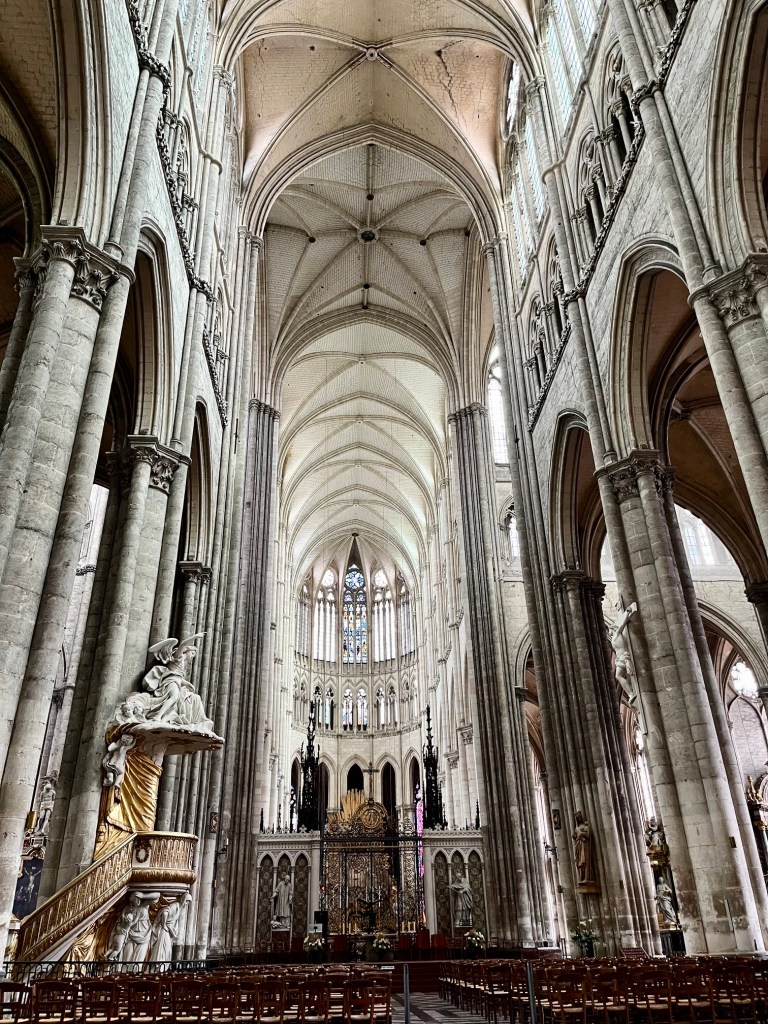
The largest Gothic cathedral in France isn’t Notre Dame de Paris. Why do I mention it? I was so surprised when I saw famous Notre Dame de Paris for the first time (it was much smaller than I imagined) that I think I still haven’t overcome the shock. Decades later I got proof it’s indeed not me but the place. Amiens Cathedral is twice the volume of Notre Dame de Paris.
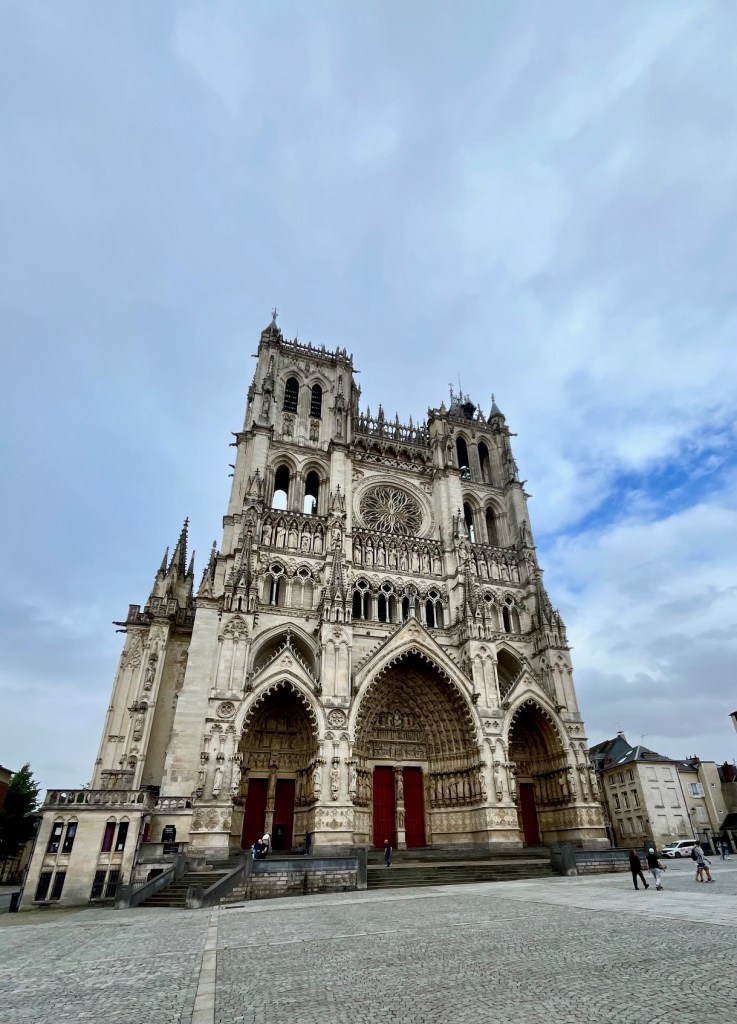
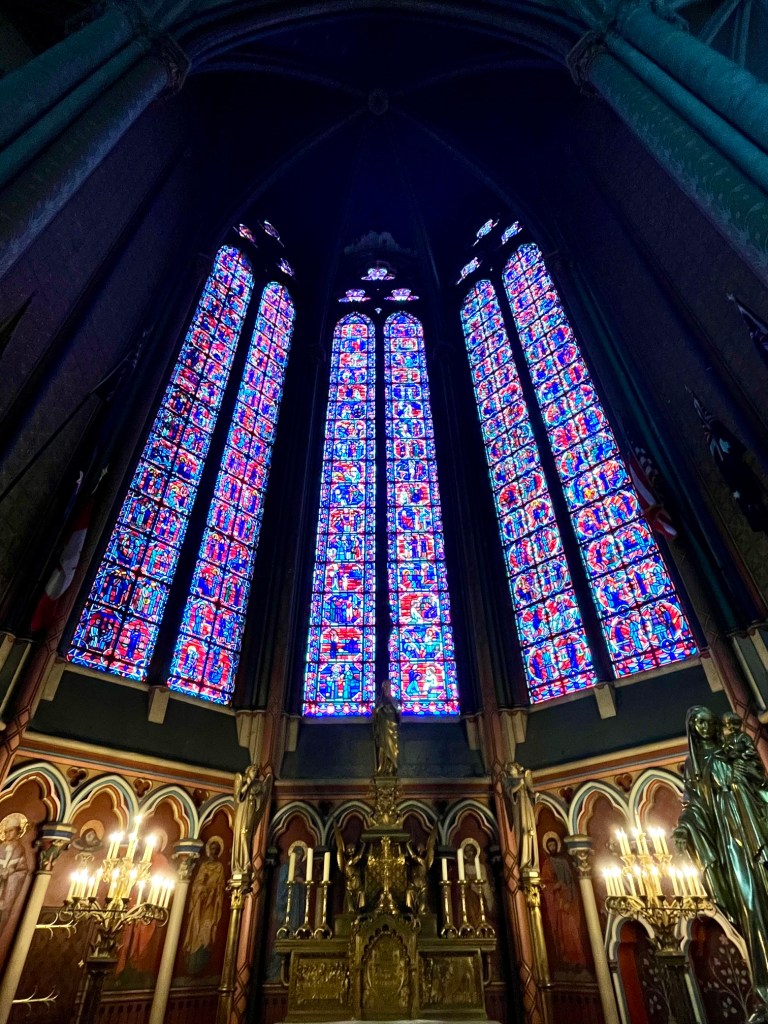
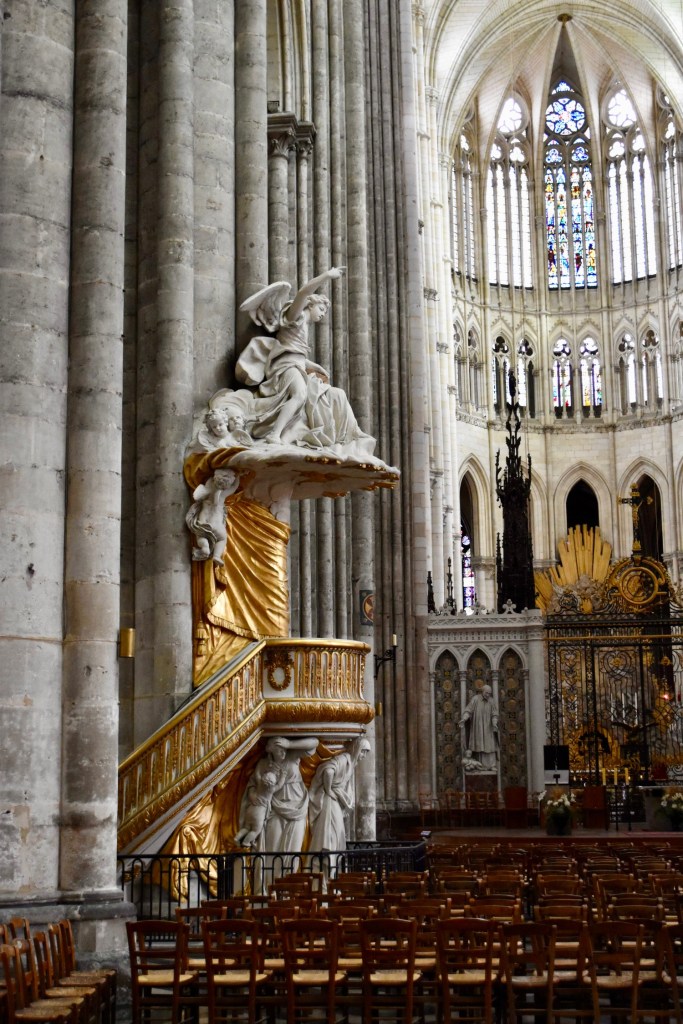
Constructed in the 13th century, it is the largest cathedral in France and a UNESCO World Heritage Site. Amiens Cathedral has stood through time, watching centuries tick by. It has seen two world wars and survived both practically intact. The head of Saint John the Baptist, the relic that other places also claim to house, is said to be kept in the cathedral.
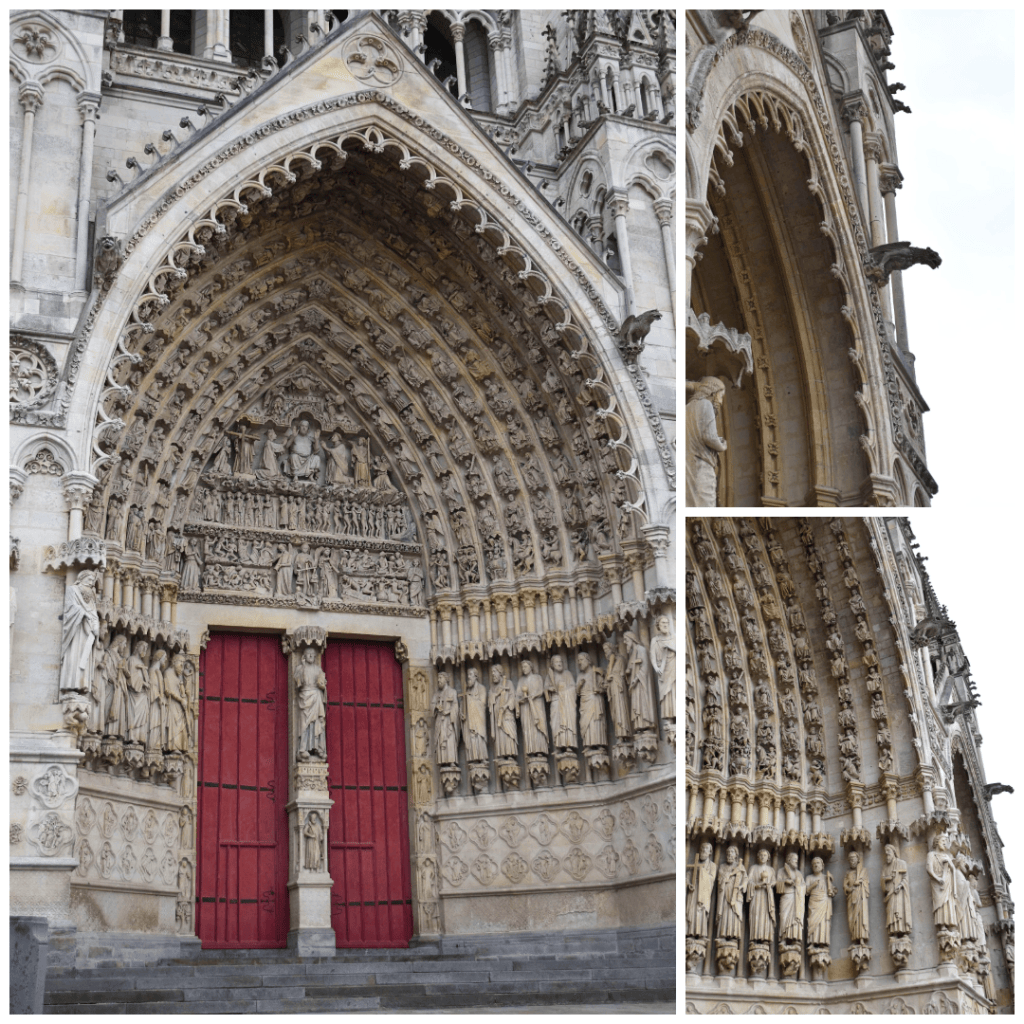
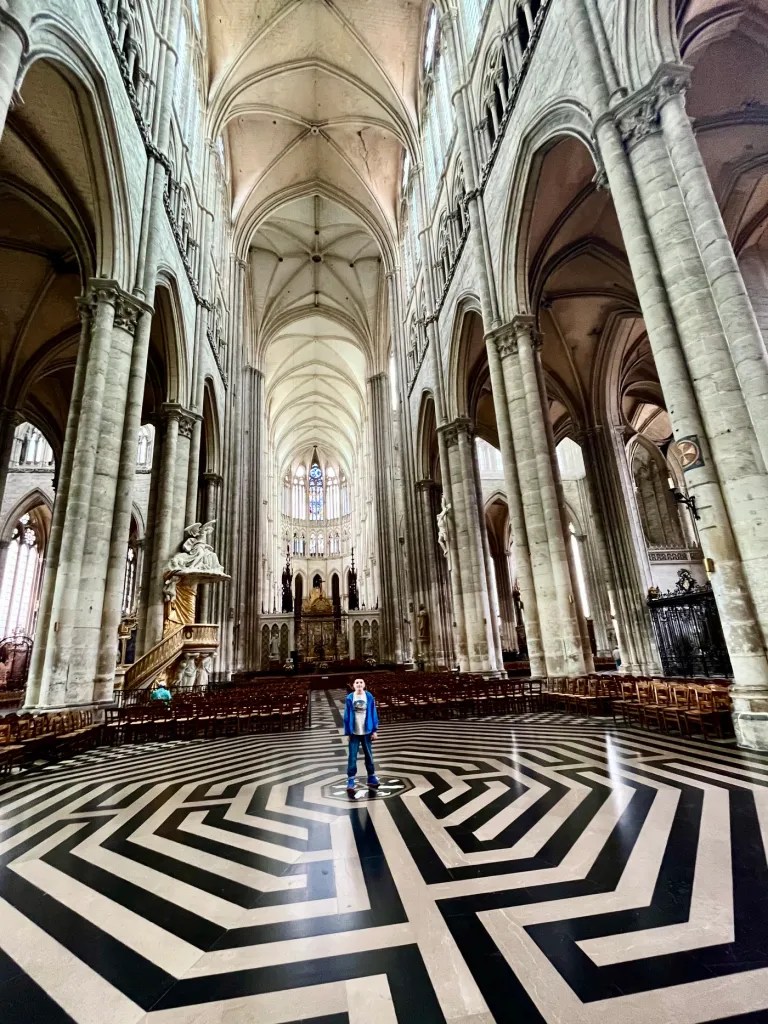
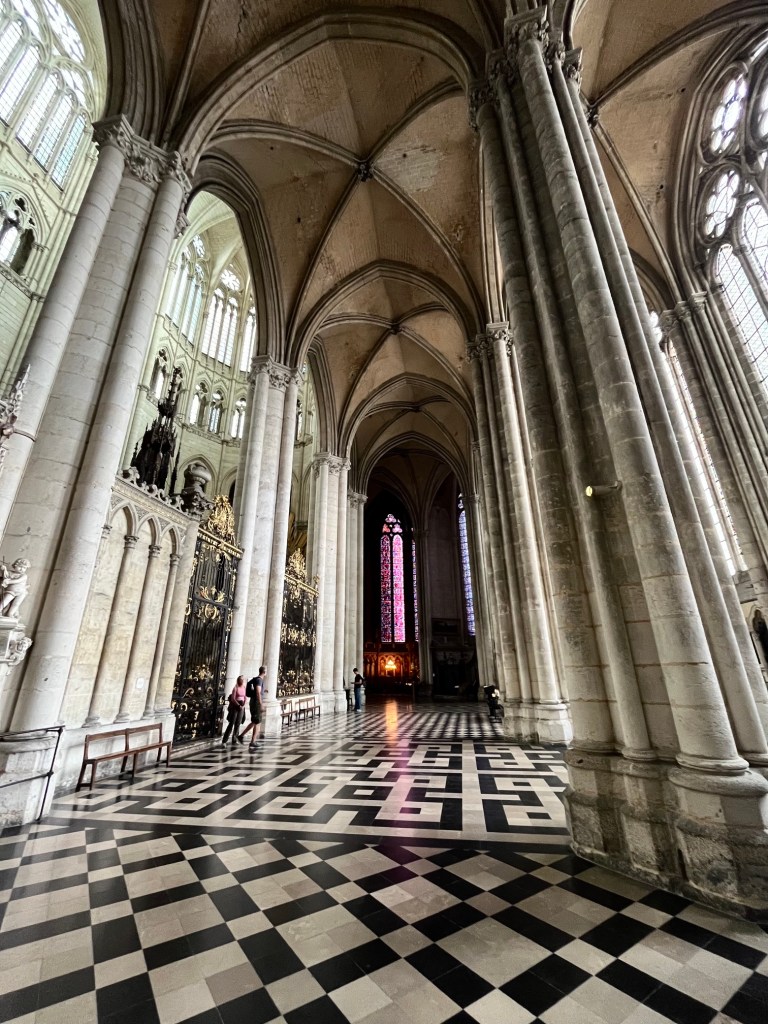
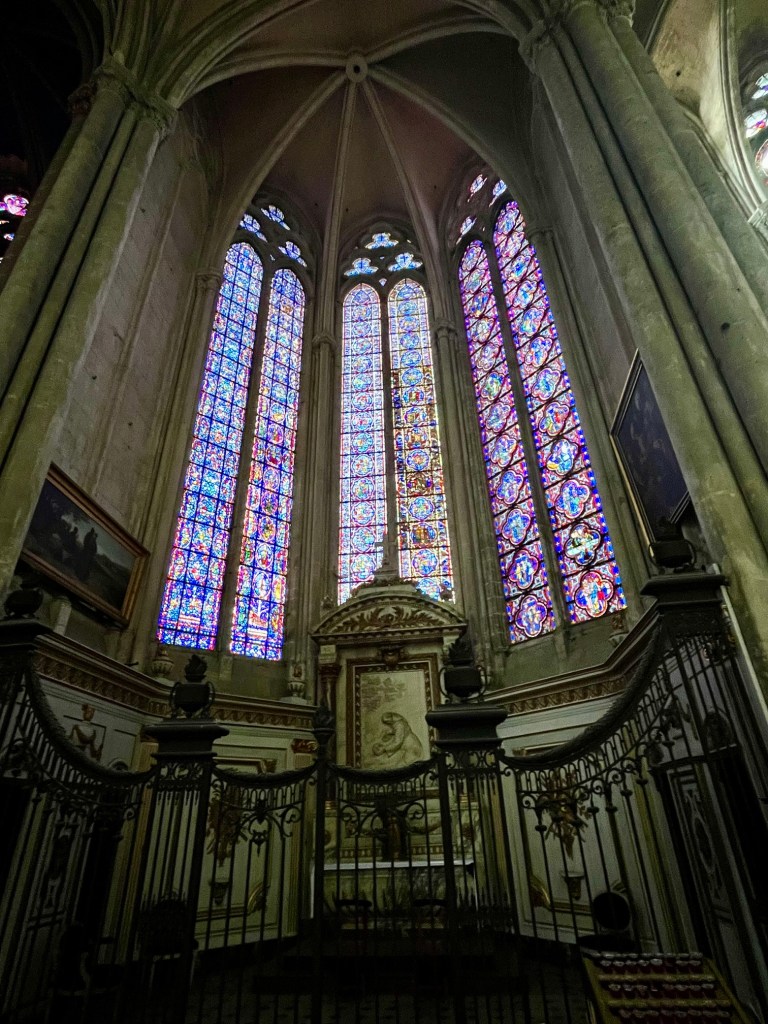
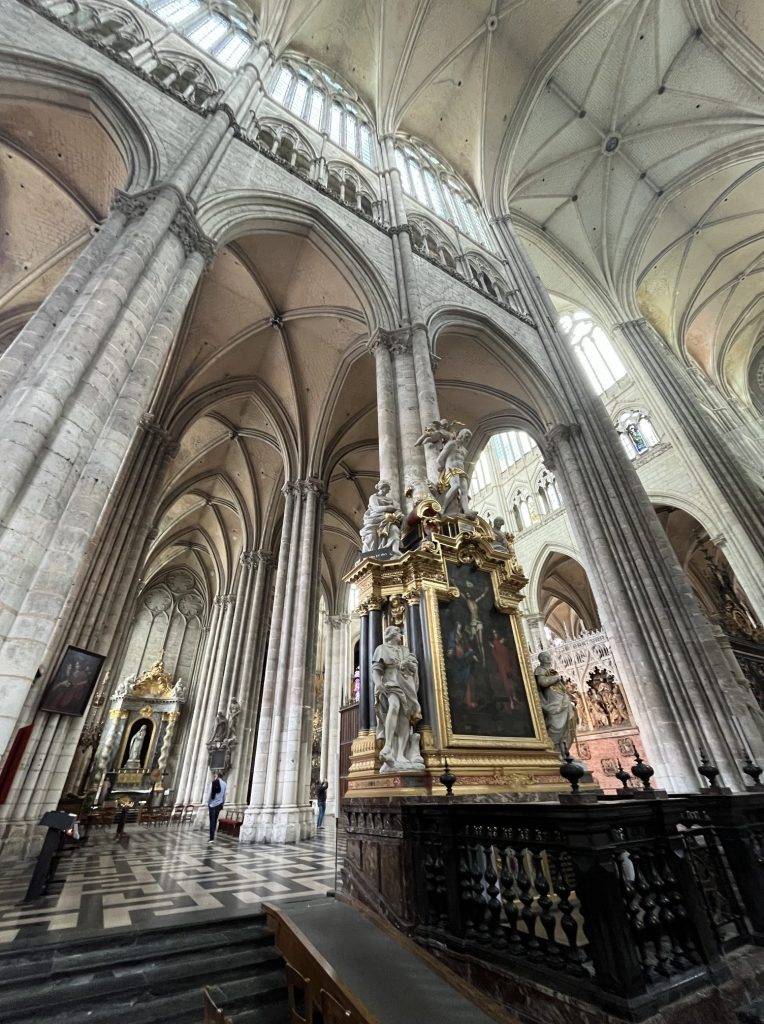
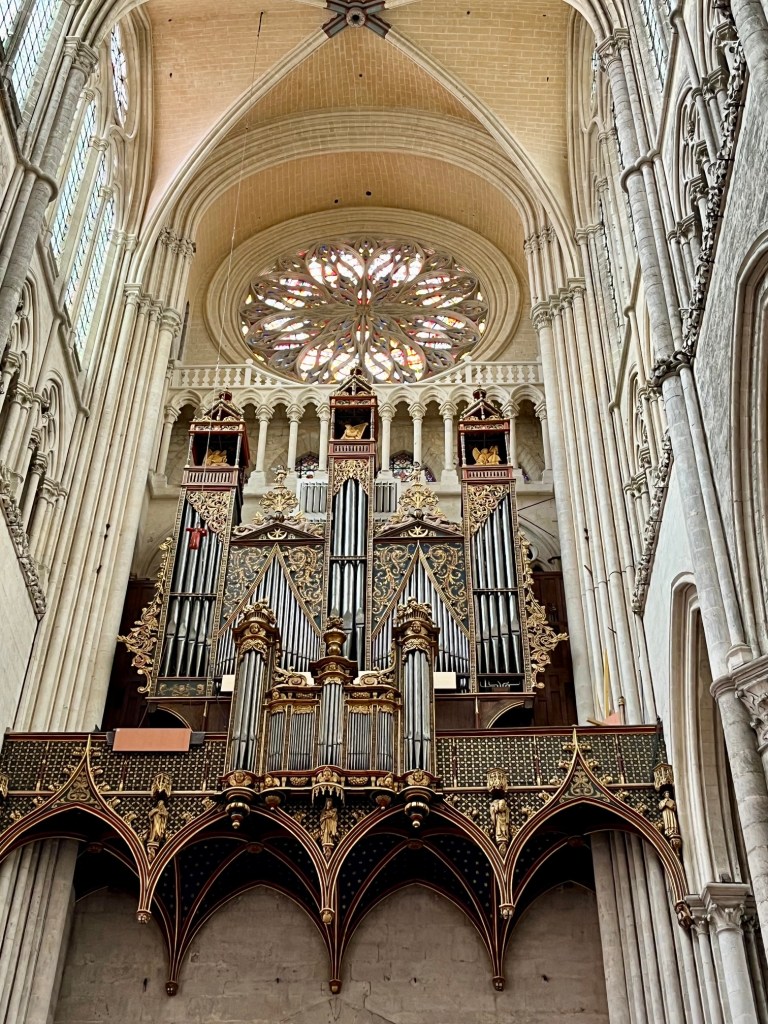
We arrived too late to climb the cathedral’s towers. Otherwise, the need to climb the 302 steps would not have prevented us from enjoying the view from above. Standing in front of the Amiens Cathedral, we lamented all the time we lost that day. We still had to drive back to our apartment in Criel-sur-Mer, and we wanted to at least have a quick look at the Amiens old town. But when my son pointed out that we can’t miss seeing the inside of the cathedral, we didn’t argue. In we went and didn’t regret it for a second. Amiens Cathedral is probably even more magnificent than Rouen’s.
The labyrinth where my son stands in the first picture is one of only three surviving medieval labyrinths in French cathedrals. Pilgrims used to follow it on their knees as an alternative to the perilous trip to the Holy Land. The one here, reconstructed between 1894 and 1896, is 234 meters long.
Ault
If I had to choose one word to describe our trip to Normandy, it would be: underwhelming. Lovely, filled with exciting discoveries and fresh impressions, but with a drawback too many to call it a complete success.
Visiting Ault, a small village on the coast, was not an exception.
We decided to spend the last full day of our trip exploring the coast. Not to waste half of the limited time on the road, we opted for the closest places to our home base in Criel-sur-Mer. Ault, with its chalk cliffs advertised all along the highway, was our first destination.
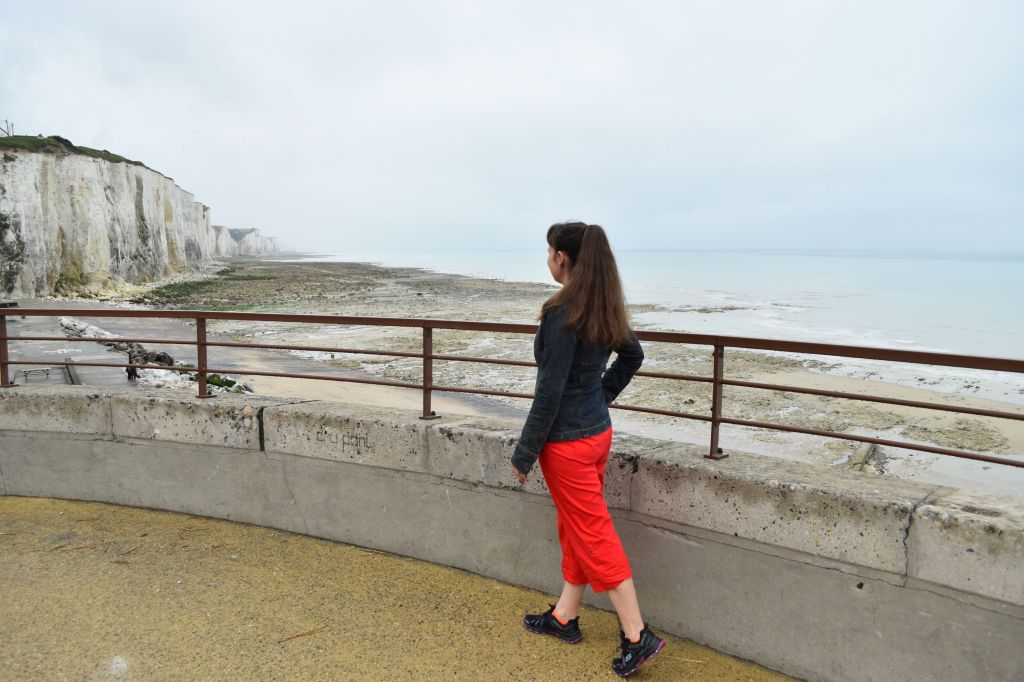
In medieval times, Ault belonged to Normandy, but now it is part of the Picardy region. Having emerged back in Antiquity, this charming spot perched on top of the cliffs overlooking the vast expanse of water gained some significance in the Middle Ages. The origins of its name are attributed to the Old French words “halte” or “aulte” – a height or promontory.
A small fishing port and an agricultural center, Ault truly flourished in the 19th century when its natural beauty started to attract tourists. The Parisian bourgeoisie favoured it as a retreat from the hustle of the big city. Here, one could enjoy unspoilt nature and fresh air. The rich began building villas in Ault so they could relax by the sea in comfort, but at the beginning of the 20th century, the railway network expanded to include Ault.
It was unavoidable that the town, strategically located on the coast, was affected by world wars. During the WW1, even without the front line passing right through it, Ault still suffered from destruction and fighting. Besides, its economy decreased drastically. Between the wars, people flocked to the idyllic spot with renewed vigour. Families with children and those looking for tranquillity by the sea chose it as their holiday destination. During World War II Ault was again spared in terms of not finding itself on the front line as such. Nevertheless, its inhabitants felt the plague of war. People couldn’t travel as freely as before and were subjected to evacuations.
Just like Saint-Valery-sur-Somme, Ault has its special church. It is special because it has a belfry. The common feature of belfries in France was that they were separate structures, not connected to castles or churches. With few exceptions. One such exception was the belfry tower of the church of Saint-Pierre in Ault. Built in checkers of white stones and flints traditional for Picardy Maritime, it is the only church in the region that possessed an ecclesiastical belfry obtained by the extension of a communal charter. Only two other churches in the whole of France have a belfry, but the church of Saint-Pierre in Ault is the oldest. Moreover, it’s the oldest ecclesiastical belfry in France and one of the oldest in the world.
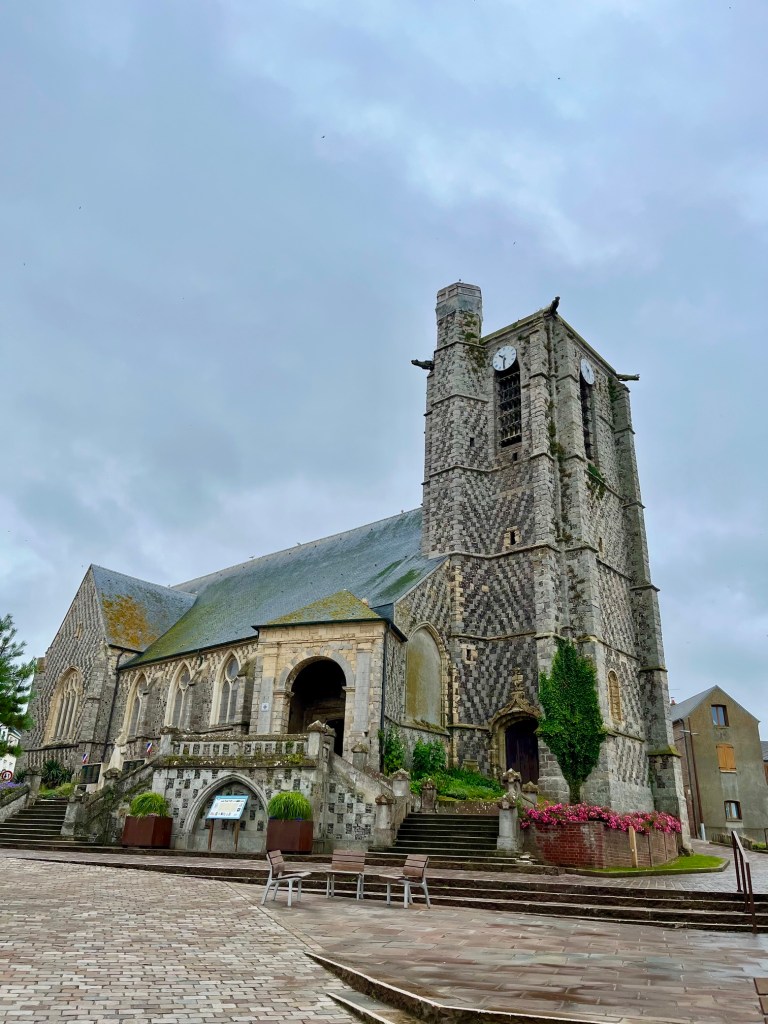
Having the permission to build the belfry didn’t automatically let the citizens of Ault get one. The Hundred Years’ War and a plague epidemic – the Black Death – were tearing the territory apart. Everyone had other, more pressing issues to solve. Finally, in 1382, the Count of Artois, the ruler of the region, came to the townsfolk’s rescue and allowed the town to use the bell tower of Saint-Pierre church as a belfry. The three bells that were installed there much later, in 1821, bore beautiful female names: Charlotte, Henriette and Louise.
A belfry in the Middle Ages in Europe was not just a tower with bells but the most important structure that regulated almost all aspects of people’s lives. As the cities grew, so did the need to assert their autonomy from feudal and church control. Belfries served this very purpose. In the era before every person owed a personal clock in one form or another, it was the bells on the belfry that regulated everyday life. They announced the hours when the markets were open and you could go shopping, when the enemy was at the city gate and you needed to run and hide; and any other significant event.
I believe the church of Saint-Pierre in Ault is not generally open to the public, except for special events like exhibitions, but since we were short of time and upset by the weather, we didn’t check. Anyway, it is an impressive landmark that we admired on our way to the coastal path in Ault.
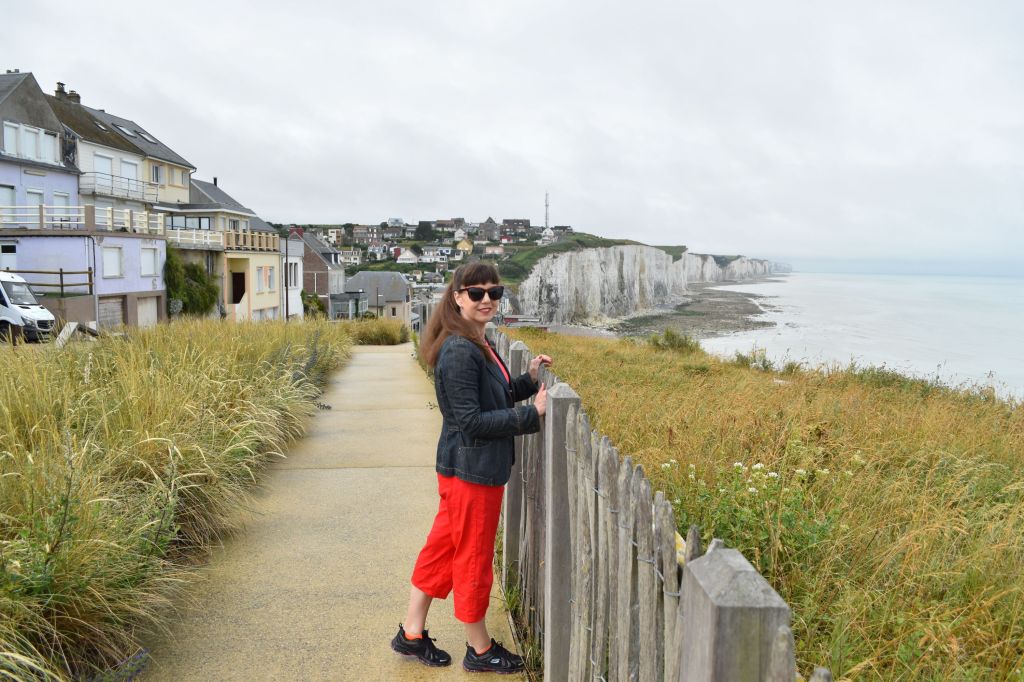
Even though the weather was teasing us, thick grey clouds not dispersing enough to make us hopeful for some sunshine, we still appreciated the charm of the place. Waiting to see if the skies would show us some blue, we first walked up in the opposite direction from the chalk cliffs to look at the panorama. The view indeed was very pretty.
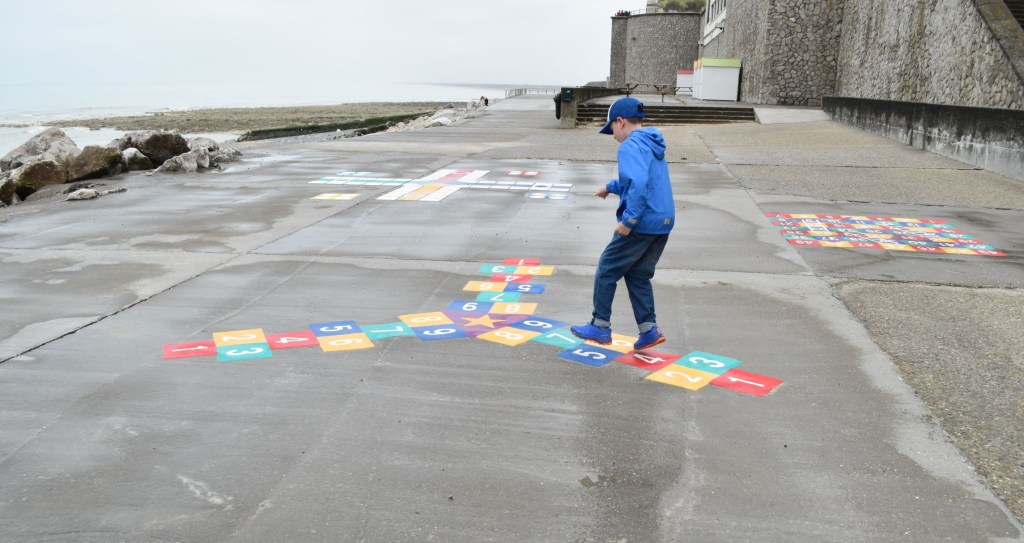
The weather didn’t prevent our son from enjoying himself. Drizzle or not, he was happy to indulge in a few rounds of hopscotch overlooking the Ault chalk cliffs and La Manche.
When the rain stopped, we headed to the main trail that connects Ault with another picturesque spot on the coast, Mers-les-Bains. That trail was what attracted us to Ault in the first place. Had the weather been more cooperative, we’d have hiked to Mers-les-Bains, had lunch and hiked back. With 7 km to walk one way, the hike, lunch, and a stroll around both villages would have taken us the whole day.
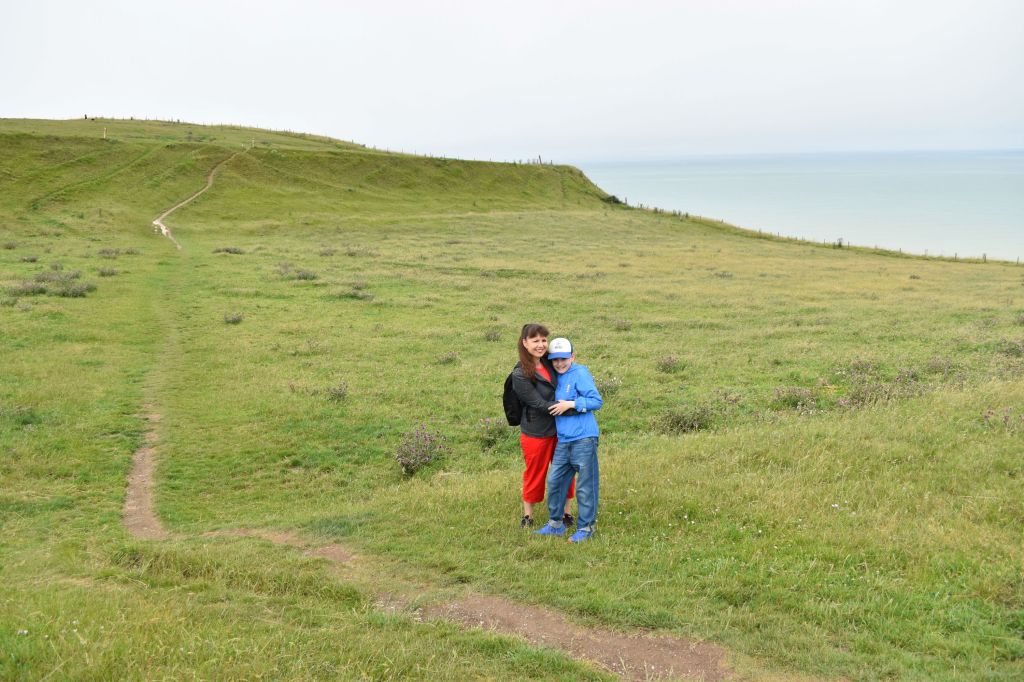
The weather had other plans. We didn’t get far on the trail before the drizzle began again, quickly turning into a steady rain. The coast path threatened to turn into muddy slosh. Besides, there weren’t any dramatic cliff views from the path, only the endless grassy landscape. Instead of a leisurely stroll admiring the dramatic rocks and slopes, we would be trudging and slipping, after a while dripping wet. So, we decided to turn back. Unhappy about this decision, we thought a proper lunch in a cosy place in Ault would lift our spirits. And then we could drive to the town located nearby, which promised not only open-air attractions.
It is true, I believe, of any trip that not all the plans that you make come to fruition. In France, Normandy, the thing that did not happen for us was bird watching. And this is something I still feel pangs of regret about, for the area is a paradise for those who love this pastime. We even have a monocular bought specifically for watching birds and other wildlife, which we carry with us on our walks.
It wasn’t easy to find clear and explicit information about the practical things like how to get to places of interest, where to park, etc., online. In Saint-Valery-sur-Somme’s tourist information centre, I asked about where we could watch birds. I’d read that people working there speak English. It turned out to be true indeed, and a very helpful young man provided us with the info we needed and gave us the brochures.
Alas, the circumstances prevented us from visiting both Grand-Laviers bird sanctuary (the former sugar refinery’s settling ponds transformed into a lush wetland habitat with over 190 bird species) and the Marquenterre Park (more than 300 bird species across 200 hectares of protected land, marshes, reedbeds, dunes, and meadows). The weather slowed us down and discouraged us from attempting a drive that could end up in disappointment.
So, we ended up taking the info centre employee’s last advice and, after having lunch in Ault, headed to the bird sanctuary of Hâble d’Ault. Contrary to what its name suggests, to access it you have to get to the next town on the coast called Cayeux-sur-Mer.
Cayeux-sur-Mer
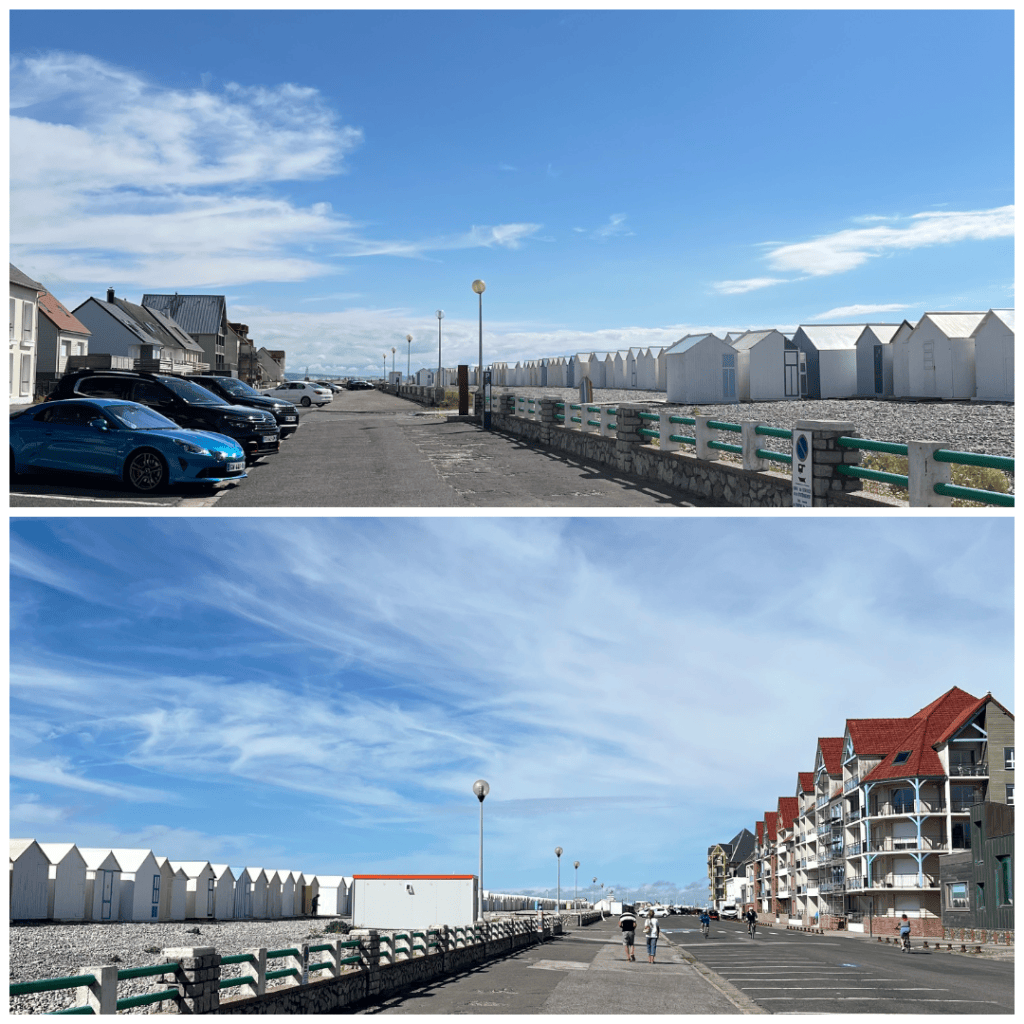
Since I didn’t do thorough research, the car navigation system led us wrong at first, and we lost time again. When we finally parked in Cayeux-sur-Mer, we were not in the mood to exert our intellectual faculties and search for the trail. We simply wandered along the beach, picking up the pebbles we found interesting, watching the waves and admiring the Ault white cliffs in the distance.
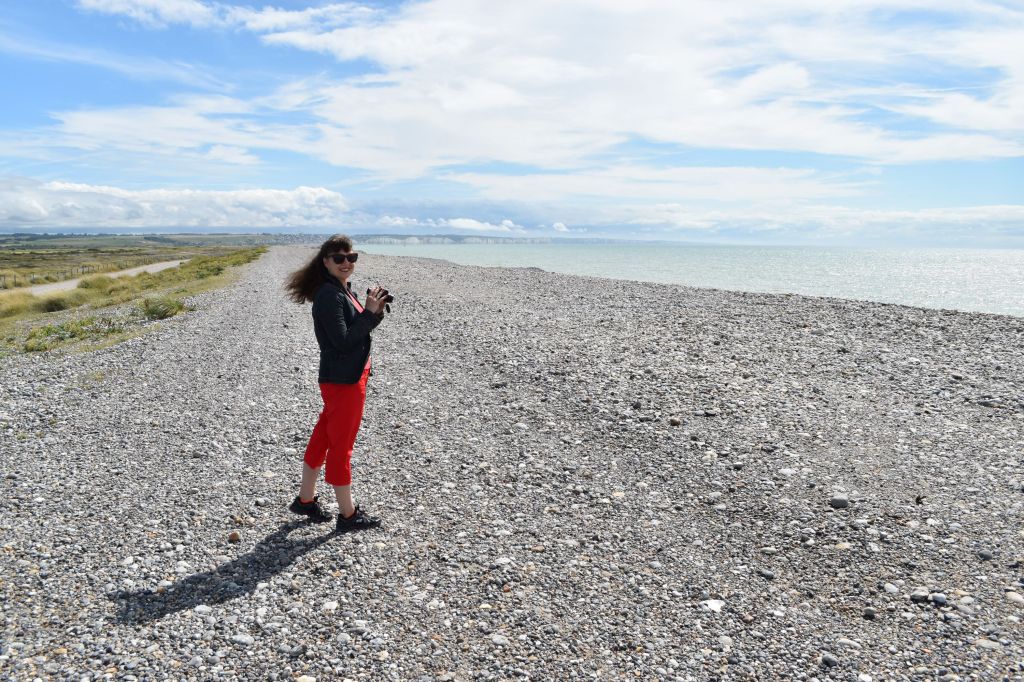
It was probably the result of our frustration that accumulated due to the weather and us getting lost that we couldn’t find the trail. I wouldn’t be surprised if it turned out that the trailhead was marked and we simply missed it. So, instead of marching across the marshes of the bird sanctuary Hâble d’Ault, we walked along the water edge.
The reserve was the grassy area to our left; we understood that much. But for the life of us, we couldn’t see any signs as to how to get to the path that would allow us to traverse it.
The bird sanctuary Hâble d’Ault is located between the towns of Ault and Cayeux-sur-Mer. It is a habitat for over 270 species of migratory birds. The species one can spot here include the Kentish plover, black-winged stilt, bearded tit, herons, swans, Eurasian teal, and short-eared owl.
Anyway, it was a pleasant walk. Next time we are in these parts, we’ll definitely find the trail and walk it.
Mad dash to the airport
Our flight home was in the early evening, so we decided not to drive anywhere and spend the day in Criel-sur-Mer. We went up the coastal trail that we loved so much and lingered longer watching the birds. We met a cow whose gaze mirrored the sadness of the world or maybe only the one about us leaving so soon. We strolled along the beach, watching the waves and looking for those mussels, which the welcoming board advertised as dotting the shore in abundance.
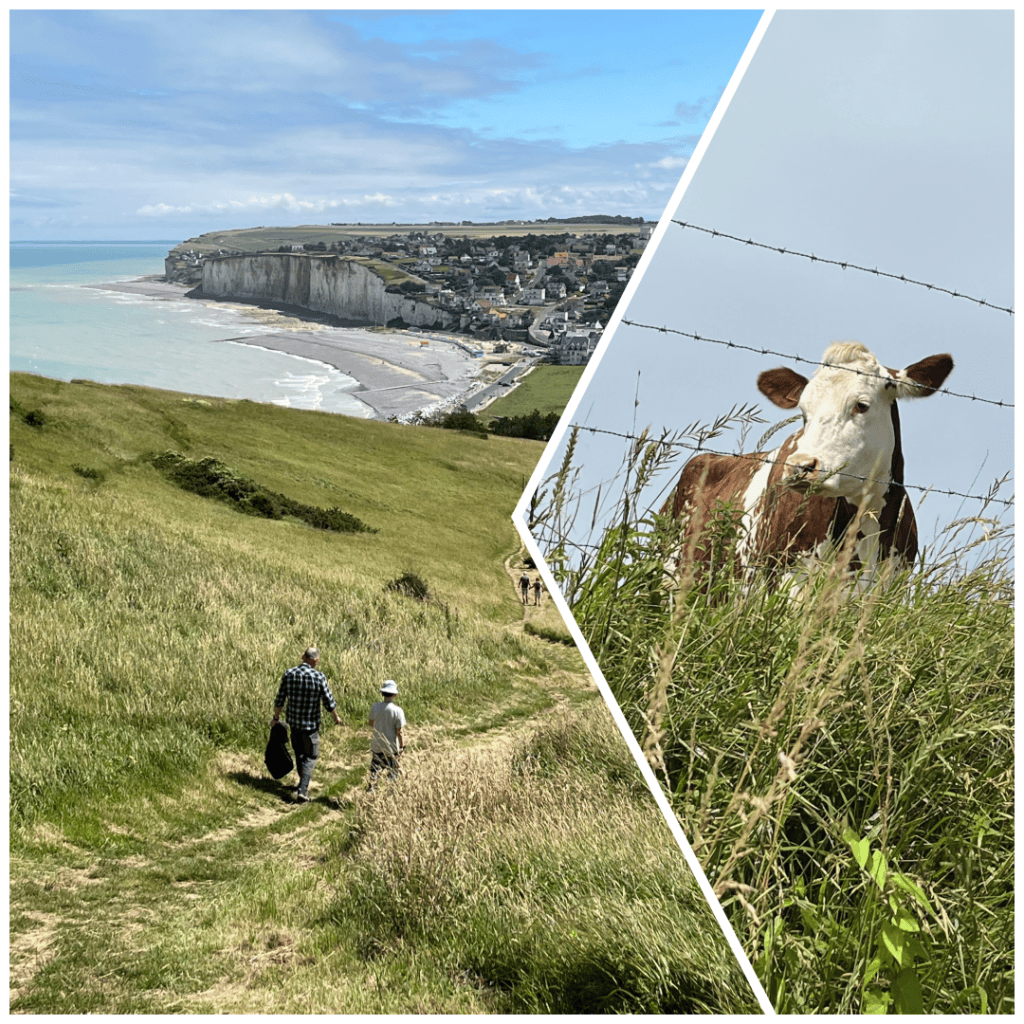
Initially we didn’t plan to have lunch, since we had a hearty breakfast. But all that fresh air probably facilitated a much quicker digestion process. So, after taking a look around, we located an inviting-looking restaurant called “Pour Koi Pas” and headed straight there.
We had the best meal, not only on that trip but ever. We all ordered different dishes, and they all were excellent. I ordered Crème brûlée, because you know, how can you leave France without tasting their famous custard vanilla dessert.
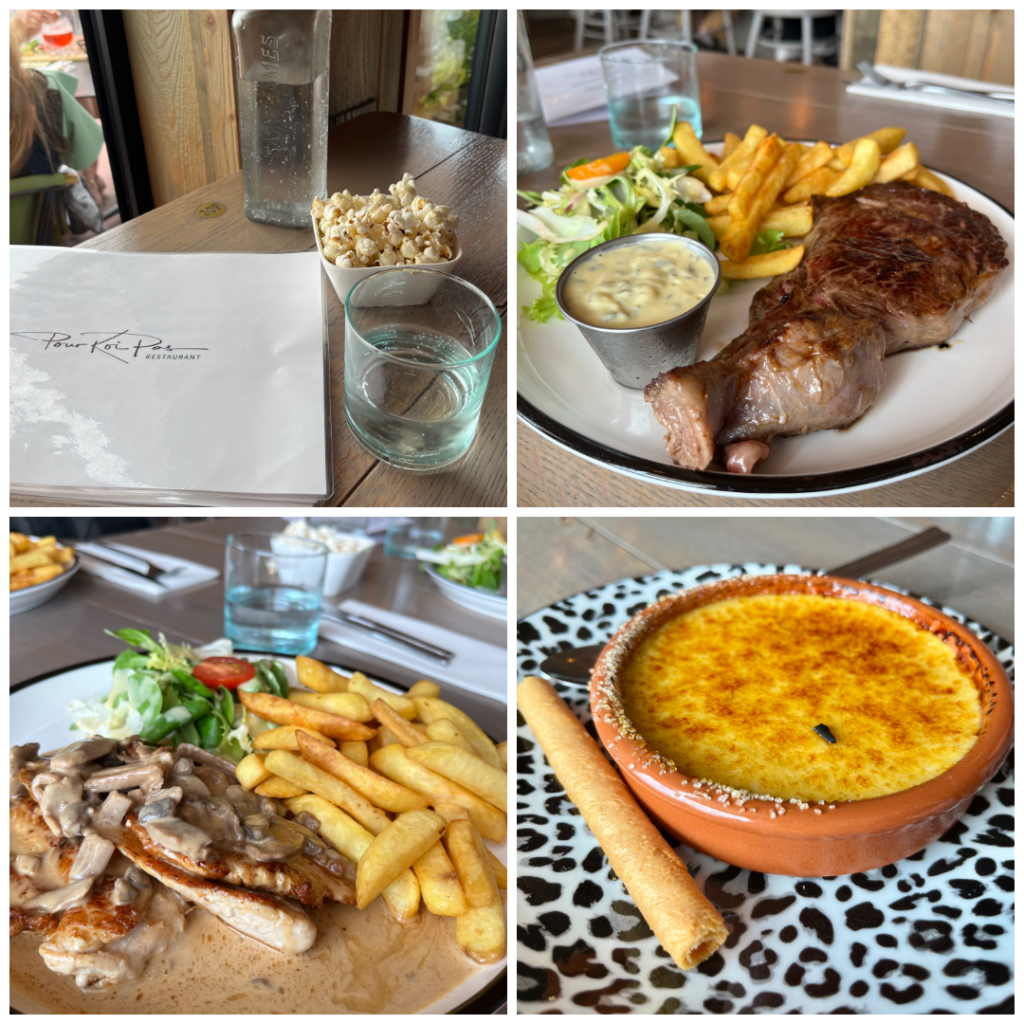
We felt so content that we set out for the airport at the very last minute. And that, I must say, is highly uncharacteristic for both my husband and myself. We are those boring people who leave home too early rather than on time.
It was a fun drive across the French countryside to the Beauvais–Tillé Airport. We arrived at the car rental lot just in time to drop the key and race to departures. We were delayed at customs, for the uniformed man found a tube of organic medical balm used for insect bites, scrapes, burns, and the like in our hand luggage. The offending article had to be packed separately in a plastic bag, and only then were we released to run to our gate. We arrived the moment our flight was announced.
Final thoughts
During any trip, we are bound to feel disappointed at one thing or another. It is impossible to be at the height of contentment all the time. Still, I cannot help but admit that, during one week in France, it happened more times than in the three weeks we spent in the USA in 2024.
I am not one of those who enjoy complaining, nor do I draw pleasure from describing unpleasant experiences in detail. So, sharing my memories about our French adventure, I feel reluctant to mention what spoilt the trip a little. Yet, for the sake of objectivity, I think I’d better do it.
It’s funny, but the same thing that frustrated me this time annoyed me the first time I visited France. I came to Paris in 2002, and was shocked by the peculiar opening hours of cafes and restaurants. These establishments served customers for a few hours during the day and reopened only in the evening. Later, I’d convinced myself that ‘it was me, not you,’ writing off my ignorance to the brutal reality of the ‘savage 90s’ that my country, Latvia, still existed in. Without going into unnecessary details, let me just say that you could buy anything and get any service at any time. Hungry at 2 am after rocking the dance floor of a trendy nightclub? No problem. Cross the square to a 24/7 restaurant, and they’ll serve you whatever your soul and stomach desire. Oysters or steak at 9 in the morning? No problem. The most fashionable of Riga restaurants will accommodate your request. So, it was expected that, having arrived from such an environment, even though at the time I could not afford this extravaganza, different rules took me by surprise.
A quarter of a century later, though, my frustration had different reasons. It was very uncomfortable to adjust our day plans around the restaurants’ opening hours. Decent establishments opened for lunch around 11, with the kitchen closing around 14. If we failed to fit this opening window, we were left to seek some fast-food place. I might appear grumpy here. I’m not saying that the French are doing it all wrong. These are their traditions, and I respect that. The only thing I wanted to say is that these particular traditions didn’t fit our needs and complicated our trip. Because of our always challenging travelling schedule, we want as little stress on vacation as possible. Alas, in France, we had a bit more of it than we could absorb without getting upset.
But there was a good thing about French restaurants as well. In those several hours when they serve lunch to customers, the service is impeccable. I was wary that it would be chaotic, with waiters forgetting to bring parts of our order or a receipt. I couldn’t be more wrong. Everything was perfect. Orders delivered on time, bills brought immediately on demand, the request to pay by card satisfied promptly. I guess this is so because everyone knows that they have only a few hours of frantic activity ahead. And in order to make it work, they simply must ensure efficiency.
Well, this is it about our trip to France.
Thank you for travelling with me.


Leave a Reply