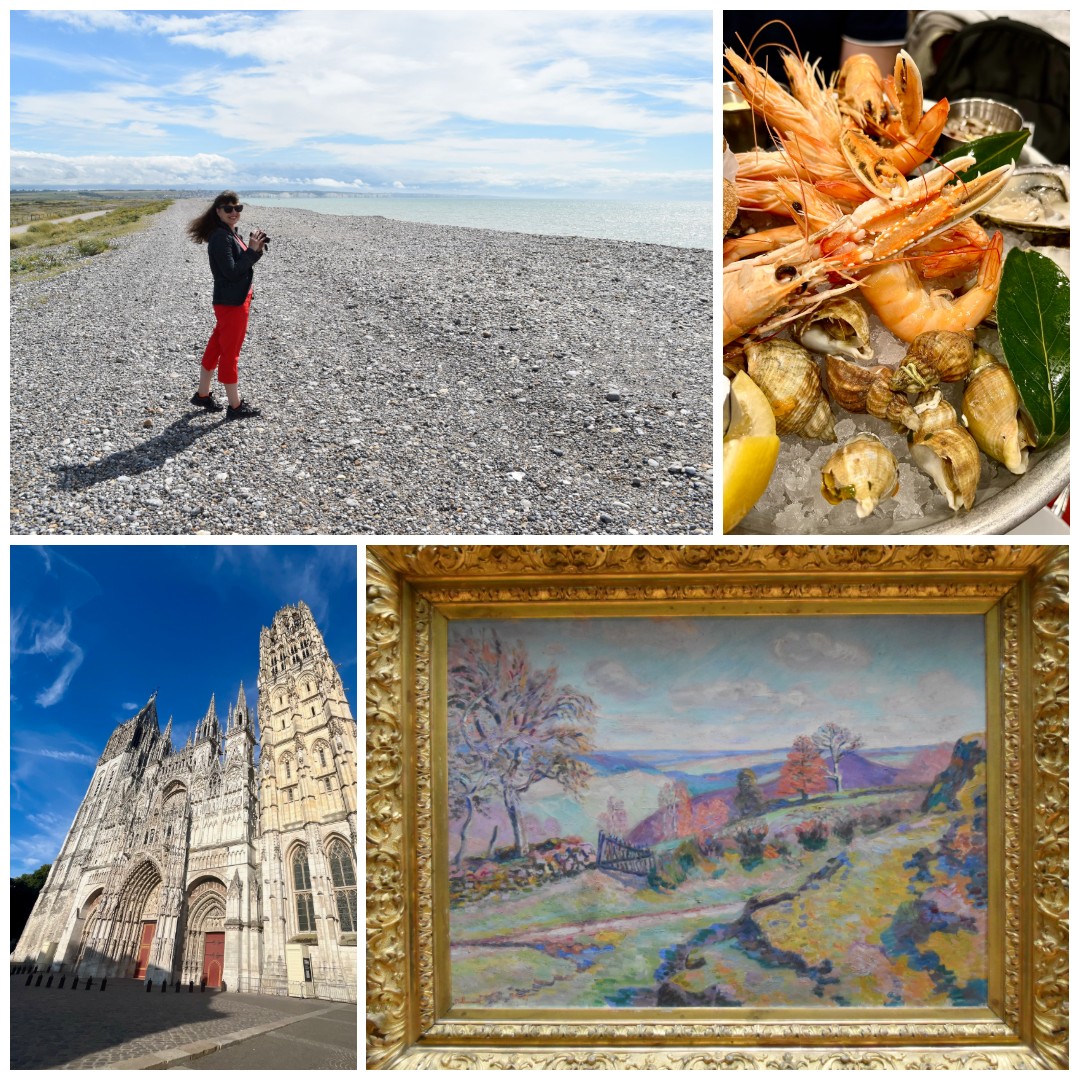
I haven’t posted anything here apart from book reviews for months. I do have a lot to say about my writing journey and how AI threatens to change the publishing scene forever. Alas, a human being still must set up priorities to get something done. So, I’ve been dividing my time between caring for my family and my writing/editing.
One thing I wanted to share on my blog is our family trip to France that we took last year. I posted about it on Instagram, but I wanted to make a complete, article-style post about it, like I did for our US 2024 trip. If you missed it, you can read about our adventures in America here:
I decided that now is a good time to take a break from editing my new dark epic fantasy series and switch to reminiscing about travelling.
I’ll start with general facts.
Duration: 1 week in June 2025
Arrival/Departure: Beauvais–Tillé Airport (located 108 km / 67 miles from Paris, thus branded as Paris–Beauvais Airport)
3 nights in Rouen
4 nights in Criel-sur-Mer, Normandy
Towns and cities visited:
- Rouen
- Amiens
- Criel-sur-Mer
- Ault
- Cayeux-sur-Mer
- Saint-Valery-sur-Somme
Places of interest explored:
- Medieval Rouen (with the original timber-frame buildings built in the 12th and 13th centuries)
- Le Gros Horloge (the Big Clock) Museum, an astronomical timepiece dating from the 1300s
- Black Plague Cemetery/Museum
- Roeun Fine Arts Museum
- Rouen’s Notre Dame Cathedral
- Church of Jeanne d’Arc in Rouen
- A stroll along the River Seine in Rouen
- Roeun panorama from the Sainte-Catherine hill
- Saint-Oeun Abbey
- The Ault Cliffs, dramatic chalk formations on the Alabaster Coast
- WWII German bunker in Le Hourdel
- Saint-Valery-sur-Somme medieval town
- Zoo Amiens Métropole
- Amiens’ Notre Dame Cathedral
- Jules Verne House in Amiens
Rouen
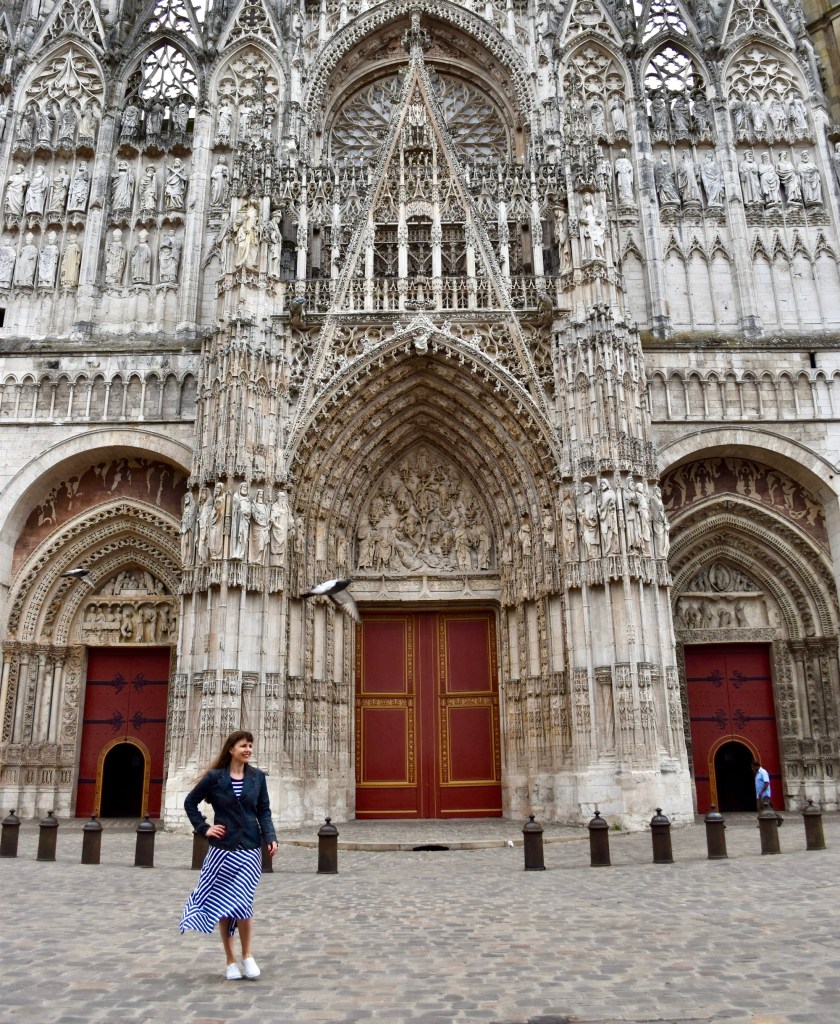
Rouen is not simply old; it is ancient.
I think that Rouen wouldn’t take offense at such a reference to its age. After all, when you are more than two thousand years old, you should have learnt to accept praise where it’s due. Called Rotomagus in the Roman era – yes, roughly a couple of millennia ago – Rouen was already a very important town. Here is proof in case you doubted that – the place had its own amphitheatre and thermae. Then, the Vikings came. What is it about these guys and their passion for raiding and invading? Okay, it was a rhetorical question. Anyway, big, blond men came, traversing the Seine River in 841, and they were so enamoured with Rotomagus that they turned it into their capital and themselves into Normans. Why William the Conqueror, Duke of Normandy, decided to build a castle at Caen and move there, taking with him the glory of the capital, is beyond me.
In 1150, Rouen became a self-governing city. Yet, in the 14th century, some rebellious individuals spoiled everything. Slew the mayor and went about robbing the town’s wealthy citizens of their riches, no less. What were they thinking? Imagining they were the Vikings probably. The king – and at the time, there ruled King Philip IV of France – didn’t take kindly to such behaviour. The monarch suspended the city’s charter and its profitable monopoly over river traffic.
In 1419, Rouen, along with a hefty chunk of Normandy, was conquered by the English. And it was under the rule of Henry V of England that Rouen witnessed its major event of all millennia of its existence.
On the 30th May 1431, Joan of Arc (in French “Jeanne d’Arc“) was burned at the stake.
Less than two decades after that sad event, the French had seized Rouen back. Did the pain of losing their Maid of Orléans play any role in that? Who knows… But we can let our imagination run unleashed for a bit, right?
In terms of architecture, Rouen is famous for its half-timbered houses. There are about 2000 of those gems.
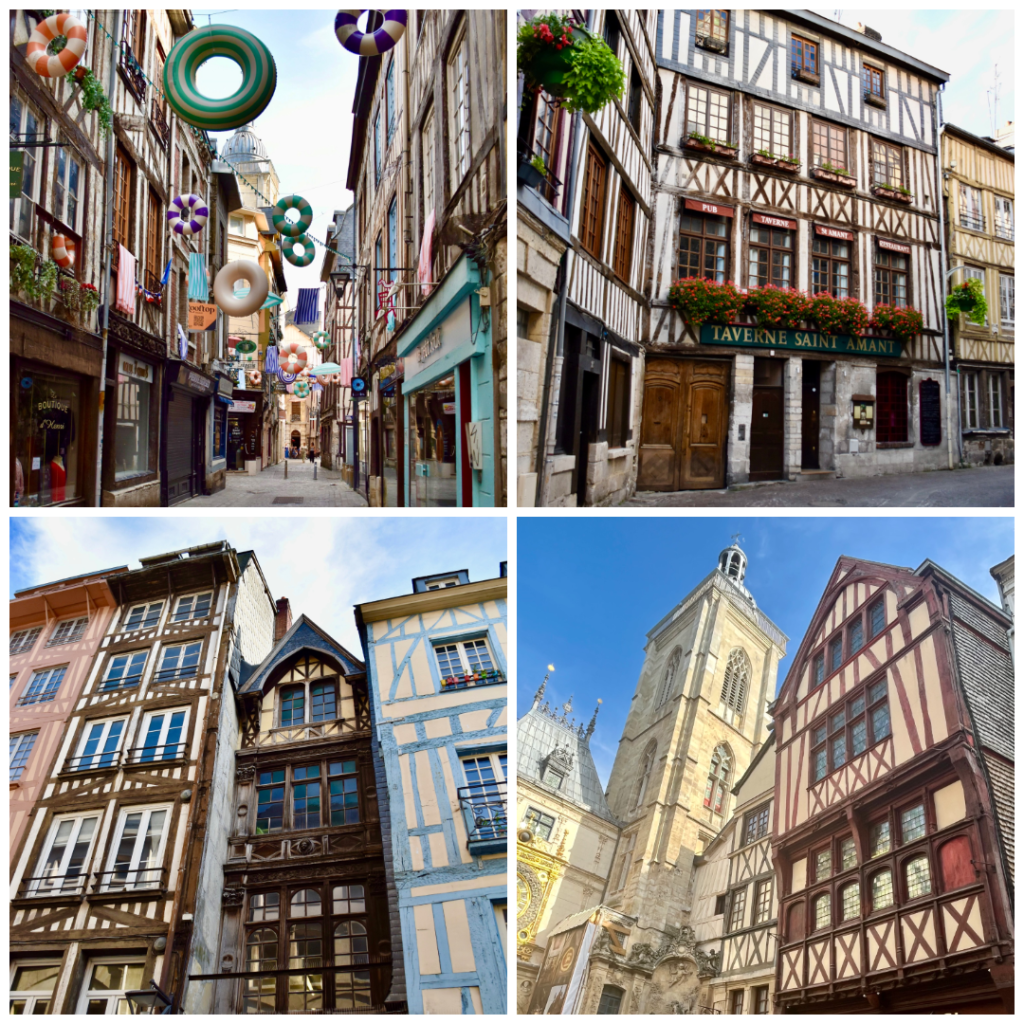
Rouen Cathedral
Rouen Cathedral, without a doubt, is the heart of the city. It’s what you come to see if you don’t have time to see anything else in Rouen. You come back to the magnificent edifice after exploring the labyrinth of quaint streets, your feet bringing you here as if of their own accord.
I can attest that Rouen Cathedral holds some kind of mythical pull that makes it irresistible. It probably has something to do with its walls having been soaking up the energies of people, their moods, thoughts, and aspirations during almost a millennium.
Rouen Cathedral was the first sightseeing place to which we headed after setting out to explore the city. We ventured to the square where it rises, majestic and timeless, towards the sky, many times during our strolls, finishing our daily wanderings watching the setting sun transforming its eclectic façade, turning it into a gigantic sandcastle.
One evening, before going back to the hotel, we found ourselves by Rouen Cathedral. We lingered by the group of tourists, listening to the guide talking with sincere passion in the language we didn’t expect to hear, but were glad that we were mistaken. We lay on the benches placed there for the purpose of admiring the architectural wonder with comfort, unable to leave. More than a year later, I still feel that sensation of utmost awe.
Its grandeur and uniqueness inspired artists, including Claude Monet, who immortalised Rouen Cathedral in his paintings. Its construction began in the 12th century and spanned for centuries after that, gradually giving it its inimitable face.
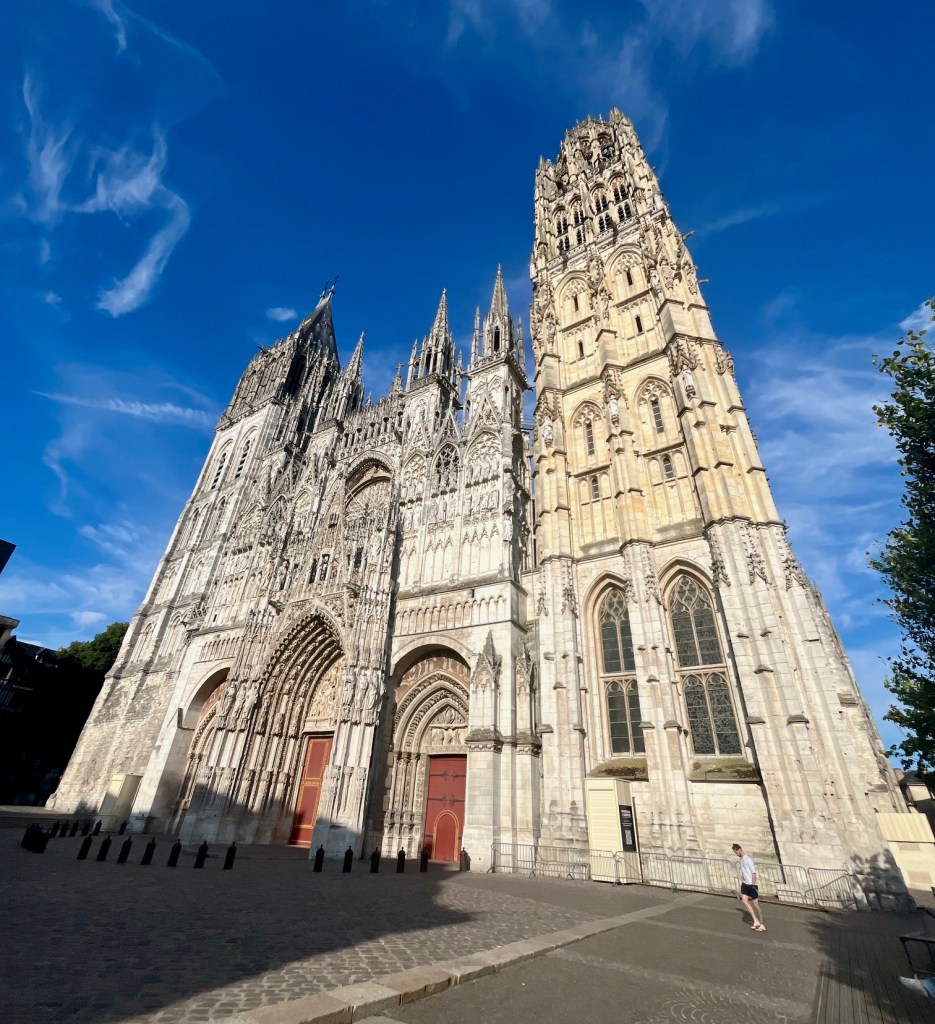
It’s almost impossible to capture the cathedral in full, but we tried and succeeded.
Besides being magnificent in appearance, Rouen Cathedral is a keeper of some priceless artifacts. The legend’s heart lies here…No, it’s not a poetic metaphor. Did you know that the King of England was only one of Richard the Lionheart’s titles? He was also the Duke of Normandy. So, it’s logical that a part of him remains here. His heart. Other parts of his remains are distributed between Fontevraud Abbey and Châlus in France. The latter has the honour of keeping the king’s entrails. Ah well, those were dark times…
Where Rouen Cathedral stands now, back in 395 already was a modest basilica. Since the conquering brutes – the Vikings in this case – don’t bother to stretch their imagination beyond destruction, the sacred place was demolished. Then, in the 11th century, in the same place, a Romanesque cathedral was erected. Yet, nothing much remained from it, and the real construction of Rouen Cathedral began in the 12th century. The part of the cathedral that Monet became obsessed with, having painted it three dozen times, acquired its ‘face’, complete with 70 carved figures, in the 14th-15th centuries.
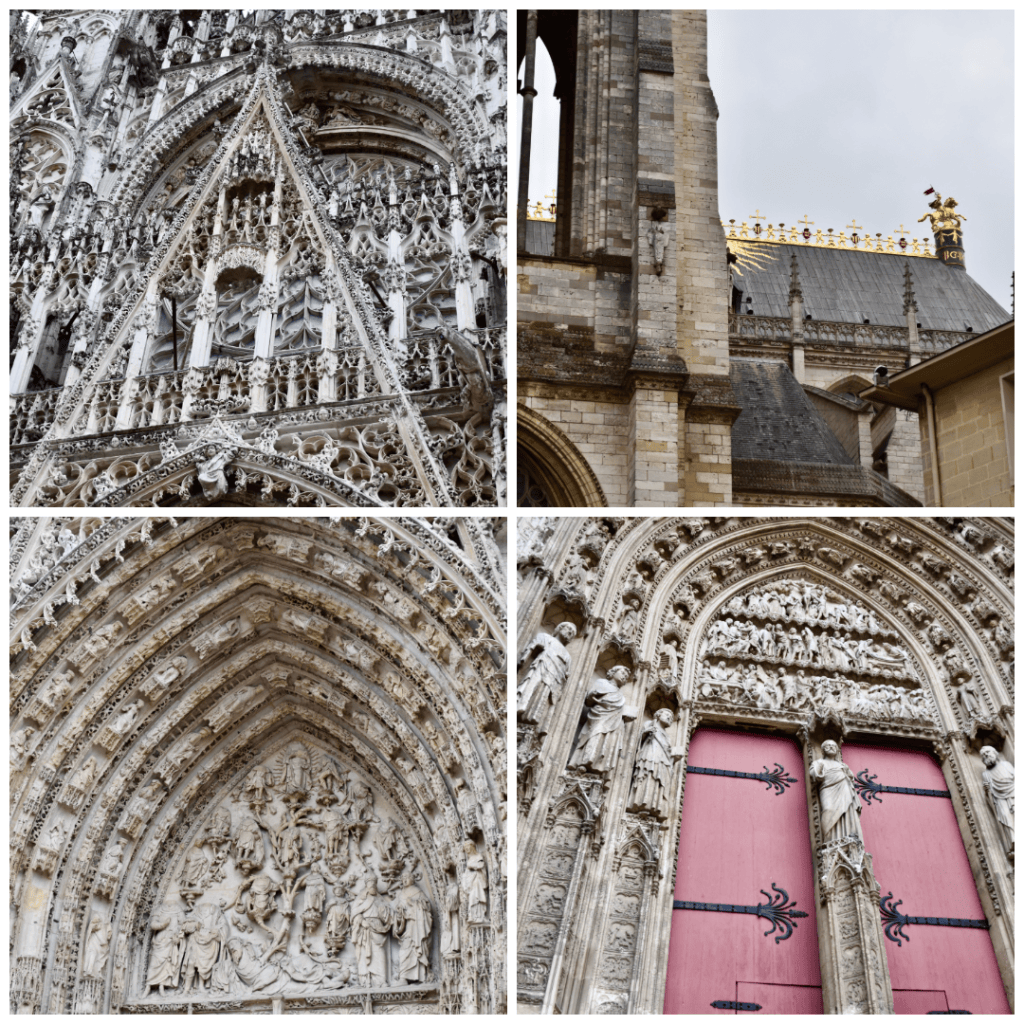
Later, in the 15th-16th centuries, the formidable edifice was complemented with an exquisite piece of late Gothic Flamboyant style, the Butter Tower. Charming title, isn’t it? The story behind it is no less delightful. Cardinal d’Amboise, apart from being a devout servant of God, had a sharp entrepreneurial acumen. He obtained a papal resolution that allowed those who paid generous indulgences to the church for the construction of a new tower to consume butter during Lent. The Butter Tower’s grandeur serves as a confirmation of people’s love for butter.
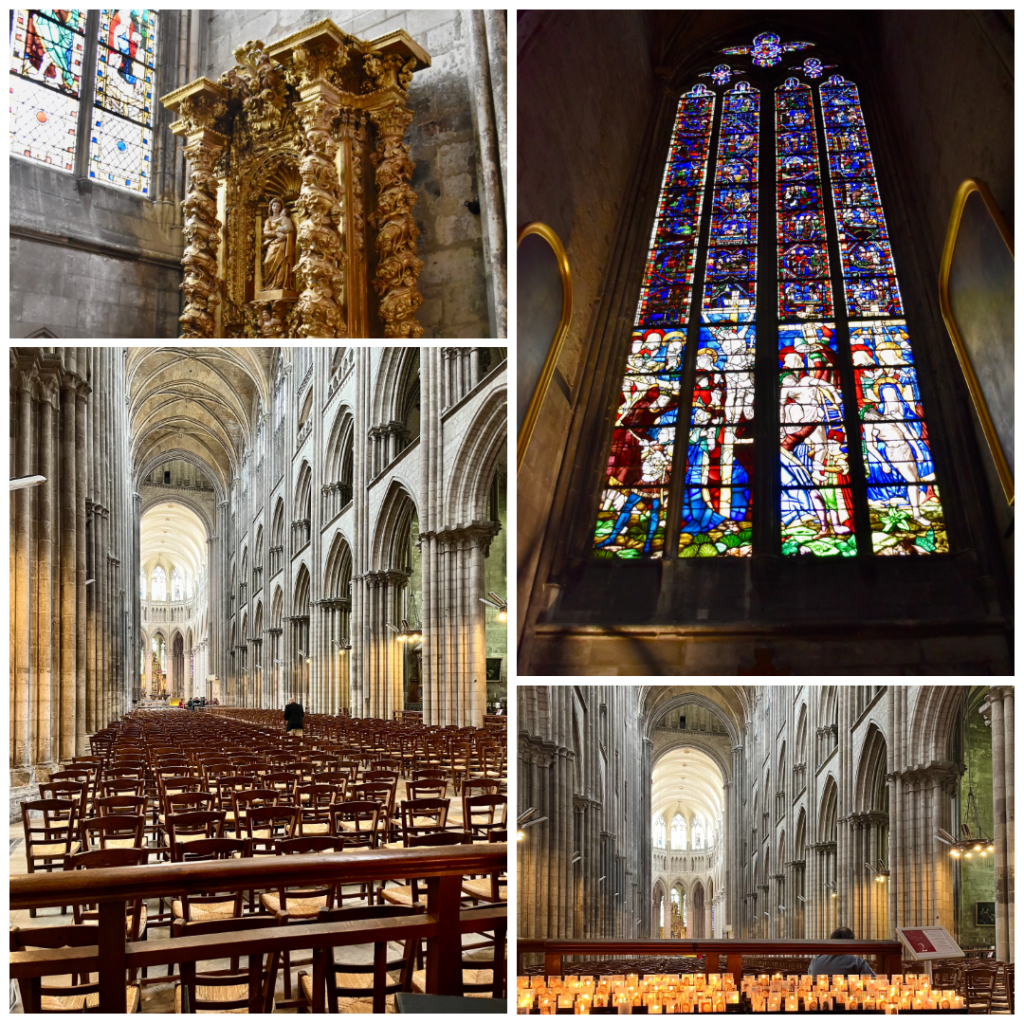
Initially, the cathedral had a wooden spire. Alas, it was destroyed by lightning. In its place came a 151-metre-high iron one. Disgusted, novelist Gustave Flaubert called it “the dream of a metalworker in delirium.” Yet, when in 2019 the plastic sheeting that covered the spire during the restoration caught fire, it was a relief that it wasn’t made of wood.
The Cathedral was damaged dramatically in Allied bombing during World War II. It took more than a decade to restore it to its full glory.
Le Gros Horloge
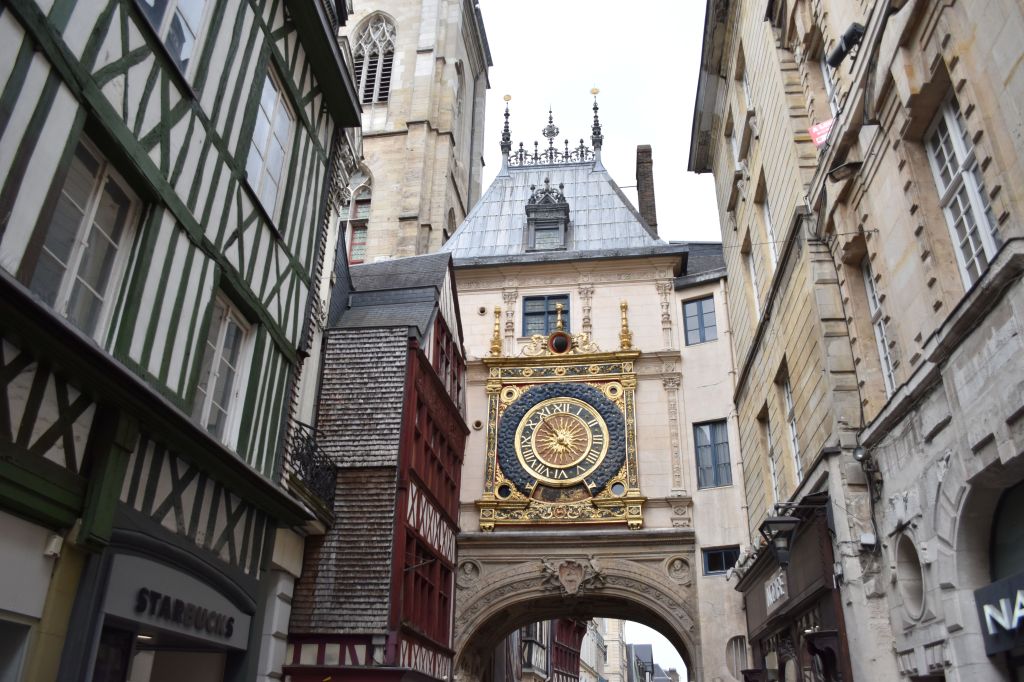
My husband, son, and I unanimously declared that the best thing in Rouen is Le Gros Horloge – the Great Clock. We didn’t plan to visit its museum, only to admire it from the street. Opening hours at such places tend to be tricky. Being on a tight trip schedule, I didn’t want us to stress over a too-challenging timetable.
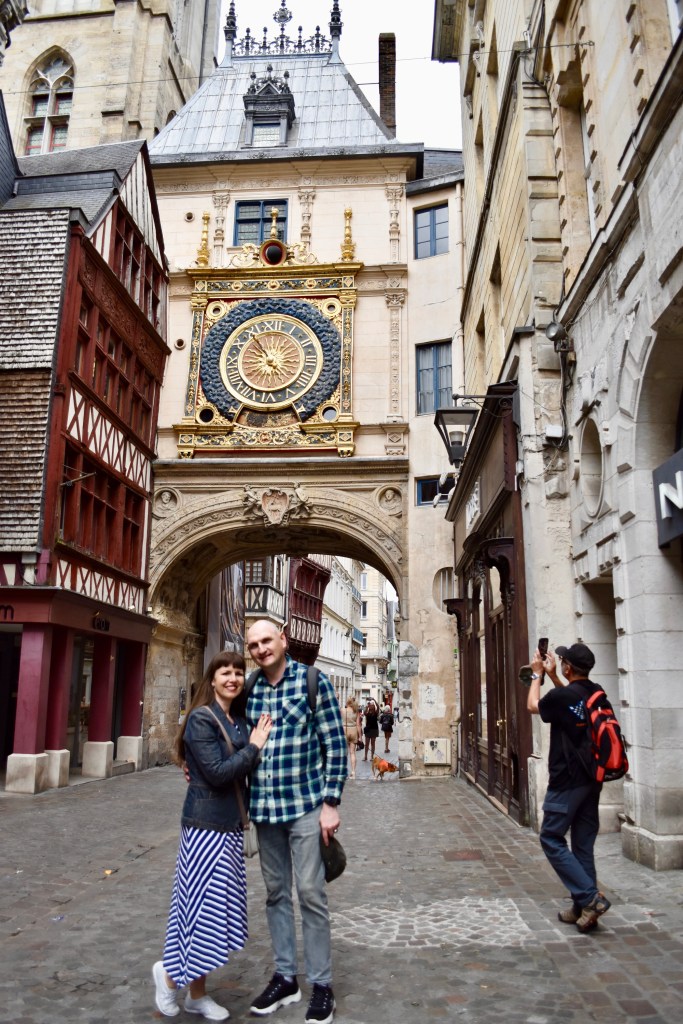
Yet, after running back and forth several times under the arch, on both facades of which a face of Le Gros Horloge is mounted, we couldn’t refrain from checking whether we were in luck. Much to our joy, the museum, located in the belfry, happened to be open.
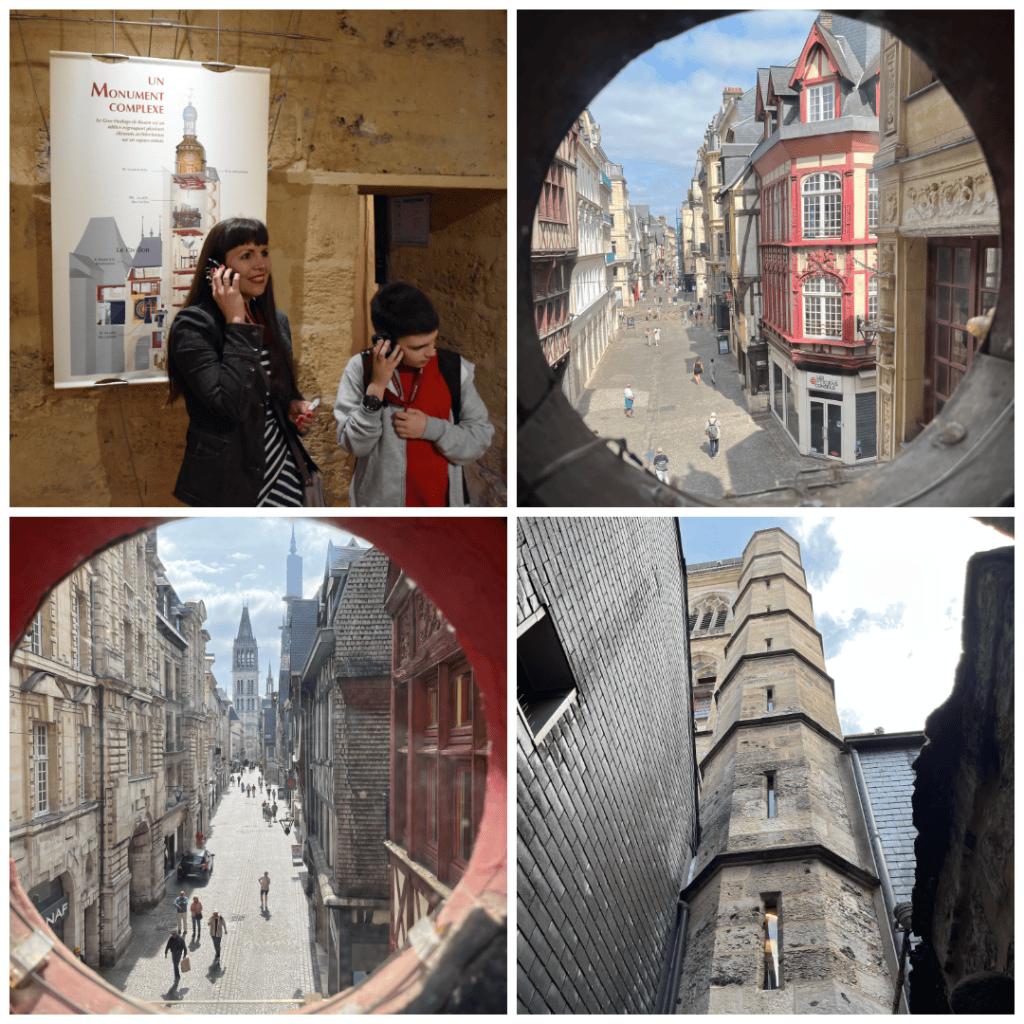
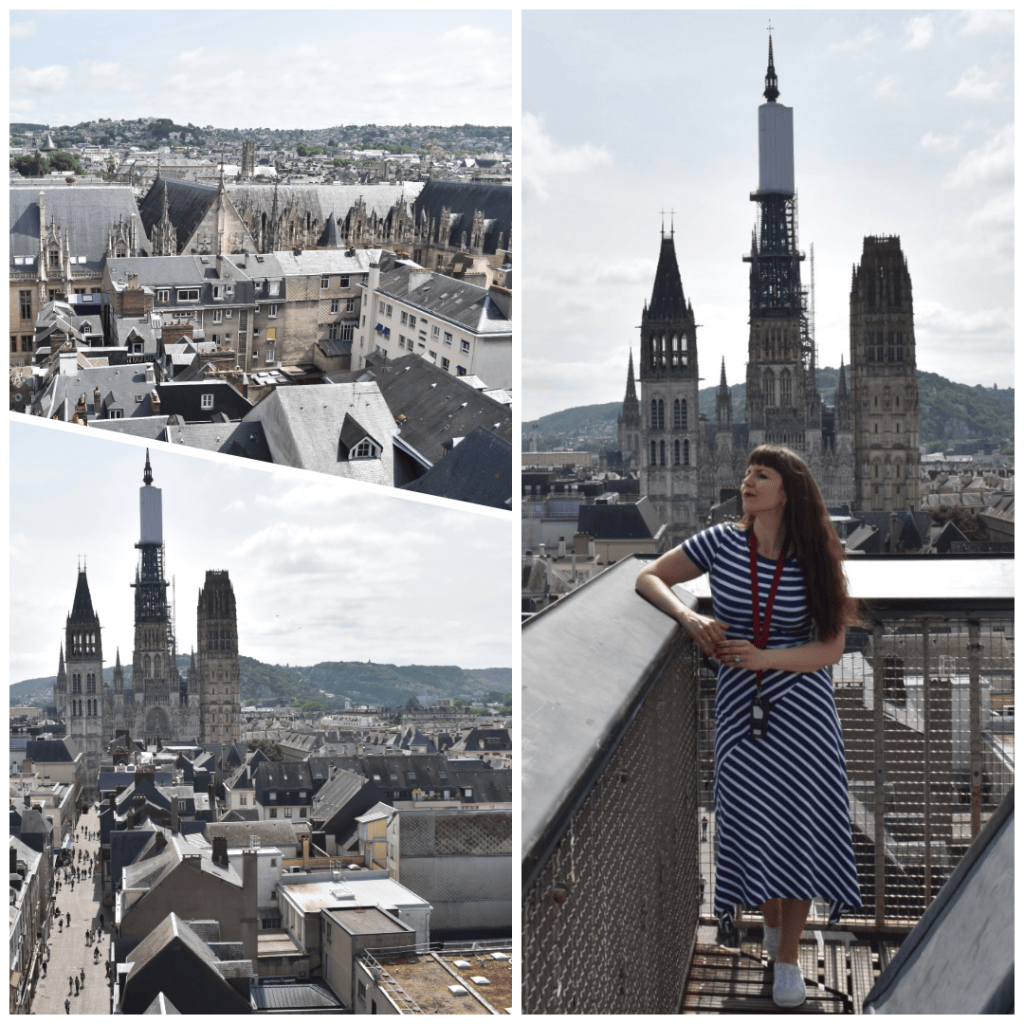
We went up and up, stopping at every floor to listen to the audioguide and admire the displays. The climb was arduous, with the stairs steep and narrow, but it was totally worth the effort. At the very top, a magnificent view over Rouen awaited us as a reward. True, the scaffolding spoils the overall impression of the magnificent Notre-Dame de Rouen a bit, but isn’t it always like this with iconic edifices? With age and prominence, the maintenance needs only grow.
The clock’s movement is cast in wrought iron. It surpasses the Wells Cathedral clock (can be viewed in the Science Museum in London), another notable specimen of the astronomical clock of the same era, being twice its size. Originally made in 1389, it is still in perfect working order! I had to pause to think it over.
True, back then, the clock had no dial. Its mechanism was used solely to ensure that the bells on the belfry ring at the right times. It was in the 16th century, when the arch was built, that the two elaborate dials were made, one to adorn each side of the arch. Those dials are about 2,5 meters in diameter, and are absolutely magnificent. Rich in detail and astronomical symbolism, they make Rouen’s visitors and, I believe, many a local, stop and stare. For example, a panel below the hour of VI reveals what day of the week it is by a symbol of a deity: Monday / the Moon or Diana, Tuesday / Mars, Wednesday / Mercury, Thursday / Jupiter, Friday / Venus, Saturday / Saturn, and Sunday / the Sun or Apollo.
Keeping up with the trends, the clock was electrified in 1928. But, as I mentioned earlier, the original mechanism is still functional.
The museum’s unique audioguide was our visit’s highlight. It is narrated by a ghost. And not merely some ghost, but the apparition of one of the clock keepers who used to occupy this very place centuries ago. I found this detail absolutely amazing. If there indeed is power in marketing, it is its brightest example. There are two versions of the audioguide, one suitable for children. My son listened to every ‘episode’ with keen interest, stopping my husband and me from moving to the next floor before he had finished. Having directed us to the next room, where we were to press the next button on the audioguide, our spectral narrator playfully informed us that he didn’t need to take the stairs, since he could float up through the ceiling instead.
People would have paid to visit the museum of the old clock anyway, if only to see the ancient mechanism and the view over the city. And yet, it didn’t stop those in charge of Le Gros Horloge from making it an experience to remember for its visitors.
Saint Catherine’s Hill
On our last day in Rouen, we planned to hike up Saint Catherine’s Hill first thing in the morning. The allure of the place wasn’t solely in the breathtaking view, but also in the fact that Claude Monet painted his “General View of Rouen” from this very spot. The painting is at the Museum of Fine Arts of Rouen, our next destination that day.
Well, the view was indeed lovely. But the route there wasn’t. Certainly, I felt upset because of the weather. It rained incessantly while we walked first through the city and then up the hill. The rain threatened to disrupt our plan. If we got too wet, we’d have to return to the hotel, change, and only then resume our excursion. Time is always limited when you travel. Before setting out, we bought cheap umbrellas in the shopping mall across the street from our hotel. By the way, cheap they might be, but they proved to be sturdy and reliable. I use them still.
The weather wasn’t the only reason for my frustration. The trail up the hill – 525 steps – was badly maintained. Metal bars stuck out of the ground in places. Stone blocks marking the steps, where there were such, were not in good condition. Mostly, it was a regular, well-trodden muddy path. The viewing platform was small. It must get crowded on a sunny day. The information board displaying the famous Monet painting looked shabby.
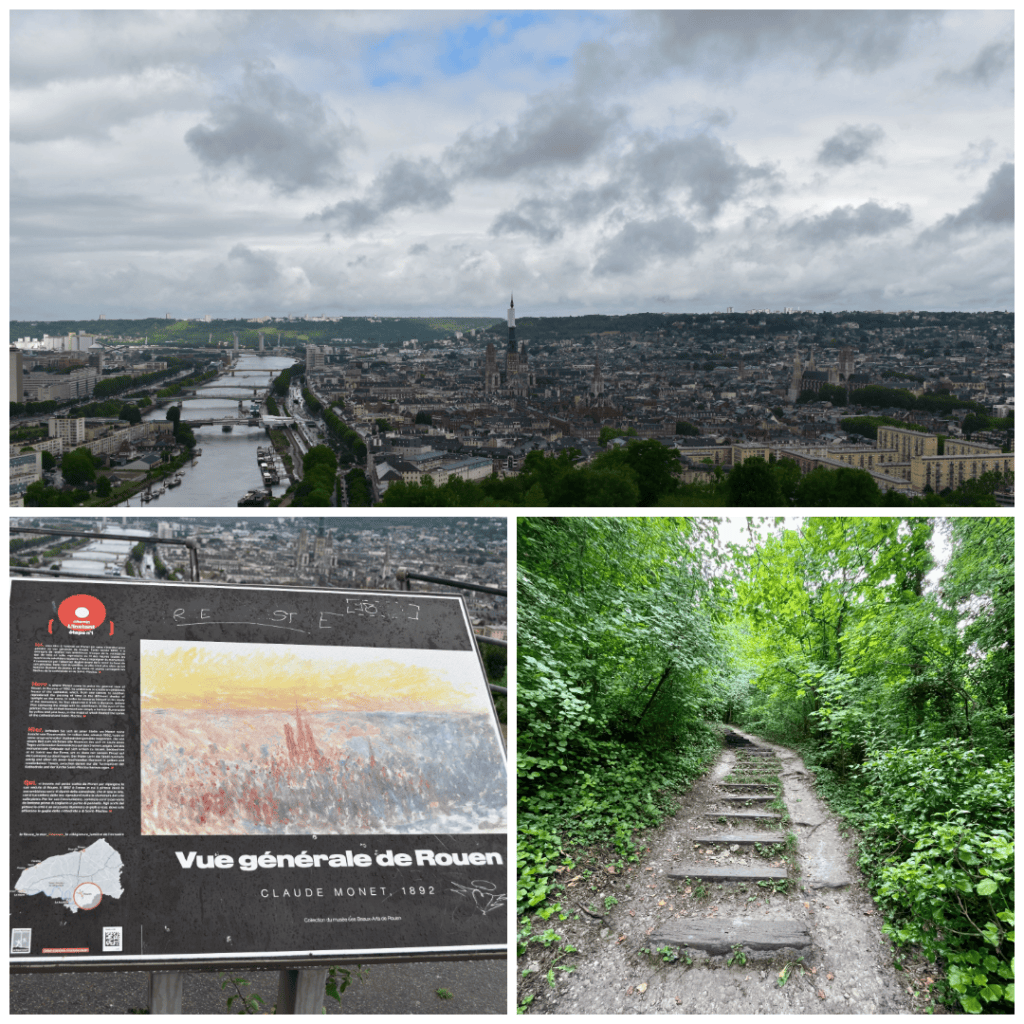
Despite my grumbling, my husband took out our camera and told me to take a picture of him and our son wearing his father’s wind jacket. He said that we’d laugh looking at it later, remembering the perilous journey up the hill in the rain. While we were at it, the weather took pity on us. The rain stopped.
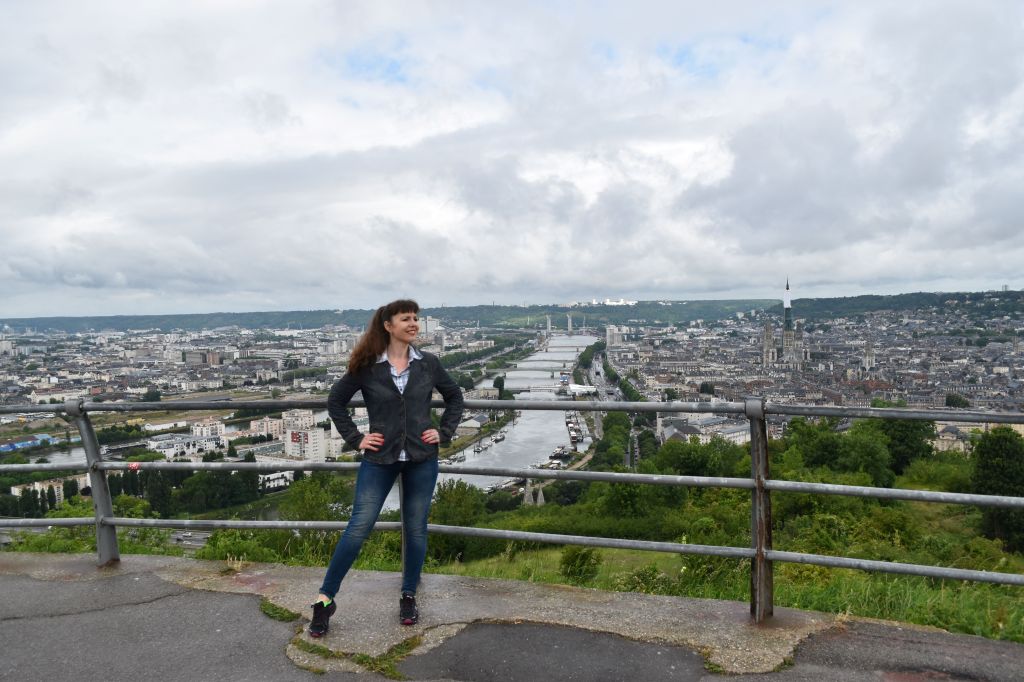
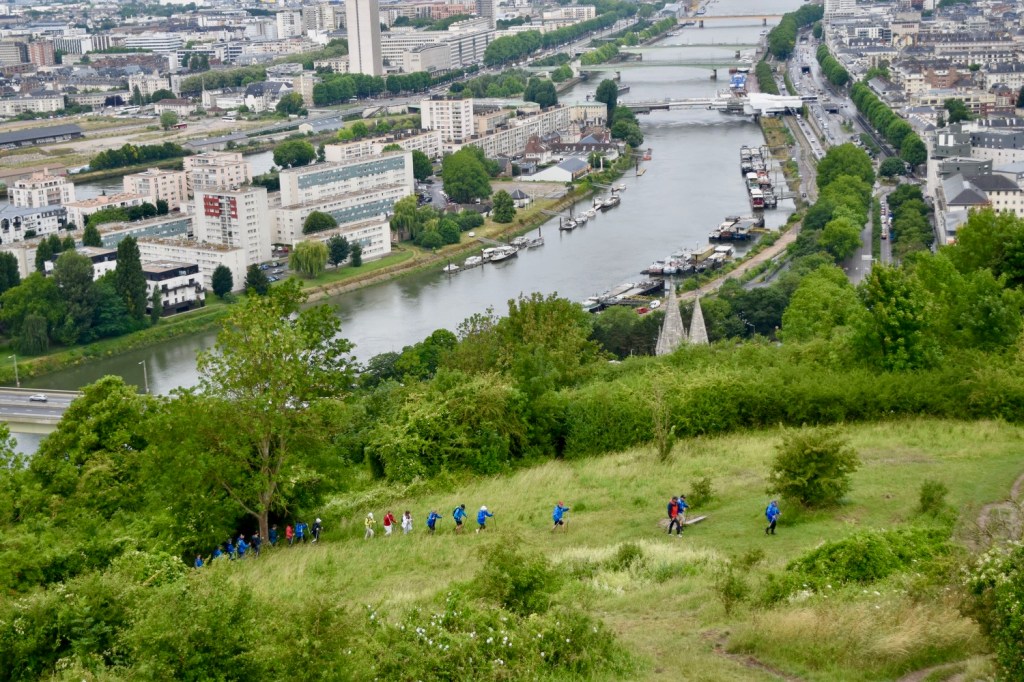
We didn’t have the place to ourselves for long. While taking pictures of each other and the view over the Seine – yes, it is the famous Seine, which is in Paris – and Rouen, we noticed that the slope, which had just been empty, suddenly filled with people. A group of people ascended the hill in single file. There were more than twenty of them. Once they reached the top and noticed us, there followed the usual exchange between those who recognise each other as belonging to the same tribe – in our case, tourists visiting France. They turned out to be from the UK, and my husband and I happily shared that we used to live just across the channel from Normandy, in Dorset. We said that we were heading to the coast tomorrow, and they said that their next destination was the coast too.
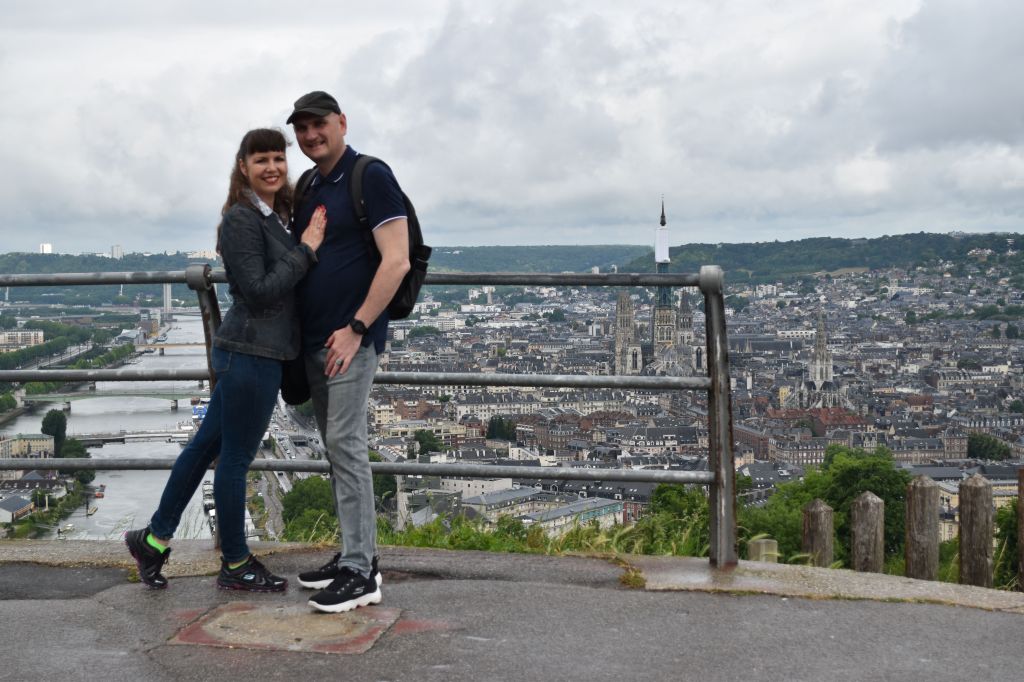
After the initial mishap, visiting Saint Catherine’s Hill panorama turned out to be a fun adventure. True, we didn’t manage to catch even a glimpse of the poetical inspiration Claude Monet must have felt while painting his masterpiece. And the sky didn’t clear up miraculously to astound us by its turquoise glory. Still, we did spend some time doing what we’d climbed here in the first place for – admired the view, without moisture pouring down on us. Rouen lay at our feet; we felt the warmth returning gradually to our limbs, and life was beautiful again. Besides, our next destination was the Museum of Fine Arts, the embodiment of inspiration. But before that, we planned to have lunch, and food is capable of more than magic when men and their moods are concerned.
Rouen Museum of Fine Arts
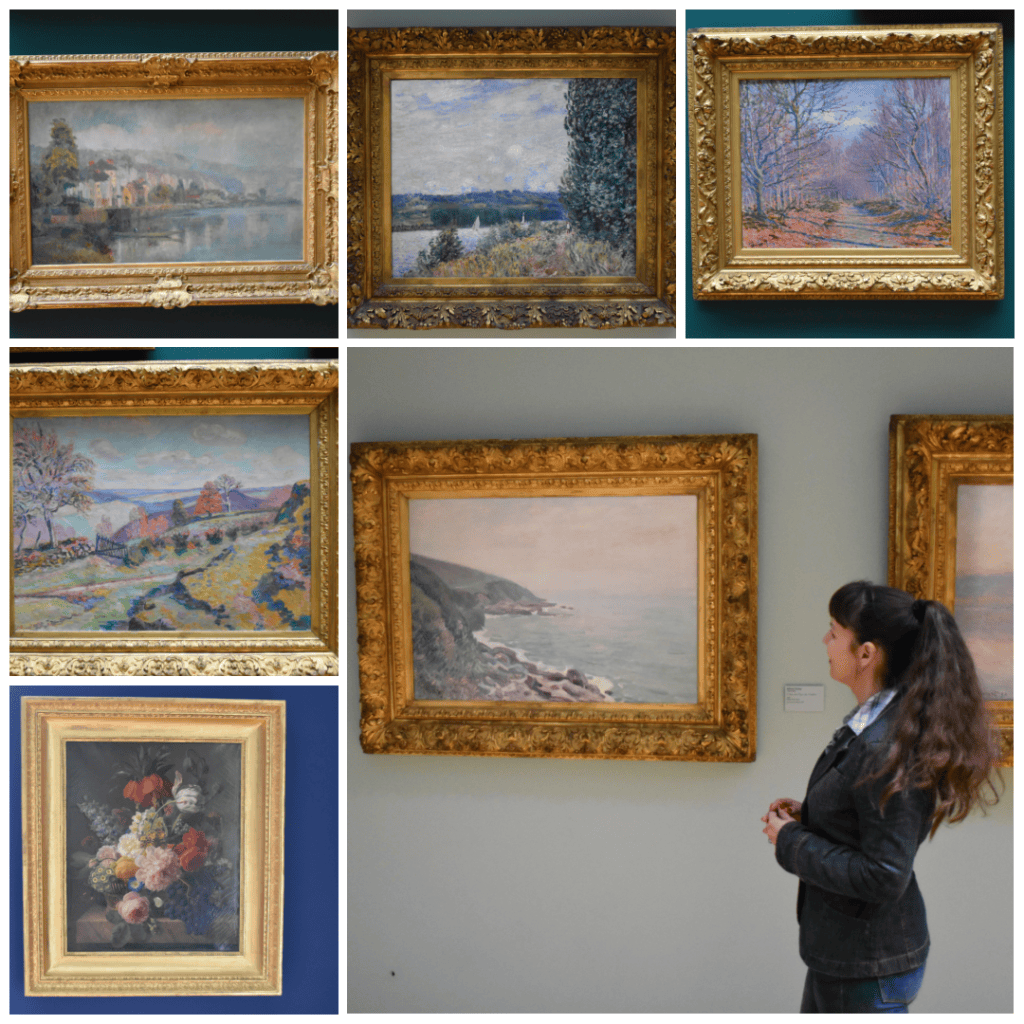
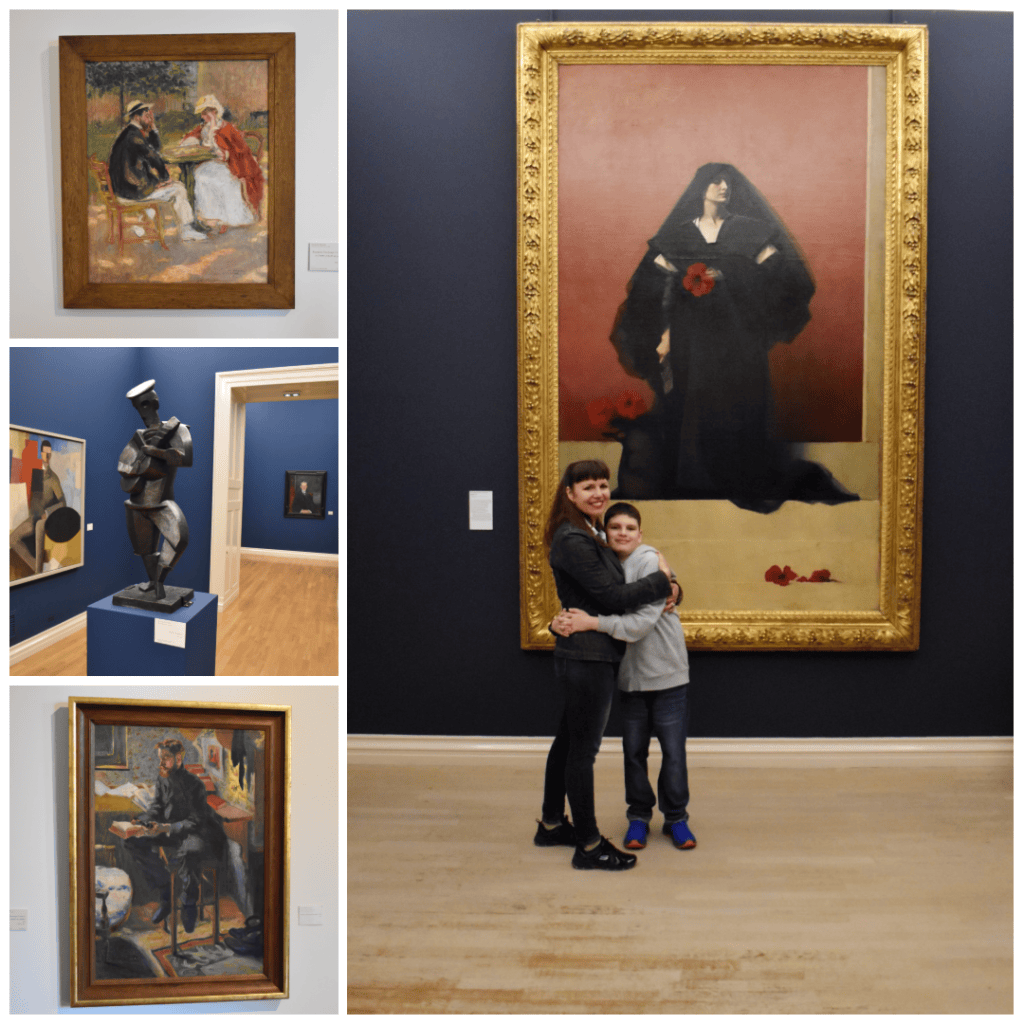
Rouen Museum of Fine Arts (Musée des Beaux-Arts de Rouen) houses one of the most outstanding public collections in France. Moreover, the biggest Impressionist collection outside Paris can also be found here.

Rouen Museum of Fine Arts was founded in 1801 by Napoleon Bonaparte. Its vast collection includes paintings, sculptures, drawings and objects of applied art, covering a time span ranging from the Renaissance to contemporary art.
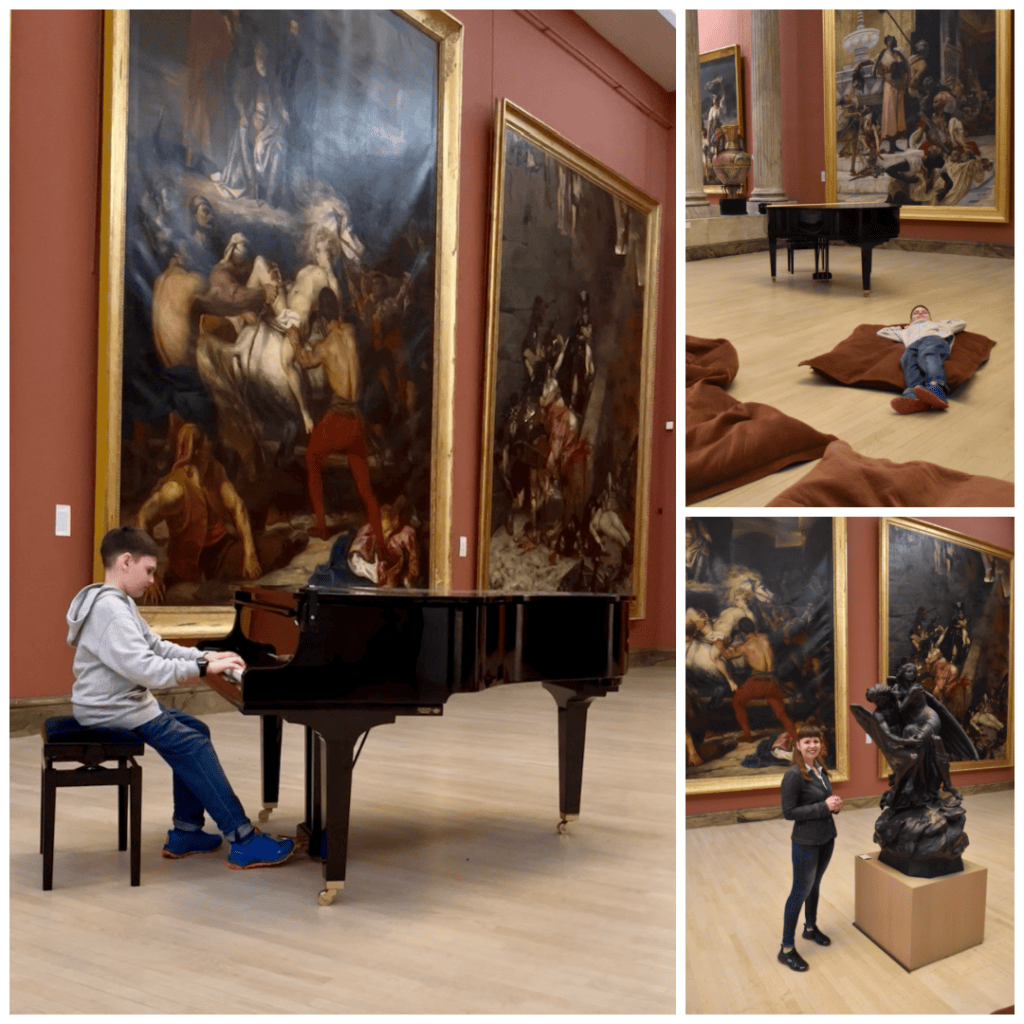
In one of the exhibition halls, we found the grand piano. Big cushions were placed next to it for the visitors’ comfort. My son made use of both. He even played the piano twice there, making us return to the hall where it stood after a tour around the museum. When we came to that hall the second time, an elderly tourist from Japan approached my son after he finished and very politely asked if he would play again so that he could film his performance. It was heartwarming how impressed the kind man was. When you are surrounded by kids who play, many of them better than my son, you forget how precious it is that he can play the instrument at all.
We would have gone there anyway, but it was still nice that visiting the Museum of Fine Arts in Rouen was absolutely free. Since most of us have to pay attention to our expenses when travelling, it is, I think, so important to know that some parts of your trip won’t cost you a thing. Especially if this is something so gratifying in many aspects as visiting an excellent museum.
After immersing ourselves in culture, history, and architecture in Rouen, we moved to our next destination – the Normandy coast – where we planned to enjoy more of nature.


Leave a comment