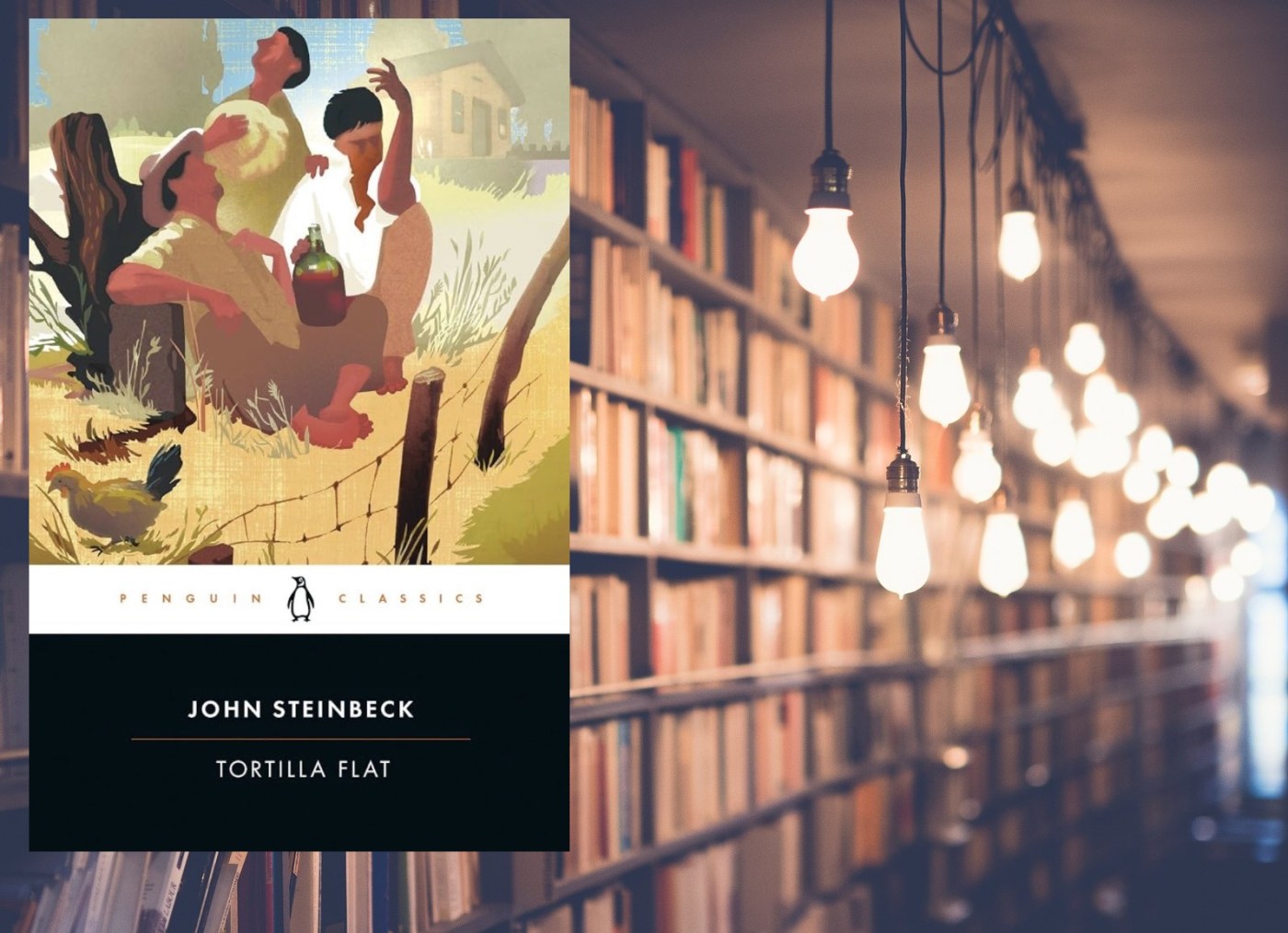
After reading “Tortilla Flat” by John Steinbeck for the first time a while ago, I was unsure of how I felt about it. I did not like the characters; that much I could say. My attitude towards people who choose life without obligations and, consequently, common comforts, is conflicted. The reason isn’t the lack of compassion or a steadfast belief that what one has is one’s fault. Life is too complicated for one-sided opinions. My uneasiness about the topic stems from my personal experience, which I won’t delve into in this review. Despite this, something in the cadence of Steinbeck’s prose, the flow of unconnected episodes designed to build a wholesome picture, the elusive depth of the story did not let me discard “Tortilla Flat” as a book I didn’t like.
Then, I decided to reread it. And this time, it all came together. I realised that the author did not tell us the story of paisanos, who don’t work and drink copious amounts of wine, most of which is stolen or given to them by those unwilling to argue. It isn’t a story about the group of men unfamiliar with the concept of responsibility. This is the story told through the perspective of these men, but it is about everyone.
This time, I noticed not only what the central group of characters did, but also how their actions influenced people around them. I noticed their honesty in some situations and their unquenchable zeal to help those in need whom they considered deserving of assistance.
This time, I noticed that the author doesn’t try to persuade the readers to see his characters in a better light. Steinbeck doesn’t romanticise the paisanos of Monterey. He simply tells us their story, in which they appear with all their flaws, just as they are. I’d say that Steinbeck very cleverly chose these characters to represent the knights of the Round Table from Arthurian legends. They indeed are rather close in essence to medieval warriors who, in reality, had chauvinistic views, drank a lot, and fought battles they considered just and profitable. Knights did not work in the regular sense of the word. Their main task was to protect their master and follow him into battle against those proclaimed to be the enemies. Danny and his friends bear a striking resemblance to these knights in that they spend their days idly but spring into action whenever an innocent requires help and injustice has been detected in the vicinity.
The author doesn’t provide us with an answer to the question of whether Danny and his friends are good or bad. This we have to decide for ourselves.


I really like the connection to medieval warriors, who were essentially not as glamorous as we would like to think!
Isn’t it interesting how the books we revisit come together in a new way! This time, you understand what he is sharing as a storyteller. When we enter the story as the author does, when we go beyond the expected conventions, we experience the story as literature.
LikeLiked by 1 person
I didn’t see that connection when I read the book the first time. Now, I see it clearly. And it is very cleverly done. Steinbeck is a genius. Sadly, nowadays fewer and fewer readers seek literature in their reads. What they crave is something predictable and with all edges smoothed.
LikeLiked by 1 person
That is so true. We are formula driven as a society, which is perhaps why we are so susceptible to AI. I felt as you did when I reread Robertson Davies’ The Rebel Angels. I went from thinking he was a literary snob to experiencing the depth of his wit, how he essentially mocks academic pretense.
LikeLiked by 1 person
I’ll have to read it. I wonder what my perception of this book would be.
LikeLiked by 1 person
I would be interested in hearing your views. I haven’t read it in close to fifty years. When I lived in Halifax, the central library was a fifteen minute walk away. Oh! The reading I did!
LikeLiked by 1 person
I’ll make a note to myself about this book, and when I read it, I’ll let you know.
LikeLiked by 1 person