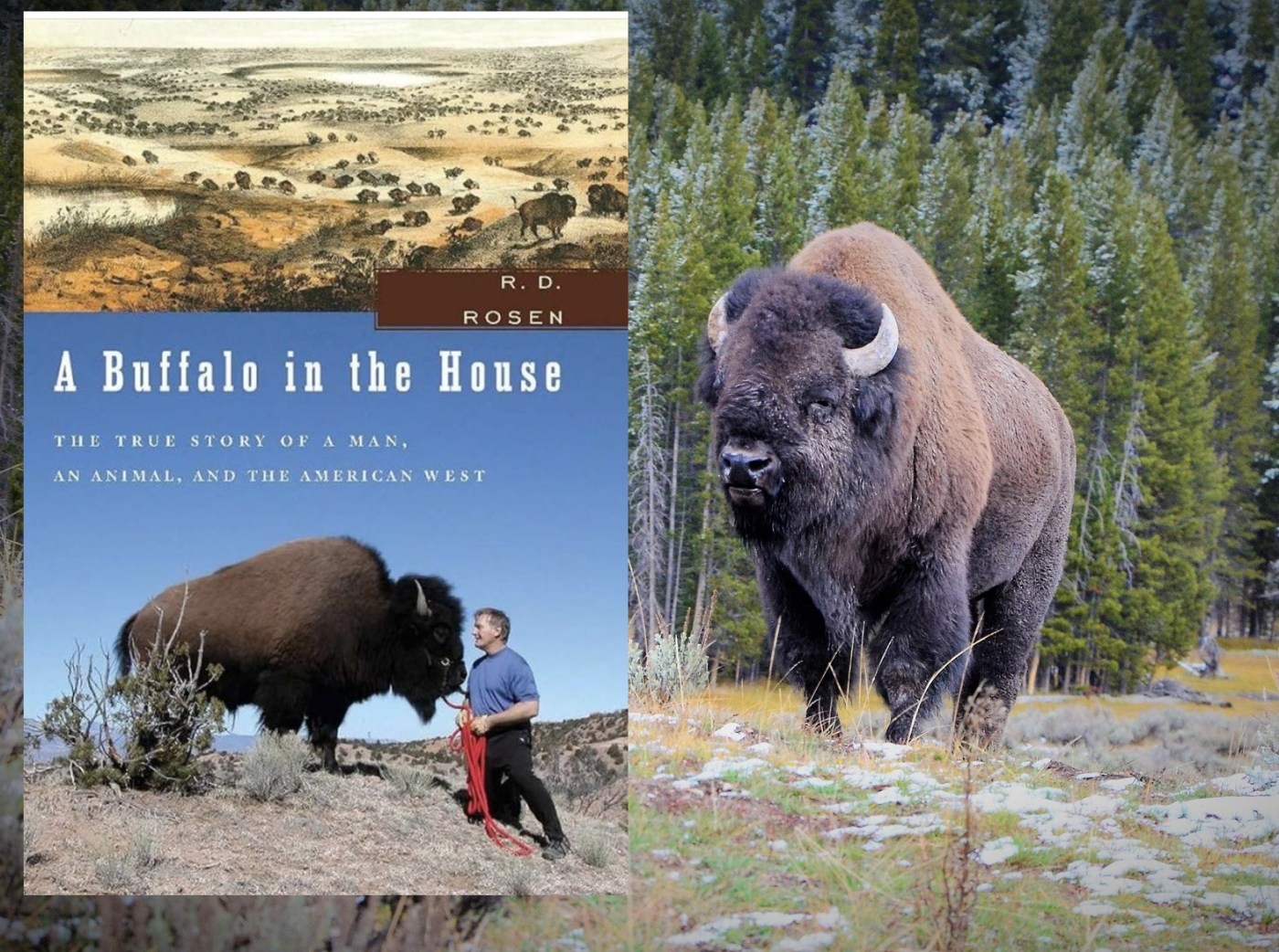
As someone who grew up surrounded by pets of all kinds, I couldn’t pass by a story of the most fascinating animal. Buffalo, to me, have always been an almost mythical species, and, to be honest, until I read this book, I’d been under the misconception that they were completely extinct.
“A Buffalo in the House: The True Story of a Man, an Animal, and the American West” by R.D. Rosen is a tribute to the most extraordinary friendship. Stories about people saving wild animals are not unusual, but in most cases, the saved predators and prey alike remain, well, wild. Once they recuperate enough, they choose to return to their natural habitat, often not giving their human saviour even a fleeting backwards glance. Charlie, the buffalo, was different. Not only did he oppose being relocated from a human home to the more appropriate accommodations when he predictably outgrew his welcome, but he even refused to accept that he was a buffalo.
Veryl Goodnight and Roger Brooks took Charlie to their house in Santa Fe, California, when the buffalo wasn’t even a week old. What had started as a creative project turned into a special relationship, the kind neither Veryl nor Roger anticipated when they approached the ranch owners with buffalo herds on the property about the possibility of taking on a baby buffalo. Soon, their request – or was it in fact prayers – was met. And with tiny Charlie becoming the first ever buffalo who flew on the plane, the unbelievable story about a companionship between a man and a bison began.
I enjoyed reading about Charlie’s interactions with people, especially with Roger, whom the buffalo obviously saw as a parental figure of sorts. I’ve lived with quite a number of pets since I was a child, and I can say that an animal’s species doesn’t guarantee a specific behavioural pattern. I’ve seen dogs who weren’t sociable or loyal, and I’ve experienced the deepest devotion from cats. Thus, while it did surprise me – I found it astonishing really – that a buffalo treated its human ‘parents’ the way it would be expected from a dog, I had no doubts that it was true.
I also appreciated the author mentioning that Roger didn’t forget that Charlie was a wild animal. My aunt taught me from an early age that even domesticated cats and dogs remain animals, and in case of danger or fright, their instincts inevitably kick in. And that it was vital to keep in mind that in such moments, your most loving pet can hurt you. She also taught me that we are responsible for the animals that we take in. They didn’t ask for it, she said, we chose to do it, and since we did, we are responsible for them. That animals live with us in our homes doesn’t turn them into people. Yet, as people ourselves, with values supposedly different from those of the wild, we must treat our four-legged or winged companions with respect and care.
The only thing that smudged the overall impression for me was the lengthy detours from Charlie’s story into the history of American bison. I am always interested in learning more about the subject, and here I don’t want to state that the knowledge about how the man had almost erased buffalo from the face of the American continent is unnecessary. Quite the contrary, it was educational and relevant, as was the information about the abysmal treatment of buffalo in Montana, where the remnants of the buffalo population can be met in the wild. It’s just that it felt like too much information, presented in a manner as if intended for those who have the authority to change something to improve the life of the American buffalo. Since I – and I believe it’s a safe guess that most of the readers of this book – am not that kind of audience, the narrative was a bit too heavy to absorb.
It would have worked better for me if the historical and other references to the buffalo situation in general were placed at the end of the book. Charlie’s story is so powerful that, in my opinion, it deserves to be told and read uninterrupted.


I agree with you regarding organization. Although the historical information is very important, and perhaps the goal was to intensify reader feelings for the loss by setting it among personal details, I too would prefer to study such information at my leisure in appendices.
LikeLiked by 1 person
The thing is that the historical references were relevant and I was interested in learning more about the subject. But those chapters were simply too lengthy. They dragged and dragged, making the point that had already been made, and in the end, it distracted me from the main – absolutely wonderful and unique – story.
LikeLike