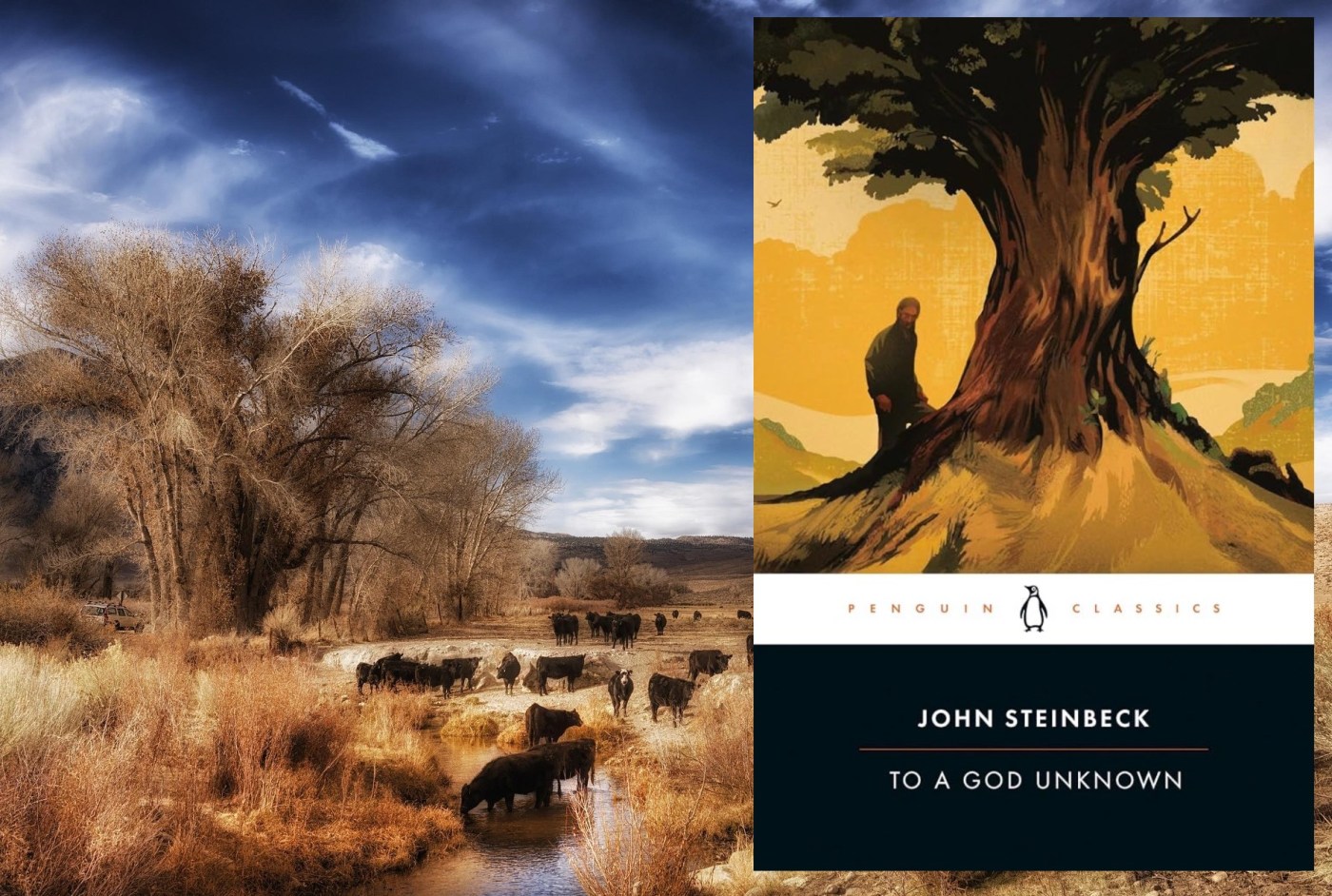
Some people have a special connection with the sea. Some feel the irresistible pull of the sky. But the closest element to human nature is probably the land, and thus the connection some people have with it is the strongest. While the theme of the magnetism of land is central in his novel ‘To a God Unknown’, John Steinbeck touches upon other things that serve as kindling for human souls. Among them are religion and understanding animals.
Joseph Wayne loves being a rancher. He doesn’t dream about leaving the hard physical work behind and starting over in town. But he doesn’t want to spend any more years working on the land that doesn’t belong to him. True, the ranch he lives on is his father’s, and someday, a part of it will be his. Still, for Joseph, it isn’t enough. He wants to be a master of his own land. Grasping the opportunities offered by times and the American government, he leaves familiar Vermont for bountiful California. What he finds there first surpasses all his expectations and then, asks for the sacrifice only a man completely devoted to his land can consider making.
The mystical component of the novel intrigued me. Mostly because I didn’t find it all that fantastical. I’ve seen people with a similar connection to the land as Joseph Wayne. Not only did they love digging, planting, and harvesting, the soil itself seemed to have given them more than it gave other people. Exotic fruit trees bore fruit where they shouldn’t have even sprouted. Harvests of vegetables and apples were twice as plentiful as in the neighbouring gardens, even in the poor harvest years. I’ve always believed that the land actually feels it when the hands that tend it belong to someone who respects and loves it.
As always, Steinbeck draws his characters with piercing, often uncomfortable realism. The people in his books are relatable, despite the time gap between our generations. To me, this is a sign of a genius. When readers feel the hardships and the joys of the fictional characters as their own, this is talent. When readers can step into the shoes of those living fictional lives more than a century ago, this is genius.
The beauty of Steinbeck’s books is not only in his deep understanding of human nature, but also in his objectivity. He never leans strictly towards condemnation or praise. He lets the reader decide what prevails. Personally, I often find that life prefers a mix, not only of the two but with multiple other components thrown in. Moreover, Steinbeck’s prose is a treat to those readers who find themselves attuned to its unique cadence. His every book is a treat, always bittersweet.


I enjoy John Steinbeck’s books. They’re about poor White Americans (many of them were written during and with the setting of the Great Depression) and the many struggles they were dealing with on a daily basis.
LikeLiked by 1 person
I like his books for their realistic portrayal of human nature. History settings I find fascinating too. There is a rare quality to John Steinbeck’s books, which I admire: his stories are piercingly honest and his characters are real. Not all of them are likeable. Some of them are hideous. Just like in real life with real people. The author didn’t shy away from controversial and difficult topics.
LikeLike
That is what I love about his books– we are presented with realities of life in rich prose, but always, the lessons are suggested. We have to think, to feel, integrating with the story.
LikeLiked by 1 person
The kind of literature to be treasured by generations.
LikeLike