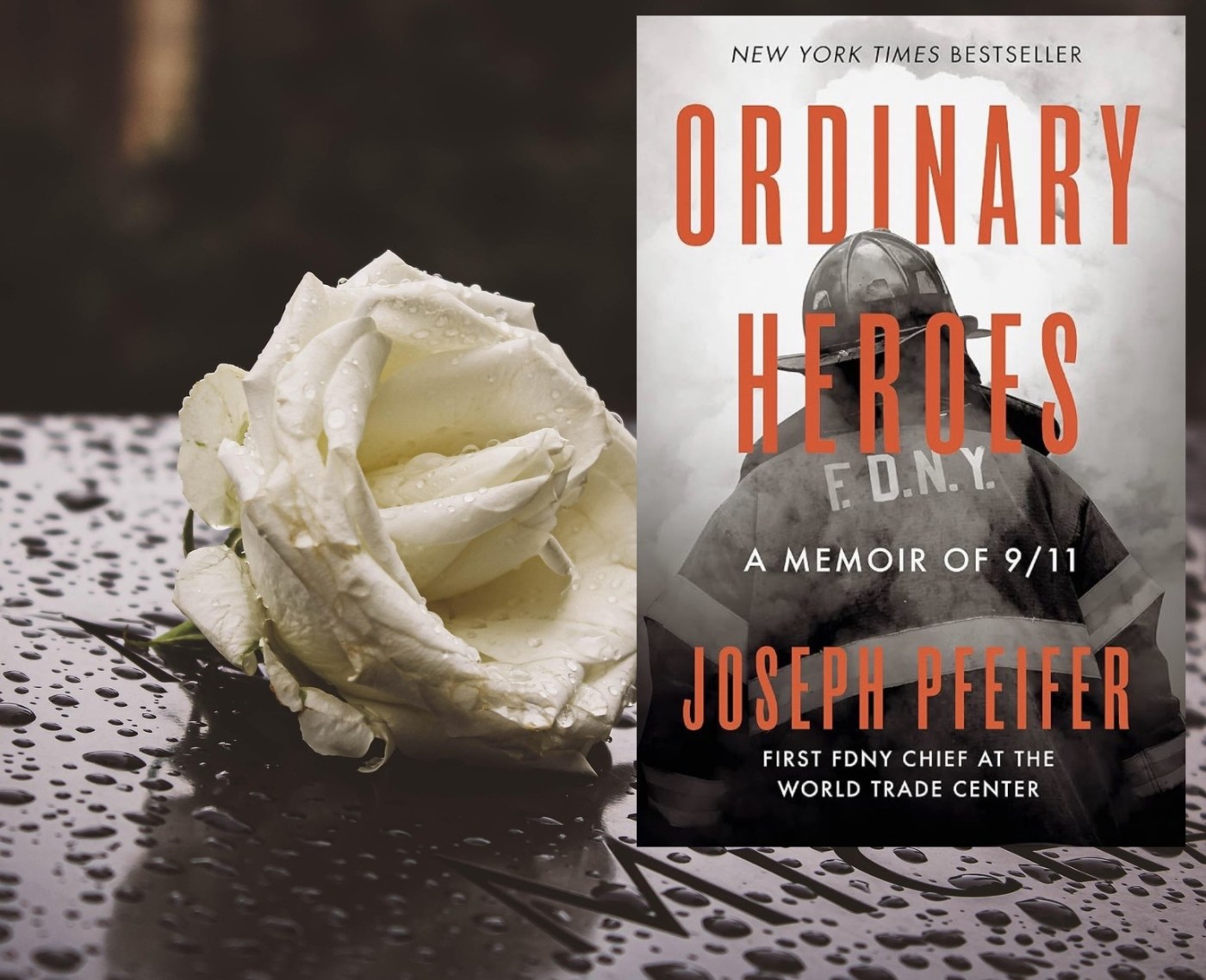
This book has moved me deeply. Not a storyteller by profession, the author has a gift for letting you into his thoughts and allowing you to see what he has seen through his eyes.
Reading “Ordinary Heroes: A Memoir of 9/11” by Joseph Pfeifer transported me right into the middle of chaos, devastation and horror. It held me there, minute after minute, all one hundred and two minutes, while no one realised what was really going on. Reading it held me in the ‘Pile’ where thousands of people first desperately tried to find someone still alive and then, dug through multiple floors of crushed cement and metal to recover bodies – for almost nine arduous months.
This is an exceptionally powerful memoir. And not only because of its theme, but largely because of the voice that has shared it.
Joseph Pfeifer’s writing voice is clear, confident, and filled with compassion. He isn’t after sensation. He isn’t burning with the desire to shock readers. After reading his book, I feel I’ve come to know the man as much as I’ve come to know about the event.
In September 2001, Joseph Pfeifer was forty-five and eligible for retirement. Chief of Battalion 1 of the New York Fire Department, responsible for the southern tip of Manhattan, Joseph Pfeifer loved his job and did not consider leaving it so early. Little did he know, on that clear morning of September 11, that he was about to come the closest to the end – of his career and also his life – as ever before.
For the Chief of Battalion 1, the area of responsibility included the World Trade Center. Firefighters were frequent visitors to the huge complex that consisted of more buildings than two 110-floor towers. Sometimes, during a shift, they were called on one emergency or other several times a day.
Joseph Pfeifer saw the plane about to hit the North Tower even before the collision. He had heard it before she had seen it. The sound of an airplane engine isn’t a usual sound in Manhattan.
Responding to the call about ‘possible odor of gas,’ Chief Pfeifer and his team were only a few blocks from the World Trade Center, some of the closest firefighters to the towers. Immediately rushing to the surreal scene, with black smoke billowing from the upper floors of the familiar skyscraper, he was the first to arrive and the first to take command of fighting the biggest fire of his career – which, as we all know, turned into an unimaginable, full-scale disaster.
Even though a detailed account of events that immediately preceded and followed the collapse of the World Trade Center is central to the book, it offers so much more than that. The author invites us behind the closed doors of the world of New York firefighters. With love and pride, he describes the life of a firehouse, with its traditions and a sense of belonging shared by everyone. Having read that, I was able to understand better the depth of loss that firefighters went through after they’d lost so many of their colleagues. Having lost hundreds, many of whom were their friends and family members, the firefighters of New York attended a funeral after funeral, a service after service – too many bodies weren’t recovered – for a year. I can only imagine what pressure these people were under, considering that, along with grief, they had to keep fighting fires and accidents, as well as working on the site of the tragedy.
Joseph Pfeifer answers the question ‘How were they able to endure this?’ with these words: “Even when our whole world is on fire, we have each other.” The people who were thrown into the epicentre of horror had each other. It was that special connection that exists between the firefighters that helped them. Without a doubt, not everyone could cope with something so beyond anything even the most experienced first responders had dealt with in their careers. Some quit, gave up, crumbled emotionally and physically. Still, many more endured. And together, they reached the bottom of the ‘Pit’ – which wasn’t the ‘Pile’ anymore – and ensured closure. For their fallen colleagues, their families, and also for themselves. For I think that they would not be able to resume living a regular life without knowing that they’ve done absolutely everything they could.
The scene with an empty stretcher, symbolising all the victims whose bodies weren’t recovered, being taken from the bottom of the ‘Pit’ and into an ambulance moved me to tears. Some might say that it was useless, just a theatrical gesture. But it wasn’t. Everyone who had worked long hours, without hope of finding anyone alive but with the determination to close this chapter so that a new one could begin, needed that gesture. A catharsis of sorts.
“In extraordinary times in history, people do ordinary things when it counts the most.” This is another quote I’d stored to keep. It is heartwarming to realise that when it does count the most, there are people who don’t run away but keep doing what they are best at. And by that, they make a difference. They make this world a better place.
I admire Joseph Pfeifer for not falling into the trap of hatred. It is easy to hate, for when you are consumed by hate, you don’t have to think or do anything to change the situation. The author chose a different path. There are a lot of things he could have felt angry about. And I’m sure that he did at some point. But he shifted his focus from the negative to searching for solutions. It takes great courage and steely determination. Also, I felt personally grateful to the author for not labelling everyone belonging to a certain group, to which the terrorists belonged. That is another thing that is easy, but it’s never just and is always harmful to countless innocent people. Reading one particular chapter, I saw my aunt standing next to me in front of the tv on September 11, 2001. She was praying as she always did at times of great stress or joy. She was the kindest person I’d ever known. For those she loved she was ready to sacrifice her own comfort and interests. It breaks my heart that after 9/11, if someone heard the words of her prayer, people would look at her through the lens of hatred. Yet, my faith that goodness will ultimately prevail soared after reading Joseph Pfeifer’s memoir.
Halfway through the book, I watched the ‘9/11’ documentary filmed by the Naudet brothers. Jules and Gédéon Naudet are the filmmakers who, in the summer of 2001, were living in the Duane Street firehouse to film a young man on probation to become a firefighter. Instead, they ended up making a unique film that made an impact worldwide. I had no time to watch the film in full, but I’ll definitely do that. After watching, the lines in the book had faces and voices and pictures behind them.
Joseph Pfeifer, in “Ordinary Heroes: A Memoir of 9/11”, does not shy away from the bad, the unjust, and the horrifying. At the same time, he doesn’t ignore or mar the good either. Life is full of colours, vivid and pale, and all of them are integral to its intricate tapestry.


This sounds like a valuable read.
LikeLiked by 1 person
It is indeed a profound read. It helps not only to understand but really feel the impact of the tragedy.
LikeLike
And that is so important. Lip service is not empathy
LikeLiked by 1 person
Exactly. The author went through the unimaginable but he remained objective about the tragedy. Not indifferent, far from it, but not hysterical and consumed by accusations and hatred as it happens too often.
LikeLiked by 1 person