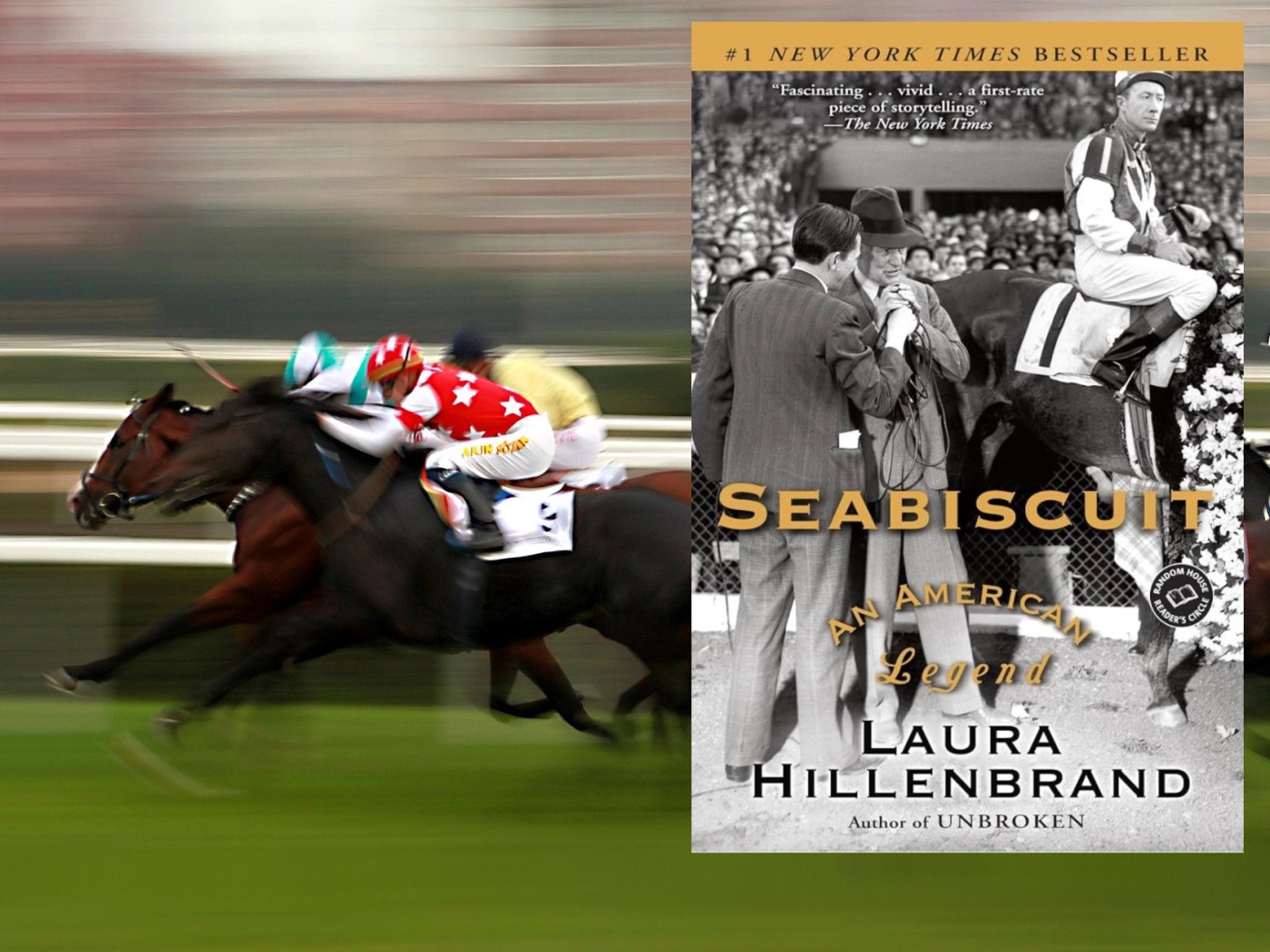
What a book! I honestly can’t remember a book, fiction or non-fiction, that impacted me as strongly as this one. When I was reading about the preparations for each race, my heart hammered in my chest like mad, as if it was I who was about to ride towards win or loss or if it was my money or reputation that was at stake. And that, considering that I’m as far removed from what one might call a gambling person as possible.
“Seabiscuit: An American Legend” by Laura Hillenbrand is so much more than a story about a champion. It is more than a story about the horse who won races or the men who owned him, trained him, or rode him to victory. It is – and there isn’t an ounce of pathos in this word – a legend. A true legend of modern times. One that shouldn’t, mustn’t be forgotten. And I applaud the author for recognising this story’s worth and doing a fantastic job of putting it down on paper.
What kind of nonsense is this, you might ask condescendingly. About any other issue, I might agree. I do tend to overdo it with enthusiasm when it comes to something I sincerely like. But this time, I don’t overdo it; if anything, I play down my raptures. Read this: “In 1938, near the end of a decade of monumental turmoil, the year’s number-one newsmaker was not Franklin Delano Roosevelt, Hitler, or Mussolini. It wasn’t Pope Pius XI, nor was it Lou Gehrig, Howard Hughes, or Clark Gable. The subject of the most newspaper column inches in 1938 wasn’t even a person. It was an undersized, crooked-legged racehorse named Seabiscuit.” Shivers are running up and down my spine again when I’m typing this. Now, tell me that Seabiscuit doesn’t deserve to be called a legend.
Besides being a mind-blowingly uplifting story with a fairy-tale quality – think Brothers Grimm type rather than Disney – this book is a most detailed account of the ‘behind the scenes’ of the horse racing world of the twentieth century’s 30s. When reviewing non-fiction books, I often mention the overwhelming abundance of details that authors pour onto the pages, striving, I’m sure, to make the book as good as they possibly can. Research, after all, is a bigger part of a non-fiction writer than actual writing. It is understandable that authors don’t want to let their hard work ‘spill’ through the cracks of editing. But for the reader, it means more effort to be put into what many of us view as entertainment. While I appreciate details and the results of meticulous research that help me create a fuller picture about the book subject, I too at times become fatigued by too much information I have to absorb.
It was the opposite with “Seabiscuit.” I couldn’t get enough of everything it had to offer. The backstories of the people who had made a staggering success out of an ‘undersized, crooked-legged racehorse.’ The rules and politics of the horse racing world. Learning about the techniques jockeys used to lose weight to meet the race requirements was eye-opening. Inhuman and unattainable, which led to horse owners using boys as jockeys, since a rare grown-up male could weigh as a wraith, those requirements were not disputed. Instead, jockeys sought new and dangerous ways to get rid of not-excessive pounds, risking their health and even lives. Stories about what these men put themselves through are as harrowing as they are completely mesmerising.
Horse racing in the 30s was a terrifyingly traumatising sport. Reading just how dangerous it was made my hair stand on end. From a modern person’s perspective, it might seem incomprehensible why jockeys chose this career at all. I admit that not once did I find myself shaking my head incredulously, wondering why they did it. But then, I remembered what marked the decade of Seabiscuit’s triumph. The Great Depression stripped millions of chances to earn their living. To have a job, any job, became a blessing, and if a man got one, he didn’t question its requirements. For jockeys, the options were simple. Most of them underage boys by today’s standards, would have run around homeless, jobless, and hungry, stealing food if they were lucky, or been killed in a criminal skirmish if they were not, had they not ended up on the racetrack. But there is more to that.
“…maybe it was better to break a man’s leg than his heart.” These words, spoken by David Alexander, a columnist and a friend of Seabiscuit’s jockey Red Pollard, settled the heated debate I’d been having in my head while reading about the unbelievable numbers of crippled, maimed, traumatised, and killed jockeys. Horses are a part of those people’s hearts who ride them. How safe or unsafe riding is doesn’t matter. The connection once felt and established between a man and a horse never gets broken. Even if a few bones in a human body do.
When the story reached its peak, I wasn’t reading. I was there, at the Santa Anita Park in California, back in 1940, when Seabiscuit, seven years old, older than most racehorses to run, not to mention to win, a first-class race, won the Santa Anita Handicap. Setting a track record for that time. With the jockey on his back who shouldn’t have recovered from the injuries sufficiently to return to racing.
“The world narrowed to a man and his horse, running.” I wasn’t reading these words; I was feeling them. Feeling them with my skin, as I felt the horse’s muscles moving underneath the saddle, and the horse and myself becoming one.
Some time has passed since I finished the book, but whenever I think about it, all the emotions that I felt while reading rise in a pulsating hurricane inside me. It is an incredibly powerful story, a sensation no doubt, but of an incomparably more potent quality than what we are used to calling by this word these days.
Again, one might say that I’m exaggerating, but I believe that in some subtly magical way, Seabiscuit had helped to bring nearer the end of the Great Depression. The emotions he evoked in people were so powerful that they overrode the sadness and despair, bringing to the forefront hope instead. And hope, in the real world, is the equivalent of magic.


Thank you for paying tribute to this great horse and the era he represented. He was legendary. In the fifties, he was still a household word.
Yet the racing world was indeed a dark and often cruel place, and this book seems to be very informative, but in a highly readable way.
LikeLiked by 1 person
Thank you for reading my review and leaving feedback, Anne. It means a lot and keeps me motivated to share my impressions. You know from my reviews that I am not always appreciative of long detours into the generalities surrounding the object of a biography. But this book is indeed an exception. Reading about the world of horse racing of the 30s was as exciting as about Seabiscuit himself.
LikeLiked by 1 person