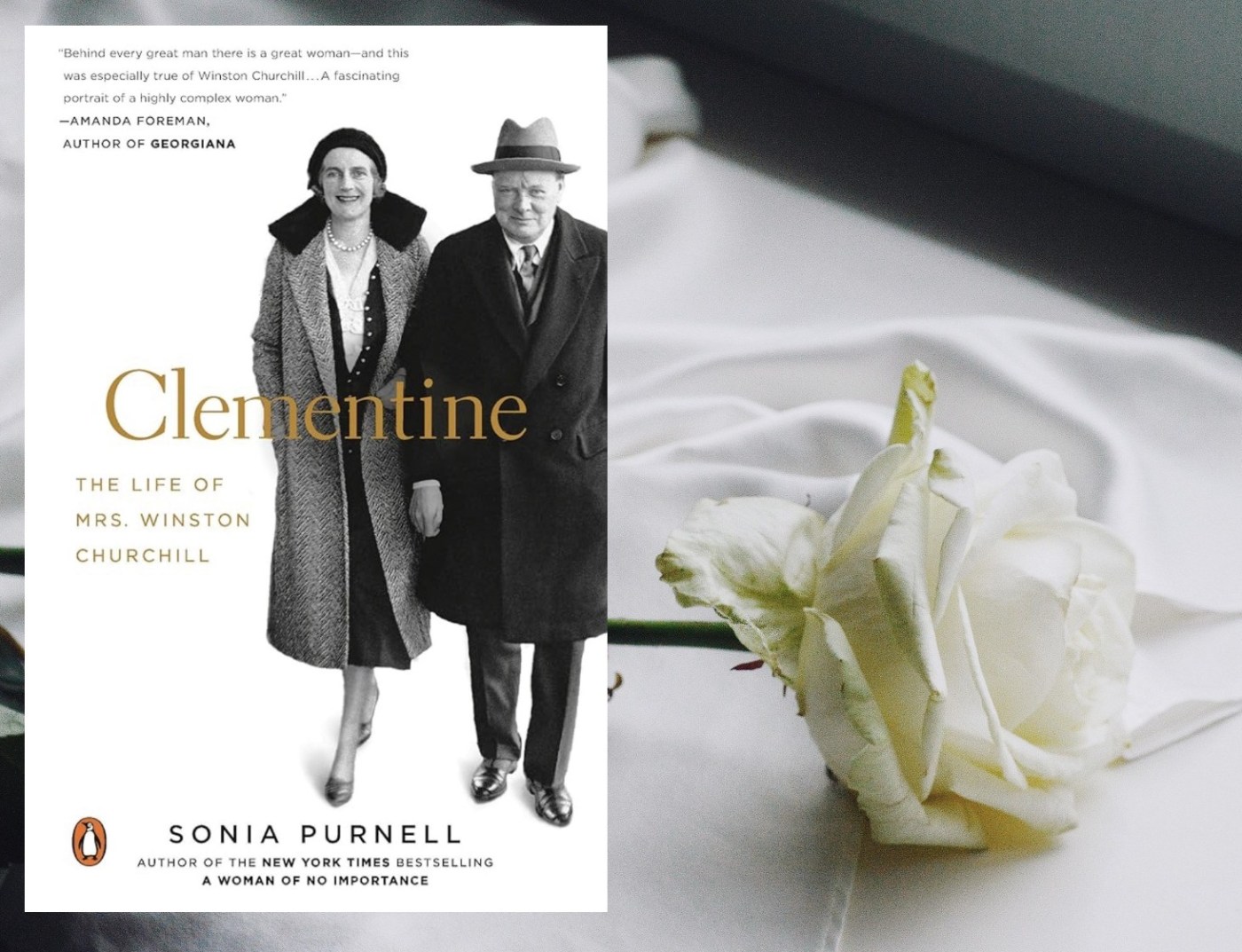
What a remarkable lady was Clementine Churchill! Here, I guess I am supposed to add ‘and not because she was married to Winston Churchill.’ But, even risking causing the wrath of strong and independent women of today, I won’t do that. Clementine Churchill was resourceful, intelligent, and had an array of subtle talents, all of which she got a chance to put into practice by marrying a man who had a great political ambition and the opportunities to fulfil it.
“Clementine: The Life of Mrs. Winston Churchill” by Sonia Purnell is a meticulously researched work, drawing a portrait of a woman who had remained in the shadow of her famous husband while playing a significant role in his success.
The author doesn’t skip the heroine’s childhood and the time before she met the future prime minister. The book provides an adequate insight into Clementine’s family and formative years. Still, it is only when she becomes Mrs Churchill that the narrative becomes really dense.
Sometimes, the thoroughness with which a biographer treats their object is tiresome. Insignificant details pile up without adding anything crucial to the person’s character or story. It wasn’t the case with this book. The detailed description of Clementine’s life, year after year, made me feel as if I lived that life with her, an almost surreal impression. I felt a deep sadness when that unusual and vivid life was nearing its end, and I was profoundly affected by reading about Winston Churchill’s passing and the effect it had on his wife.
The Churchills were extraordinarily fitting as husband and wife. Throughout the book, the author repeatedly stressed that what Clementine Churchill achieved, including a tremendous war effort during both World Wars, was not enough. Due to the restrictions imposed on women by the times, she could be just that – a wife of an important man. Were the circumstances different, had she been born a century later, she could have done so much more. I must confess, again, at the risk of being accused of the lack of female solidarity, I disagree with this assessment. From the book, I got the impression that the Churchills had an almost perfect symbiosis in their relationship. One wouldn’t have achieved what each achieved without the other. I don’t see how, separately, Clementine would have been more successful in any of her endeavours, including a possible political career, if she indeed had been born in the modern age when all paths are open to anybody irrespective of gender, etc. (which isn’t true, but this isn’t a subject to delve into in a review).
The author states that Clementine dedicated her life to her husband. I didn’t see it this way. Winston Churchill accepted her ‘quirks’, if you will, just like she reconciled with his habits. True, she threw herself into his election campaigns, before the press, and into supporting activities when he held high positions in several offices, including the highest, as a prime minister. But because of the strain it put her under, she regularly travelled without him, staying away for months at a time.
I find that very often, a crucial component of marriage is overlooked nowadays. While stressing the equality of both partners, people seem to forget the essence of partnership. It is the exchange of equally important values, which, due to the complicated nature of relationships between human beings, cannot be completely uniform. The dynamics of relationships simply cannot be as straightforward as in business deals.
It seemed somewhat amusing that, while lamenting the ‘men’s world’ that didn’t let Clementine show all her worth as a working woman, the author repeatedly stressed her deficiencies as a mother. I realise that it wasn’t meant this way, but I had a feeling that I was being manoeuvred into the opinion that, since the woman had no chance to build a brilliant independent career, she had no right to help her husband in building his.
Despite the incongruity between the opinion the author strived to convey and the one I formed after reading, I truly enjoyed the book. Clementine Churchill might not have been perfect, but no one is and should not be expected to be such. In many ways, she lived her life the way she wanted. And largely, the reason why it was possible was that she had chosen whom to marry wisely.


Mrs. Churchill had an intriguing life during an essential era in human and English history. We’re starting to get more biographies about the wives/spouses of these powerful figures/rulers. We’re in for necessary insights into how these individuals influenced these times.
LikeLiked by 1 person
And I am absolutely confident that their influence was immense. The world we live in now would not be the same if these women didn’t steer their husbands into more levelled and practical decisions. Or reckless ones. That I also can imagine. I have an Eleanor Roosevelt’s book on my Kindle for a while. After reading about Clementine Churchill and the mentions of Eleanor Roosevelt in this book, I want to read it even more.
LikeLike