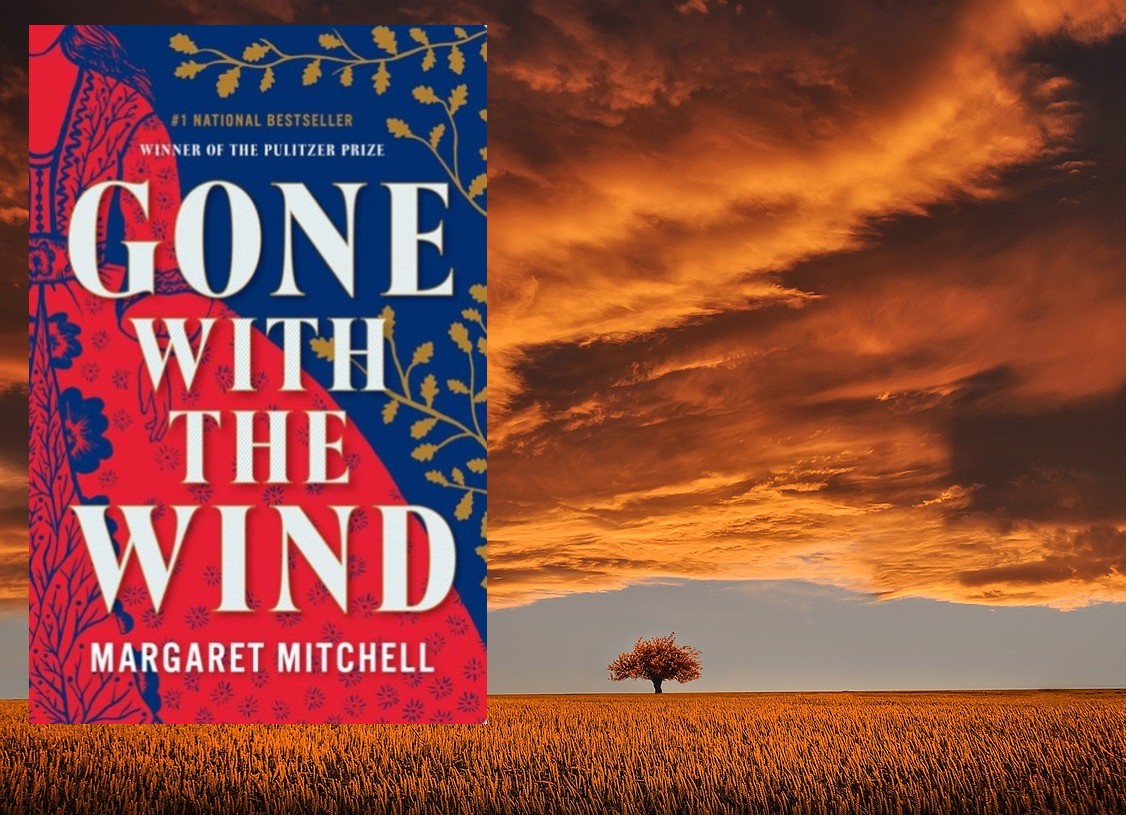
It is incredibly hard to write about the book that for decades has been among your favourites. The book, which you’ve reread quite a few times, at different periods of your life, every time finding something new. The controversy surrounding the book complicates matters even further.
I always meant to write a review of “Gone with the Wind,” ever since I’d discovered Goodreads. Yet, the more time passed, the more things got in the way, preventing me from sharing my thoughts about the book, which I, figuratively speaking, was carrying with me since I was a teenager.
As someone who suffered from prejudice based on belonging to a certain group, I choose to avoid ‘drawing fire upon myself,’ where I know that it is likely to happen. It won’t make me stronger. Life has dealt me enough blows to know that I am strong enough. This is a conscious choice that I make not to add to the worries and frustrations of which I have aplenty. That’s why I do not enter arguments about politics, for example.
At one point, I decided not to write a review of Margaret Mitchell’s novel. After all, it doesn’t matter if I share my thoughts or not. Besides, people tend to see what they want to see, not only in reviews. A story from my now almost forgotten office life comes to mind. It happened not long before my maternity leave. My superior scolded me for not signing all the pages of a document. I was heavily pregnant, our office was on the fifth floor of an old building, with high steps and no elevator. I just returned from the building across the street, where a part of our divisions was housed. I forgot to sign the annex, which, by the way, was duly signed by my colleague who prepared the document. I told my superior that. But she went on and on about me not signing the papers on purpose. The hormones must have taken their toll, so I said that she was entitled to her opinion, but instead of making me listen to it when I could have done some work, she could include her complaints in the annual evaluation form and give me a lower grade. She accused me of disrespecting subordination.
So, if after reading this review, you’ll want to accuse me of something, I will humbly accept it. I can only say that me loving this book means solely that I love this book. It doesn’t speak of my views on broader subjects.
Is Scarlett a good person? Most definitely, not. She isn’t kind, generous, patient, nor is she knowledgeable in any particular subject in a scholarly way. I don’t know how anyone, save for her mother, could love her. I don’t know how Rhett Butler could love her. But I think I do understand why Melanie loved her. Despite her sweetness and gentility, she had the same iron rod for a core, and she understood its value. What would Melanie do without Scarlett’s strength? She and her son would have died. Her beloved Ashley would have been lost in the new reality and most probably would have died too. Melanie clung to Scarlett, as I see it, not only out of love, even though, being the way she was, sentimentality definitely was present, but because she was crucial for the survival of herself and her family.
Did Scarlett, stubborn, narrow-minded, and egoistical, still do good? Yes, she did. After the war, she could have taken her sisters and gone to Charleston to live with her aunts Eulalie and Pauline. She could have insisted that Melanie and her son go to Macon to their aunt Pittypat. As to the rest of Tara’s inhabitants, Scarlett could have pointed out that since they were now free, she didn’t have to keep feeding and housing them. True, she despised Eulalie and Pauline. She also kept Melanie with her, wishing to be at the place to where Ashley would return. Yet, at the times of crisis, it doesn’t matter so much what one thinks as what one does. And Scarlett pulled them all through the harshest times of hunger, uncertainty, looting, and the lingering danger posed by soldiers of both armies.
Margaret Mitchell said that “Gone with the Wind” is about gumption, about the people who have it and those who don’t. And that’s what this book is to me. Not a love story, not the glorification of one side of the conflict, most certainly not the justification of one of the reasons for that conflict. Rereading the book the last two times, I saw a broader picture.
“Gone with the Wind” isn’t a romance. When I read it for the first time, and when I saw the movie, I certainly saw it this way. I was a teenager. I was incapable of seeing, let alone analysing the civilisation crumbling around me. I saw the two beautiful people in love, who were kept apart by unfortunate circumstances. Several decades later, having reread the book a few times, I see something completely different.
I imagine that, reading the book for the first time, I must have skipped Rhett Butler’s speech where he explains to Scarlett how some people become rich while the world crumbles around them. “What most people don’t seem to realize is that there is just as much money to be made out of the wreckage of a civilization as from the upbuilding of one.” I wasn’t much younger than Scarlett and just as ignorant and not interested in anything that didn’t concern me directly. But now, after having witnessed the wreckage of a civilisation and lived through a full circle of revival from it, Rhett’s words read differently, and I even read them aloud to my husband.
Another passage that I read to him was from Ashley’s letter that he sent to his wife from the front, which Scarlett reads in secret from Melanie. I was struck by how familiar the sentiments he expressed felt. It could have been my father who wrote that letter. The episode with the taxes being raised to force Scarlett to sell Tara felt painfully familiar as well.
I could continue listing the similarities between the falls of two different civilisations, separated by time, ideology, and geography. The last time that I reread “Gone with the Wind,” they leaped from the pages at me, so that I had to pause and ponder.
The Reconstruction era in the United States after the war between North and South and the decade after the collapse of the Soviet Union. What could these time periods possibly have in common? Absolutely nothing, at first glance. Margaret Mitchell proves otherwise.
Human nature, quite astonishingly, remains the same, across times, generations, and continents. While the circumstances change, people’s basic reactions don’t. The reasons for wars might be different, yet the behaviour and feelings of the winners and the losers remain roughly the same. And the bottom line is that, even if a tree is rotten and about to fall, when it is felled by force, someone who didn’t deserve it suffers when it collapses. The same with lifestyles or, in Rhett Butler’s words, civilisations. Even if an existing civilisation was built on false principles, good people will suffer when it gets destroyed. No matter how noble the cause, changes always bring hardships and sorrow.
Still, the opposite is true either. Along with victims, there’ll be those who will prosper on the ruins of the old, often using dishonest means before the new is settled into place.
It took me a while to sit down to write this review. As I mentioned at the beginning, I was reluctant to do it. Now, I am glad that I’ve done it. Thoughts were swarming in my head, buzzing and sometimes even stinging like bees. I feel relieved to have gotten rid of that company.
Books don’t have to reflect every possible viewpoint on the subject. Books don’t have to have identical protagonists. Books owe us nothing. Books exist to show us more than we can realistically witness in our lifetimes, limited by natural causes. Books don’t have to give us answers, but rather provide us with questions.
I truly believe that if we stop expecting something from books, embracing the story shared with us instead, even controversial books will bring more good than harm.
 Eve's Book Diary
To review a book that reflects that period and outlook is a challenge. I think we have to acknowledge the failings of the time while recognizing the strengths of the writing; you manage this balance well.
LikeLiked by 1 person
Thank you. I strongly believe that by hiding one’s head in the sand, we cannot learn anything new and also cannot possibly change anything for the better.
LikeLiked by 1 person
I think your analogy of the tree falling is most appropriate. It might be rotten, but when it falls, it affects everyone, whether good or bad. Literature should move us to a deeper consideration of the realities of the world, and take us beyond our comfort zone, if we are to grow.
LikeLiked by 1 person
I agree. And I really appreciate it when literature leads me to thinking rather than offers ready-made solutions. That’s the power of art as I see it. Not once did I want Scarlett’s world to continue as it was. But I’ve seen what happens to decent people when drastic changes descend upon them, and I was capable to sympathise and see the shortcomings of what was planned to bring solely the good.
LikeLiked by 1 person
It is always helpful to see how the people of the time perceived the experience. And yes–art challenges the mind; it does not dictate our thoughts.
LikeLiked by 1 person
That’s the most valuable thing, I think, that literature gives us. We get a chance to see life at different times and in different places through different lenses.
LikeLiked by 1 person
Did you learn about how and why the author ended up writing this novel? It’s very interesting; and, very tragic.
LikeLiked by 1 person
I haven’t read her complete biography, but I did read about her life, the story behind writing her famous novel, why she was forced to quit her journalist career, and also about her tragic death in a car accident. Your comment made me think about looking for Margaret Mitchell’s biography. I think that she was an extraordinary person, not necessarily a nice one, and I’d be interested to learn more about her. Thank you for giving me this idea!
LikeLiked by 1 person