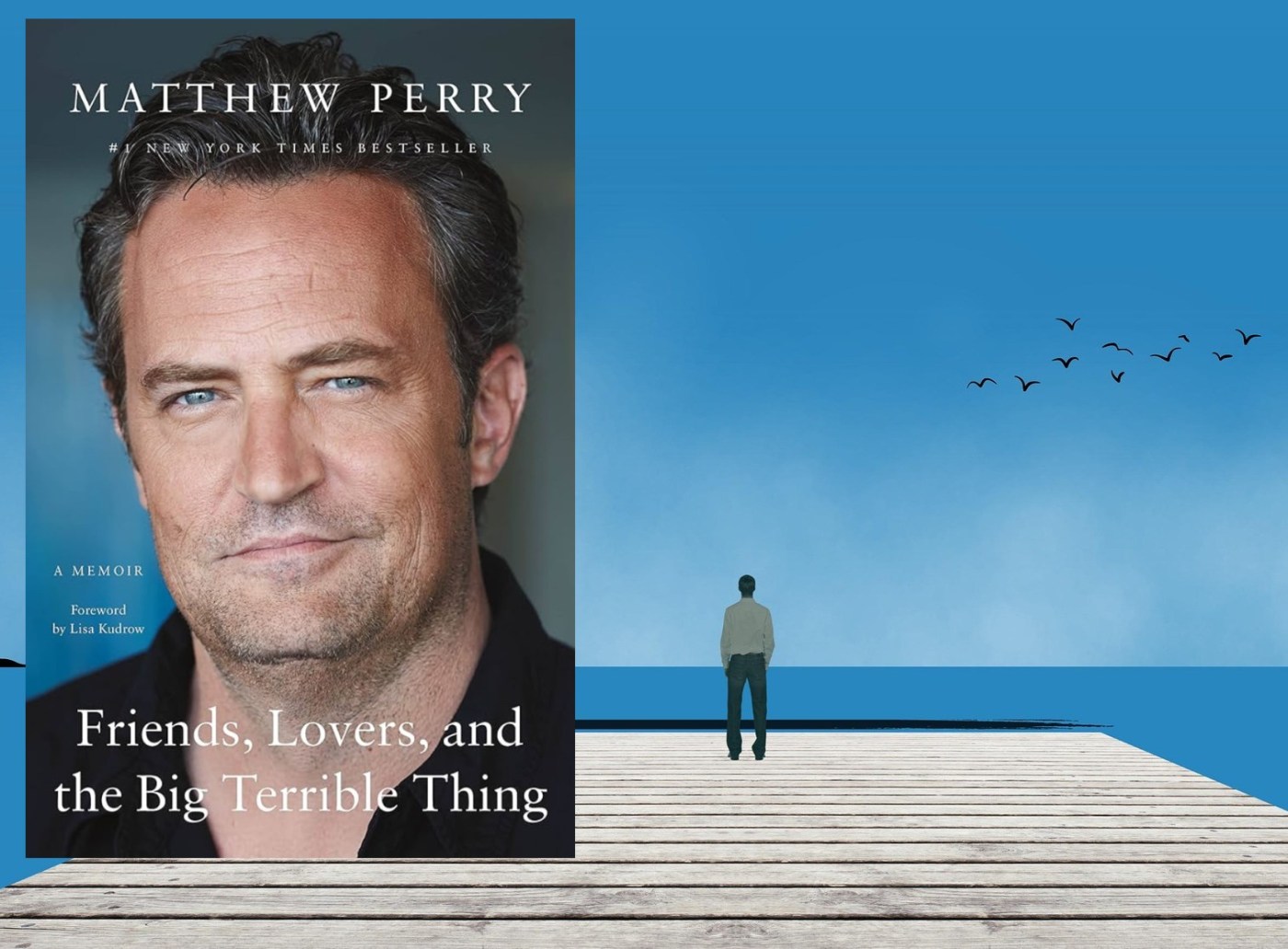
Reading this book was painful. I felt sad and angry. At some point, all the negativity so overwhelmed me that I almost decided not to finish. And it says something, for very seldom do I not finish my reads. The reason wasn’t that I condemn addiction and don’t believe that it is a disease. The reason was the complete helplessness that Matthew Perry’s confession threw me into. I read the book knowing that the actor died, and it shrouded his words in utter darkness, which could never be dispersed.
I noticed this book on the bookshelf in the bookstore several years ago, probably soon after it was published. “Friends, Lovers and the Big Terrible Thing” by Matthew Perry caught my attention since I am a big fan of memoirs and biographies, and new arrivals always catch my eye. I never buy them right away, while they are too expensive. But I come back later when the hype dies out, and the price becomes reasonable. This time, I had a gift certificate from the big shopping mall. Whenever I get them, I always spend them on paperbacks. I was glad that Matthew Perry’s book was still in stock, and it indeed was reasonably priced. Well, I think that if I hadn’t bought it in paperback but read it on my Kindle, I wouldn’t have finished it.
Okay, enough about me.
I felt close to tears so many times while reading this book. The actor’s story put life’s unfairness in such a stark limelight that I wanted to scream. Why should addiction be so destructive, so unconquerable? Isn’t it enough that most of us struggle with claws and nails to make our dreams come true so that we can live our lives the way that we want rather than follow a pattern laid out for us? Isn’t it enough that we succeed so rarely that when someone does, their story becomes a beacon of hope for millions? Isn’t it enough that it remains unattainable for most to ever make their dreams come true at all because, well, life is the way it is? Why should it be possible that when someone wins in this highly competitive game called life, snatching the victory from the indifferent destiny, they cannot enjoy their success to the full, suffering from addiction instead? I felt deep sympathy for Matthew Perry’s desperate struggle with drugs and alcohol. And all the time while reading his memoir, I was asking myself these questions, knowing full well that I would never receive the answers to them.
That said, I have to add that reading this book made me see that the author wasn’t a very nice guy. I am not sure if he was a little delusional about the magnitude of his fame because his brain was clouded by drugs and alcohol. It might be so, so I by no means want to offend his memory. Yet, my subjective opinion is such that he thought that he was bigger than he really was. He mentions several times throughout the book that the whole world knew his most iconic character, Chandler Bing from “Friends.” I can honestly confess that I didn’t know the names of most actors playing in that series, apart from maybe Jennifer Aniston, and her name I knew not because of her role in “Friends,” but rather because she became a famous movie star later. And I most certainly didn’t know the names of the characters. Yes, one might say that back in the 90s, being from the country freshly freed from the clutches of the totalitarian regime and new to the democratic fold, I was totally ignorant as to the trends everyone in the civilised world was aware of. To that, I’d reply that, okay, maybe not exactly in 1994 when “Friends” hit the small screens, but a few years later, we all here across the pond knew Bruce Willis, Arnold Schwarzenegger, Jean-Claude Van Damme – and Vivien Leigh and Clark Gable for that matter – and I do remember catching a glance of “Friends” on TV. Despite this, I still had no idea who played those friends sitting on the couch in their New Year apartment – so disappointingly small to our imaginations, which had huge mansions with a must-have garage for two cars embedded in them as an image of the true American dream.
It scratched my perception unpleasantly when the author mentioned that his father quit drinking when, on the way home after a fun time in a bar, he found himself unconscious in the bushes. Instead of commending him for getting rid of alcohol addiction, Matthew Perry, somewhat disdainfully, declared that, although his father was able to quit drinking, he never got a chance to star in a mega-popular show such as “Friends.” From that, I got the impression that the actor believed that his addiction, in a way, facilitated his rise to stardom. Again, it is my subjective opinion, and I don’t claim that it’s how it really was.
As I mentioned at the beginning of this review, reading this book wasn’t a pleasant experience, hence the three-star rating. It is not to diminish the merits of the book, which, it is clear, took a lot of courage to write. Still, I fail to see how this story can be helpful to other people suffering from addictions. If only a deep shock effect makes someone quit drinking and using drugs, for truly, the details that Matthew Perry shares about health problems brought on by addiction are horrifying.
I was left emotionally drained after finishing this book. Undeniably beautiful, magnificent, and amazing, life, at times, is a real… ahem, joker, and an extremely cruel one at that.
 Eve's Book Diary
Interesting about his perceptions of his fame. Over here, to admit that one did not follow Friends was an invitation to social shunning! I am wondering if his self perception was influenced by the image associated with the show–the struggles of addiction augmented by public expectations.
LikeLiked by 1 person
Well, I guess there is no such show which every single person on the planet followed 🙂 And even such giants like Friends or Game of Thrones aren’t exceptions. As to Matthew Perry, as I understood from his memoir, his issues with addiction began before he became famous. But whether actually becoming a big star facilitated its increase and deepening, I cannot say. Maybe he would have struggled even more if his dream to become famous hadn’t come true, who knows.
LikeLiked by 1 person
That is indeed possible. What I was a wondering here was how much the public really cared about him and what he did. Whether his perception of his personal standing in their lives was accurate. Like did he think ‘they’re going to be shocked by this’ when they really didn’t care.
LikeLiked by 1 person
He mentions in the book that during a particularly hard time with his addiction flaring up, he looks very thin in the show. He kind of accuses viewers of not noticing. At the same time, he went to great lengths to hide his problems from everyone, including his co-stars and also the public.
LikeLiked by 1 person
Interesting. We hide our troubles, since we are not supposed to draw attention to ourselves, and then we feel bad because no one notices. One of the ironies of the human condition.
LikeLiked by 1 person
Indeed. One of life’s controversies.
LikeLiked by 1 person