“I can spend time wondering what could have been, but these days I find myself, far more often, wondering what might still be.”
I think that this is one of the most important, if not the most important, things that we must embrace when we hit a certain age. I don’t like putting labels, so for some, it might happen at forty, while for others, closer to sixty. What matters is not to drown in contemplating what you cannot change.
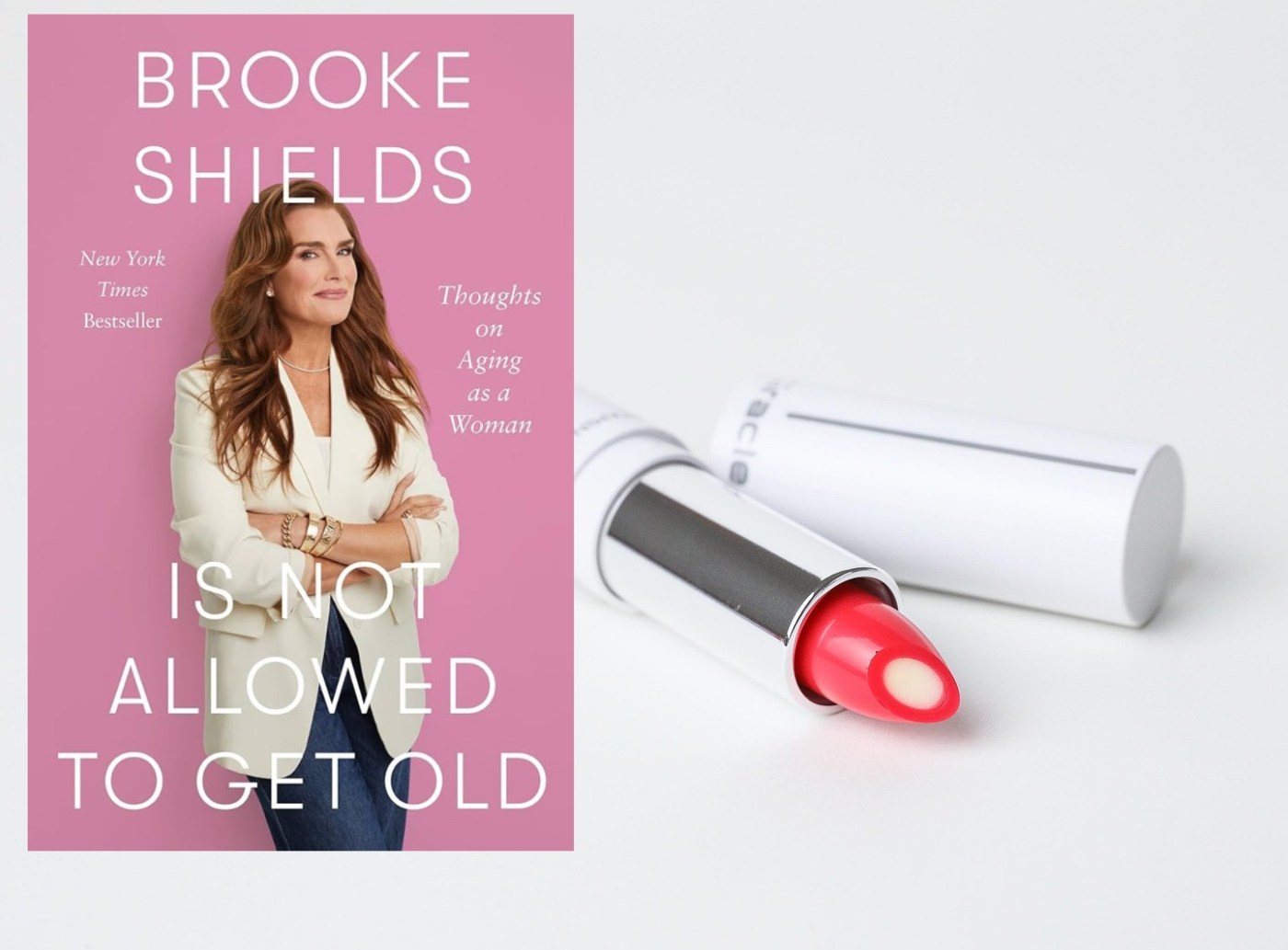
“Brooke Shields Is Not Allowed to Get Old: Thoughts on Aging as a Woman” by Brooke Shields was an interesting read. While in many aspects I could not relate to the author’s experiences, others felt very familiar.
My favourite notion shared by Brooke Shields in this book is that at forty (fifty, sixty, etc.) we don’t have to pretend that we are in our twenties. We don’t have to take up some activities – in the example she shares, it’s surfing – just to prove that ‘we can do this.’ It is okay not to be able to do something. “Acceptance is also knowing that you can’t and don’t want to do something, or even that you’ve aged out of it.” I feel it acutely that society in general is afraid to accept that at a certain time in our lives, some doors close. I don’t know if it comes solely from the fear of aging and death. I suspect that it is more complicated. But what I do know is that it makes my life more difficult. I have to think carefully before saying the most innocent things, like ‘Oh no, miniskirts are not in my wardrobe anymore.’ As a rule, if I do let something along these lines slip, people start reassuring me that ‘it’s not about the age’ and ‘look at (insert the name of some famous person with a unique physique or a great Photoshop guru team), she is older than you and wearing micro shorts.’ I laughed reading the part where Brooke Shields writes about the trick she uses when filming with ‘gluing up’ the skin above her knees so that they look like they ‘should’ – according to society’s standards, obviously.
I personally am not at all afraid to admit that certain pieces of clothing are not for me anymore. I accept it and don’t fret about it. If aging with grace means hiding one’s head in the sand, I am ready to age without it, but naturally.
The author mentions that she took up surfing, even though she knew she wasn’t physically fit for such a demanding pursuit anymore. She persisted despite this activity not bringing her true pleasure. She stopped only when she got hit on the head by the board. I must say that I understand her only too well. When I mention that fitness activities like Zumba, CrossFit, or running aren’t for me anymore, people always try to tell me that I’m wrong because ‘we can do anything.’ As if I am diminishing not only my but also their value by stating that I don’t want to do what I, well, don’t want to do. Yes, my reluctance to do certain things comes from the limitations of my age, but why should I be ashamed of it? Working out has been a part of my life for twenty-five years. I don’t plan to stop. But a part of this journey is the ability to adjust your routine according to your health requirements and, yes, your age. “These days I’m more interested in preventing new regrets.” And getting hurt and traumatised during sports activities is one of the regrets I am determined to prevent. It won’t do anything good for me if I proudly overdo it with weights in the gym and then spend a few months recovering, while my body suffers from the absence of exercise.
Brooke Shields mentions her experience with health issues and dealing with medical institutions. Sadly, I could relate to the struggles she went through. It seems to be a generally accepted opinion that people shouldn’t play a ‘Google doctor,’ and leave setting diagnoses to specialists. The reality of modern medical systems is that doctors don’t know their patients well enough to always be able to do that. I could continue on this subject indefinitely, but a book review isn’t a place for that. I’ll only say that, just as Brooke Shields writes, knowing myself and my body better than anyone, I was able to diagnose myself early, which, and there’s not an ounce of pathos in these words, saved my future and the future of my family. If I’d relied on doctors to do their job, my life and the lives of my loved ones would have turned into a nightmare of an everyday struggle. It is challenging as it is, but it could have been much worse.
“I want to settle into the middle place, where there’s effort in the comfort, and comfort in the effort.” This is my aim at this stage of my life as well. I don’t mind putting effort, even extra effort, into what I do. But I have to know that this is what I want, not what society expects from me. Right now, my focus is on my writing. It does bother me that only a few people in my life truly support me in it, but it is my age and the experience that comes with it that helps me not to pay attention to the naysayers.
Some things in this book fell flat for me. One of them is “…if you are a man who is forthright, you’re a leader. A woman, you’re a bitch.” I guess this is largely because, as I always say, in my country, Latvia, feminism had won long before it did in the rest of the world. We’ve always had a lot of strong women who rule over every aspect and sphere of life. The closest example to me is my mother, who was a career woman when there hadn’t yet been such a thing, and then a fighter against the currents at a time when many men crumbled and gave up.
What made me cringe a bit is the extensive use of the f-word in the first part of the book. Then, miraculously, it disappeared and reappeared only once or twice towards the end of the book. I’m not a prude, and I do use a strong word or two in my speech. I also don’t think swear words should be banished from literature. It’s just in this particular case, when the topic was aging and a woman’s image and value in that context, it felt unnecessary. It is never efficient to address the audience with a language more fitting for addressing a different group. I felt that the author spoke to grown-up women as if we were her teenage daughters. Maybe her publisher insisted that she do that based on some top-scale research. But it didn’t work for me. The effect was the same as a salesperson addressing me with ‘Hey, you girl!’ would be.
All in all, I enjoyed this book. The author doesn’t simply share her own personal ideas and experiences; she adds research data to give her conclusions weight. It is true that the life Brooke Shields has at almost sixty isn’t like the lives of most women in their forties and fifties. But then again, at our age, we all know that not only wouldn’t a book like this be published if written by an ‘ordinary woman,’ but even if it were, few people would read it. So, I appreciate that the topics important to me are discussed at all.
 Eve's Book Diary
I am remembering when Brooke Shields arrived on the scene and we were in awe of her! Now, we are both old! I am blessed to be part of a local culture that looks upon old age as a triumph– as long as you expend all your energy working for the church or organized volunteering. Keep writing, Eve, and celebrate every second you are still growing!
LikeLiked by 1 person
I won’t give up writing, that’s the one thing I can say for sure. I spent too much time pretending that this part of me doesn’t exist. I won’t do that anymore.
LikeLiked by 1 person
That is important! I often think of my father’s advice: “We need two lives, ont to learn and one to live.”
LikeLiked by 1 person
An extremely valid and valuable piece of advice!
LikeLiked by 1 person
I agree. The trick is to follow through. Still learning that part.
LikeLiked by 1 person
Good luck to both of us to finally learn it.
LikeLiked by 1 person
Brooke Shields is one of those celebrities who has been around forever. That’s a good thing, too.
LikeLike