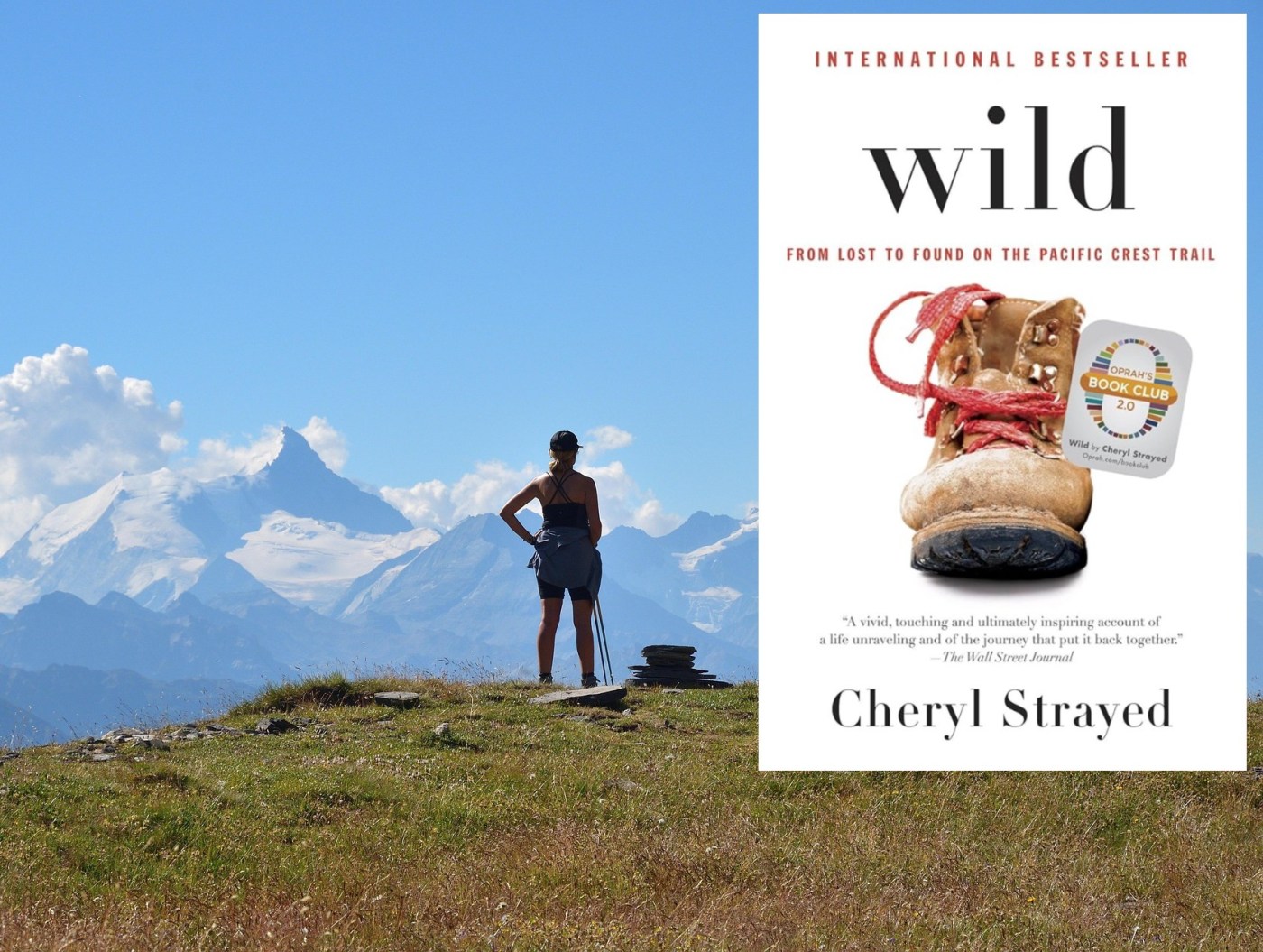
Would you do an eleven-hundred-mile hike through the wilderness alone? I know that I wouldn’t. Would you read a book written by someone who did it? I did and loved it.
“Wild: From Lost to Found on the Pacific Crest Trail” by Cheryl Strayed is as much about hiking the Pacific Crest Trail (PCT) as it is about what made the author do it and what she learnt while treading the harsh, uncompromising, often barely marked paths of the PCT.
In Margaret Mitchell’s “Gone with the Wind,” Old Miss Fontaine tells Scarlett that for a woman, there is nothing more soul-destroying than having faced the worst. She means the horrors of war and violence, the kind of which she has faced when, as a child, she witnessed the killing of her family, and also the devastation brought on by the Yankees at present. This scene, which I skipped when I read the book for the first time as a teenager, stayed with me after I reread it decades later. It made me think about how what I’ve been through shaped me into the person I am now. And the truth of Old Miss’s words hit me hard. That I’ve seen too much hasn’t made me a better version of a woman I could have become had my experiences been of a lighter variety. Alas, harsh things make you harsh. And no one particularly likes harsh people. Unfair? Maybe. But true nevertheless.
While reading “Wild,” the wisdom that Old Miss shares and Scarlett being Scarlett dismisses as she does with everything that is, in her view, irrelevant to her current predicament, came to my mind. But this time, from a different angle. Another thing that’s absolutely shattering for a woman’s soul is losing her mother before her time has come. I’m not saying that it doesn’t hurt to lose one’s mom to old age. Losing our loved ones always hurts. But it is still different when a person closest to you passes unexpectedly, years or even decades before it is generally considered ‘their time.’ And the agony a daughter goes through when the person she has lost is her mother is especially painful.
Adding to the burden of grief is society’s expectations that you must get over it sooner than possible. People want you to behave as if you are fine. Mostly, for their own sakes. And when you do, they have an excuse to treat you as if it were true. “Just as I’d seemed to be doing okay after my mom died. Grief doesn’t have a face.” It isn’t necessarily because people are cruel and indifferent. As I see it, grief is hard to respond to, and it is uncomfortable to deal with. People realise that their words, chosen wrongly, might cause more pain or maybe even an aggressive reaction. And, of course, sympathy requires time and effort. It is seldom that people are willing or ready to share these things with others.
Cheryl Strayed loses her mother at twenty-two. Her mom loses the battle with cancer at forty-five. It doesn’t surprise me that for the author, this tragedy turned out to be an insurmountable mountain. Not at once, but four years later, she decides not to simply climb one real mountain. She sets her mind on crossing range after range of cliffs, all seemingly impassable for a first-time long-distance hiker.
Why on Earth didn’t she leave the trail after the first day when the extent of her unpreparedness became evident? Or after the second or the third? I kept asking myself this question after each chapter. I suffer from minor blisters between my toes brought on by wearing heavy winter footwear for too many days in a row due to an uncharacteristically cold winter. While the author had to bear not only blistered feet but also her skin, almost all over her body, chafed mercilessly by the monstrosity of a backpack she was carrying.
Already before I reached the last chapter, I started to get the glimpses of ‘why,’ and it was extremely satisfying to wrap up the full understanding in a neat package I could stash away for further musing when I finished the book.
As I mentioned at the beginning of this review, I wouldn’t choose the same way of overcoming grief as did the author. I just don’t have it in me to put myself through more suffering than absolutely necessary. I can’t be sure that hiking the Pacific Crest Trail or a similar one wouldn’t help me shed what presses me down. Maybe I’d feel renewed and relieved. What makes me doubtful is that I’m already walking the paths I didn’t allow myself to step on when I was young. Grief and loss, in a way, liberated me – from preconceived notions of how I should act to be viewed as a ‘good girl.’ Still, they also put me into a new set of shackles.
Reading “Wild” by Cheryl Strayed inspired me to try to search for something that could do what hiking the Pacific Crest Trail did for her. I, too, want to stop feeling broken inside. Even if it’s not evident – I took society’s expectations of getting over it seriously – I am still a heap of crumbled pieces, far from whole.
“If he could do this, I could, I thought furiously. He wasn’t tougher than me. No one was, I told myself, without believing it. I made it the mantra of those days; when I paused before yet another series of switchbacks or skidded down knee-jarring slopes, when patches of flesh peeled off my feet along with my socks, when I lay alone and lonely in my tent at night I asked, often out loud: Who is tougher than me? The answer was always the same, and even when I knew absolutely there was no way on this earth it was true, I said it anyway: No one.”
In 2024, my family spent three weeks travelling across the American Southwest. I remember feeling awe-struck by the vastness of the Mojave Desert when we drove from Flagstaff, Arizona, on the way to the Sequoia National Park. Reading the book, I tried to imagine how much more intimidating it must have felt for the author to cross this area on foot. Maybe, just maybe, in some form, let it be totally amateurish, I might still consider doing something like hiking in the wild.
 Eve's Book Diary
There are many routes to follow as we set out to heal our brokenness. For some, a monumental challenge is the mechanism. That is commendable, as long as the Journey itself is not viewed as the solution. Whatever we do, it is the inner processing that affects the change.
LikeLiked by 1 person
Yes, that’s true. But in order to facilitate this inner change, we need something to stir it into action. Different things work for different people. So far, nothing has worked for me. At least, not fully. Writing does help, but it hasn’t healed me so that I could say that I am whole again. Maybe it is impossible, and I’ll always be a bit broken.
LikeLiked by 1 person
Perhaps ultimately, we find our healing in the recognition that our brokenness is part of us, not in accepting it thoughtlessly, but in loving ourselves anyway.
LikeLiked by 1 person
Your words made me think. I do love myself. And I do love life and the world. The part that is broken within me is that I don’t view it all with optimism.
LikeLike
and so perhaps a journey to challenge yourself will help you to stir that optimism.
I do not find such challenges leave a lasting effect, but they do stir us to consider all we can be.
Writing is a release, but as you point out, it does not fully heal. Perhaps its function is to help us carry our brokenness.
LikeLiked by 1 person
Sometimes I think that our brokenness is a prerequisite for our ability to write meaningful stories.
LikeLike