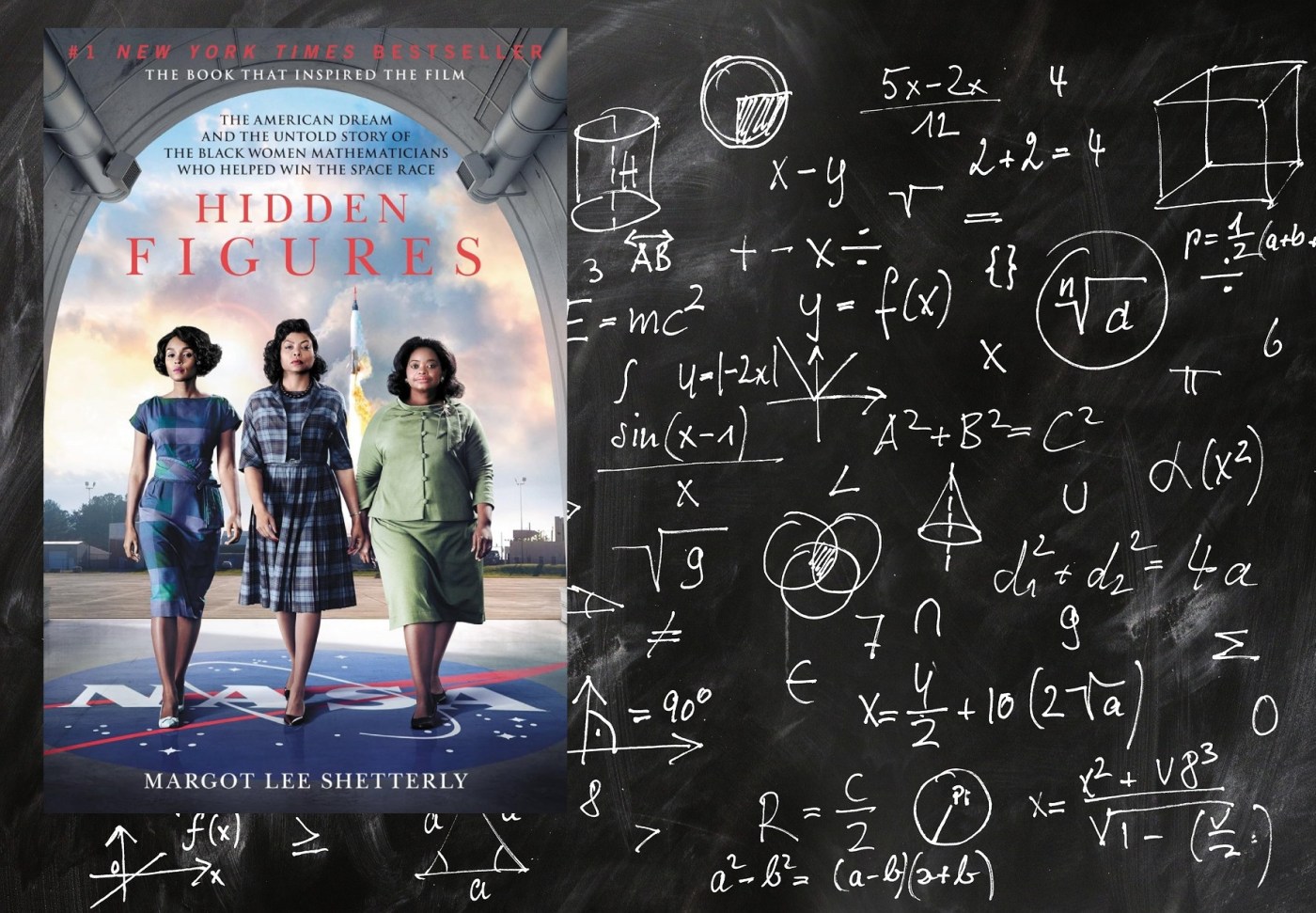
I was telling my husband about the book I was reading, and he said he saw some videos on YouTube that resembled the plot I was describing. I checked my Kindle and found out that, indeed, there was a mention of the film on the cover. The book was published, and the movie was released in 2016. I guess it illustrates how disconnected I am from current trends perfectly. I was glad, though, to see that the actress whom I liked at the time when I was still watching movies and tv series on a regular basis played one of the leading roles. Both my husband and I loved Joss, played by Taraji P. Henson in ‘Person of Interest,’ and yes, we haven’t overcome the trauma. No spoilers!
“Hidden Figures: The American Dream and the Untold Story of the Black Women Mathematicians Who Helped Win the Space Race” by Margot Lee Shetterly was an eye-opening reading experience. I love nonfiction that teaches rather than preaches. And this story was right up my alley.
Before computers had become what we know them to be – machines that control all aspects of our lives (sorry, a bad joke) – they were…people. It was a huge revelation that a ‘computer’ used to be a person, a mathematician, who performed calculations ‘by hand.’ “Hidden Figures” tells the story of a group of human computers who, in a way, have changed history.
World War II had a vast impact on everything. Apart from the obvious – a lot of people losing their lives – it had changed the basis of economics around the globe. Even before the United States sent soldiers to fight, the country had entered the war in other ways. Demand and supply had changed drastically. Suddenly, the world needed planes. Lots and lots of them. And since those planes weren’t needed to spray the fields with fertilizers but to participate in battles, they had to be effective, fast, and reliable. People’s lives depended on their performance. This change of demand led to the increased importance of the government agency called NACA (National Advisory Committee for Aeronautics), the one that would in a while become the legendary NASA.
To satisfy the rapidly growing military needs, NACA had to expand. And expand it did, both physically by constructing new buildings for research and testing and by hiring new personnel. They quickly realised that to ensure the latter, they had to become more flexible. Thus, the ‘for whites only’ policy was put aside, and the first African-American women mathematicians signed their contracts with NACA. For them, who knew that becoming a school teacher was the only way they could apply their mathematical skills, it was an opportunity of a lifetime. And they had done everything to use it to the fullest.
Another revelation was to learn that it was one of those African American women mathematicians who performed the calculations for the legendary landing on the Moon mission in 1969. Katherine Johnson’s job was to check and re-check the computer-generated calculations so that the astronauts wouldn’t die because of the mistakes made by machines. Reading about that was especially touching.
Sometimes the book was challenging to read because of the abundance of details, and also, after new characters were introduced. I admit, I mixed people and timelines, and as to technical issues, alas, it was hopeless to hope that I might understand them. Still, I guess that it’s a curse, for the lack of a better word, of good nonfiction. You cannot expect it to be solid while lacking details.
“Hidden Figures” by Margot Lee Shetterly is an exceptionally well-researched and adequately presented account of a fascinating page in history. I recommend it to all those interested in lesser-known facts, which, although not advertised, made a significant impact.
 Eve's Book Diary
I remember my excitement learning of those underappreciated brilliant women. I am so glad you brought this book forward, truly inspiring. And I quite agree that absorbing and processing the details of Nonfiction can be challenging.
LikeLiked by 1 person
It was one of my favourite nonfiction books that I read last year. So fresh and taught me something I did not have the slightest idea about. I love such discoveries.
LikeLiked by 1 person