
This year, a Dream came true. In June, I finally travelled to America.
It was a journey of a lifetime in so many ways, not only for me but for my husband as well that I feel the trip report needs to be preceded by some backstory.
For both my husband and myself, visiting the US was more than yet another trip. It was a kind of a milestone. And knowing that we can give such an experience to our nine-year-old son added to the overall feeling of excitement.
Those who have read my book “The Accidental Cop” know where my husband and I come from. The ‘savage 90s’, which ripped apart so many people’s lives in my country after the collapse of the Soviet Union, were the reality we both were entering our adulthood in. The coming-of-age phase wasn’t about searching for what our interests were, nor was it about torments over the first love or imperfections in our appearances. For us, it was about survival. Those who’ve read the book, know that I’m not being over-dramatic here. For many, those were vicious times. Unmerciful. Ugly.
We were young. We did have dreams and hopes. I guess that’s what made us move forward, not letting the filth and the ugliness cling to us. Still, looking into the future from the times twenty-five years ago, it was almost impossible to imagine that one day, we will board a plane, land on American soil, and head towards the adventures in a brand-new rented car. Back then, it would’ve sounded like a fairy tale. And, to be honest, it did feel a bit unreal all the while we were travelling around America.
Well, I don’t know why, but I needed to tell you this. I could have just said something like ‘Oh wow, guys, we’ve just had this really cool trip. Look at my pics!’. But it was so much more than that. It was almost a spiritual journey that helped us close some doors and open others.
Now I can begin telling you all about it.
Las Vegas / Never a dream but an explosive burst of impressions
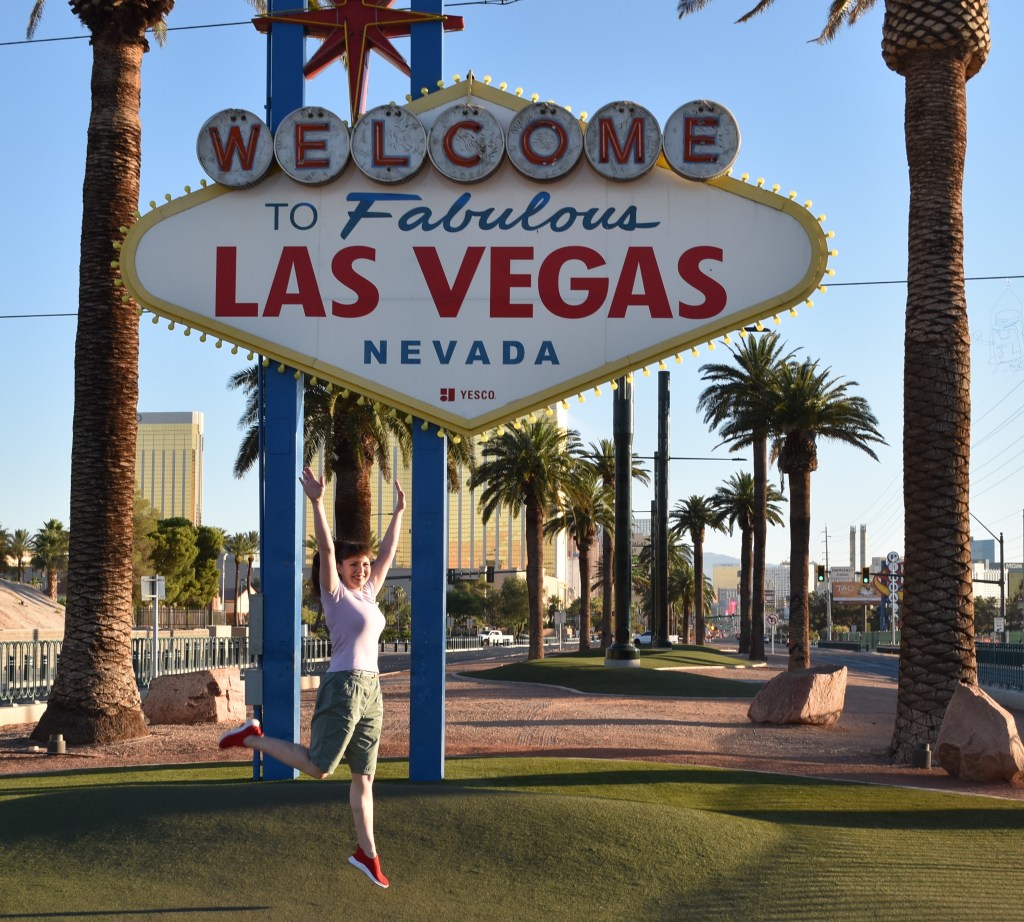
That’s what Las Vegas turned out to be for us. I’ve never wanted to see the Sin City. I’m not a gambler. Nightlife, with loud music, glamour, and booze never held any appeal to me. But Las Vegas was the closest place we could fly to if we wanted to visit the Grand Canyon, so the choice was made for us.
On June 11, we arrived in Las Vegas after two in the afternoon. After spending around thirteen hours on the plane (two and a half hours flying from Riga to Amsterdam, and ten hours from Amsterdam to Las Vegas) plus a few hours waiting in Amsterdam Schiphol Airport, the three of us were surprisingly lively.
The flight with KLM from Amsterdam was very comfortable. I worried about finding the right place to eat in Las Vegas, but the Dutch airlines fed us so well that eating was out of the question. Besides, it was hot. Really hot. 42 Celsius / 107 Fahrenheit.
Determined to start fighting the jet lag right away, after my husband went to a nearby store to buy water, we staggered out of our motel towards the famous Strip.
We didn’t see much that day. We walked the Strip for a while and returned to have some rest. But we did see a few sights that made Las Vegas legendary, like the New York New York Hotel, and it made us realise that there is more than gambling and casinos to this city.

Las Vegas is overwhelming. It is ‘over’ in every sense. Too crowded. Too packed with all kinds of entertainment. Sparkling. Luring you in with every possible attraction the city seems to have gathered from all over the world.
Las Vegas strives to give you anything you might want. The grandest shows of the most famous singers and performances like Cirque du Soleil take place in its posh hotels. Moreover, this is probably the only place where the concerts we can see only on special tours run on a regular schedule.
If you are into museums, Vegas is ready to give them to you. We haven’t visited any this time, but I’d love to see the Titanic artefact exhibition, for example. Moreover, Vegas invites you with its trademark flashy flourish. The ad for the wax museum was so funny, with different stars claiming that this is the best wax museum in the world. When we walked back to our hotel past the wax museum and Vin Diesel announced from the big screen with aplomb something about ‘the best wax museum in the world’, my son finished his sentence loudly ‘…is in London!’.
Las Vegas gives you options. You can do it cheap, and you can do it expensive. You can eat in high-end or chain places. You can shop for designer clothes and accessories, and you can grab a couple of pretty souvenirs in Walgreens for ten dollars.
What I loved about Las Vegas is that I felt that it wants you to be there and it wants you to feel good while you are visiting. It made me want to come back someday. Again, on my way to other destinations, but now, after experiencing the city with my own eyes, I know what it has to offer from the pool of things I truly want to see.
After that first short stroll along the Strip, I realised that I made the right decision to spend two last nights in Las Vegas before our departure instead of spending this time on the road driving back from California.
From Las Vegas to Grand Canyon
Stopping at Hoover Dam is a must do on the way to the Grand Canyon; every guide, travel blog, etc. mentions it as such. And we almost skipped it.
It is very hot in the area in June. Although we had three weeks to explore the American Southwest, the time planned for every location understandably was limited. I wasn’t sure that stopping at Hoover Dam would fit into our schedule. I wanted to spend as much time at the Grand Canyon as I could. Anyway, I did some research to find out from which spot it was possible to get the iconic view of the famous dam.
Luckily, due to jet lag, the next day after the arrival, we woke up at 2:30 am, dutifully tried to sleep for around an hour, then decided to get up and start getting ready. So, we were at the Fabulous Las Vegas sign after 5, and at Hoover Dam just after 6. Will you believe it that ours wasn’t the only car in the parking lot? When we were leaving, at about 8, the place was full.
We climbed the stairs to the Mike O’Callaghan-Pat Tillman Memorial Bridge, marvelled at the awe-inspiring view of Hoover Dam, and took pictures. It was a special moment for me – as were so many during this trip so that at some point, I was overwhelmed with strong emotions – for I remember how impressed I was by Hoover Dam watching the first ‘Transformers’ movie all these years ago. I didn’t know then that it was a real location.

Hoover Dam is an arch-gravity dam located on the border between the U.S. states of Nevada and Arizona. It was constructed during the Great Depression (1931-1936), and the works understandably attracted a huge number of people looking for work. After the word about the huge project was out, Las Vegas, then a small city with a modest population of 5 thousand people (I’m trying hard to imagine it), experienced the wave of the unemployed flooding it. It is estimated that between ten to twenty thousand people arrived dreaming about landing a job at the dam construction site.
An interesting fact: during its construction, the dam was referred to as the Hoover Dam, but after completion was officially named the Boulder Dam. Only a decade after, in 1947, was the name Hoover Dam restored by Congress.
Boulder City was built specifically to house the workers who built the dam.
Hoover Dam was recognised as a National Historic Civil Engineering Landmark in 1984. It was listed on the National Register of Historic Places in 1981 and was designated a National Historic Landmark in 1985.
The construction of the legendary landmark officially took 112 lives. However, the workers claimed that the deaths recorded as having occurred due to pneumonia were in fact caused by carbon monoxide poisoning. The site’s diversion tunnels frequently reached 140 °F (60 °C), enveloped in thick plumes of vehicle exhaust gases. There are records of 42 workers who supposedly died from pneumonia; they were not included in the official total number of deaths that occurred at the construction site.
My conclusion after this brief stop is that Hoover Dam is indeed a must do on your way to the Grand Canyon. Next time we visit, I’d like to do a full tour and see the ‘inside workings’ of this engineering marvel.

The towns of Kingman and Williams are two more stops recommended by most travel guides and blogs on the way from Las Vegas to the Grand Canyon. We thought that we would stop in both, but when we were approaching Kingman, we realised that we weren’t tired or hungry enough and decided to keep moving.
Williams is located 188 miles / 303 km from Hoover Dam, so by the time we reached it, we felt that we needed a break.
First, we stopped at the Route 66 Museum And Gift Shop. It is a lovely place to wander around, marvelling at the old days’ memorabilia, and for buying some souvenirs. My son appreciated the references to the animation movie ‘Cars’ which he loves. We bought a few magnets, and I fell in love with a silver & turquoise butterfly pendant on a silver chain. I must say it hasn’t happened to me in a very long while. I am mostly indifferent to things nowadays. But there was something special in that pendant – crafted locally – that made my heart beat faster.
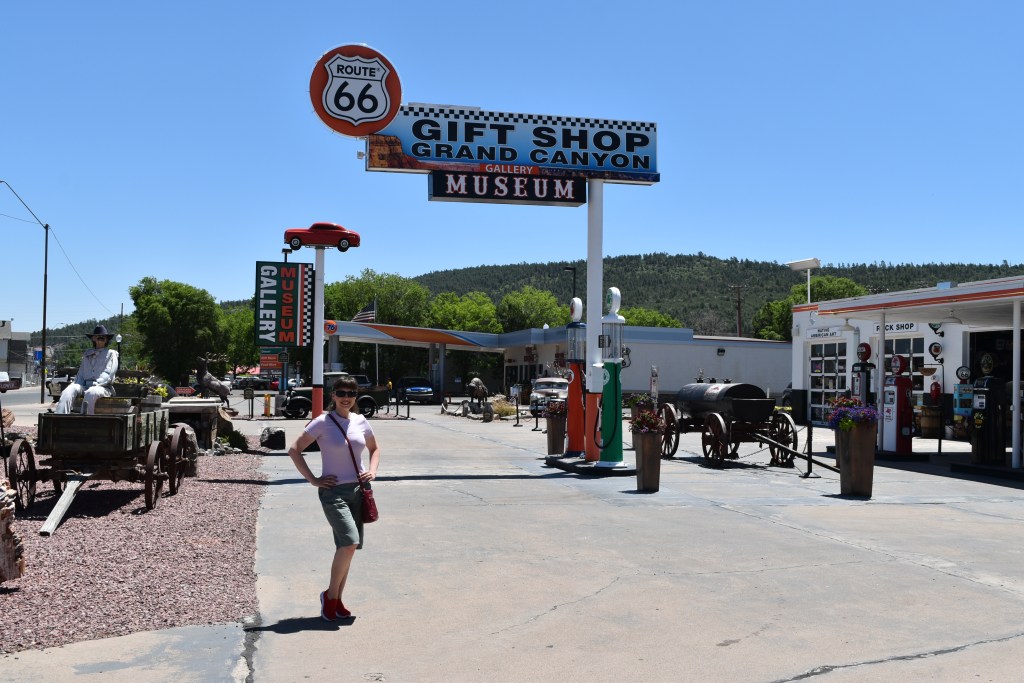
We had a great lunch at KFC. It was our first time there. We have a few KFC restaurants in Riga, opened with a great flourish after long deliberations over the unreasonably high labour costs in our local market. We don’t eat in fast food places at home, and, you won’t believe it, have been to McDonald’s only a few times. And that happened only because it was the only place open late at night when circumstances forced us to grab a bite. In Williams, McDonald’s turned out to be extremely confusing, without an opportunity to eat inside. We didn’t want to eat in our rented car, so we simply crossed the street and went to KFC.
Just like with our Hoover Dam visit, the short time we spent in Williams made me want to return and explore it more.
The Grand Canyon – the greatest adventure
Visiting the Grand Canyon was the most incredible part of our overall amazing journey around the Southwest US. After seeing it in its full glory, I can confidently say that neither photos nor videos do it justice. And I did a proper research before our trip. Since we travelled with our nine-year-old son, I had to make sure all the trails and places we were going to see would be safe enough for him.
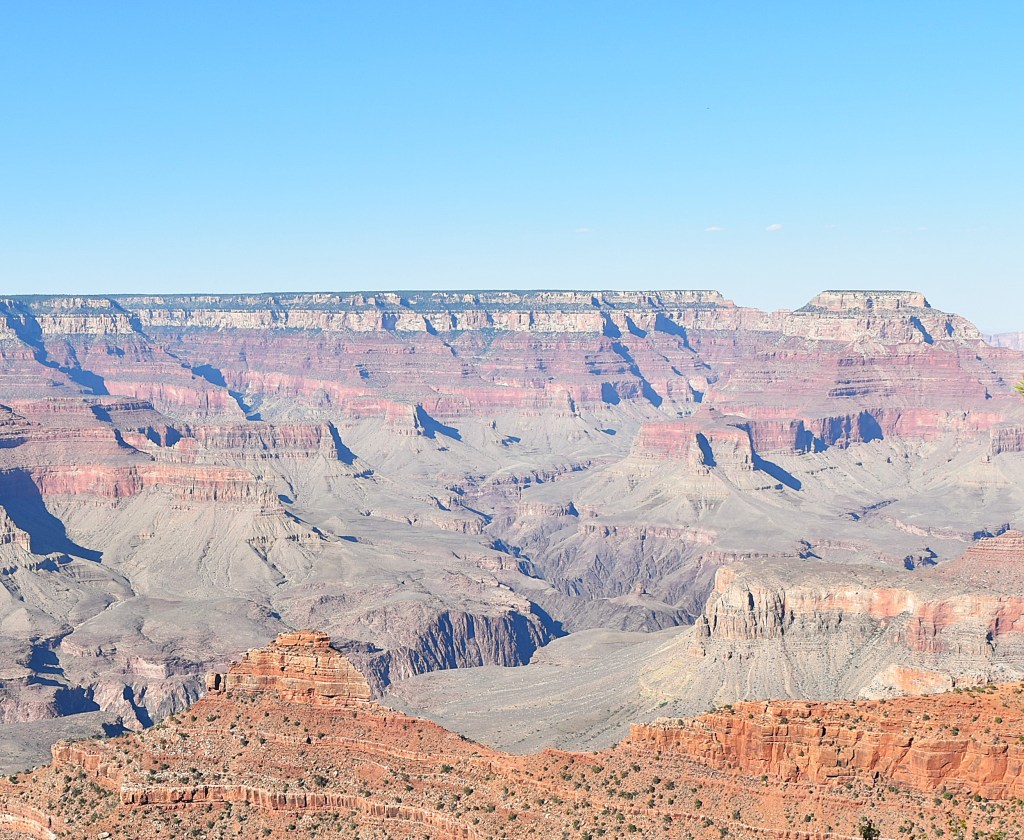
Sometimes, when you arrive at some place, you feel that you’ve already been there, seen everything, so explicit was the information you gathered. Has it happened to you? With the Grand Canyon, it was the opposite. Yes, what you see when you get there, is what was ‘advertised.’ And yet, nothing can prepare you for how it really looks and how it makes you feel.
Some practical info about our stay:
Duration: 2 nights
Accommodation: Yavapai Lodge in Grand Canyon Village
Things done & Places visited:
Hiking along the South Rim Trail,
Watching the sunset (Mather Point overlook and the Rim Trail),
Watching the sunrise (Mather Point overlook),
Hiking a section of the Hermit Road (stopped at the following overlooks: Trailview Overlook, Maricopa Point, Powell Point, Hopi Point, Hermit’s Rest);
Hiking down (approx. 1 mile) the Bright Angel Trail into the canyon.

I’ve noticed than a lot of people come to the Grand Canyon for a few hours. While I am totally happy with my decision to spend two nights here, I understand for some people a few hours are enough to enjoy it. Simply walking the South Rim Trail in Grand Canyon Village is enough to take in the magnificence of this natural wonder. The most popular section of the Rim Trail runs roughly from the Mather Point overlook to the Bright Angel Trailhead. It is easily accessible from several free shuttle bus stops, paved, with many overlooks offering spectacular views of the canyon. This section’s length is approx. 2.7 miles / 4 km.
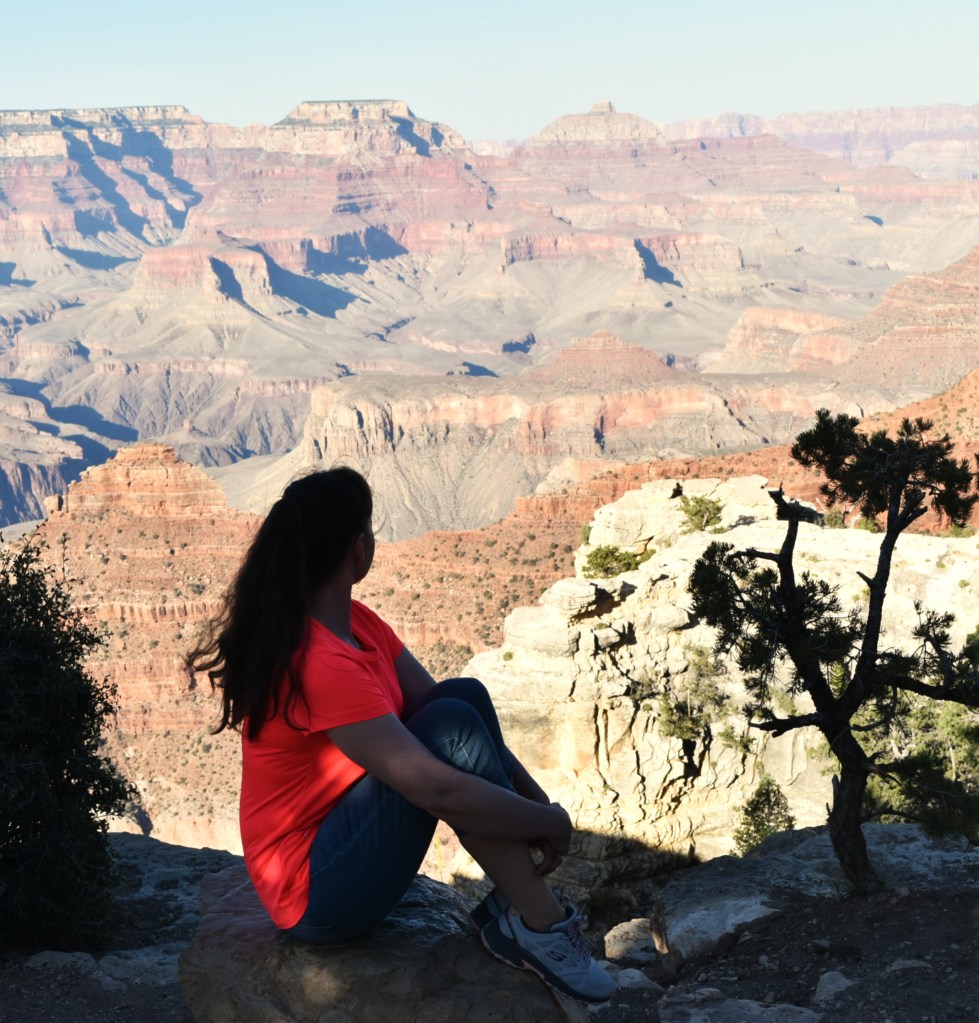
We didn’t walk its full length, for we wanted to see ‘wilder’ parts of the trail and also to climb down into the canyon at least a little. But I’d love to walk this trail at a leisurely pace, stopping at all the points of interest. Every time when we walked by the Yavapai Geology Museum, it was either still or already closed. I hope we’ll drop in there the next time we visit.
Crowded, overpriced, far from big cities – is it worth it?
While I searched for information for our trip to the Southwest US, I read all kinds of things about the Grand Canyon. Travel experiences are inevitably different for everyone. Here is my take on this mega-popular destination.
Is it crowded in summer?
Yes, it definitely is. The most visited parts of the Grand Canyon, like the section of the Rim Trail I mentioned above, are full of tourists. Be it at sunrise, at sunset, or during the day, you will find a lot of people at every popular place.
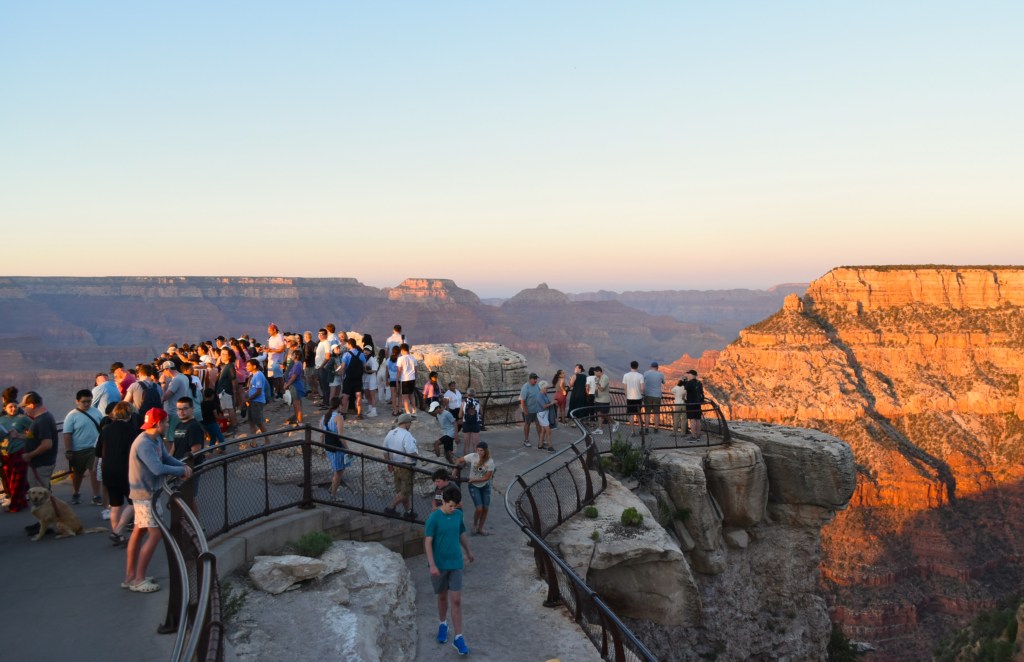
Did it spoil the experience for us?
No. Since we stayed inside the park, we were more flexible with our time than those who come for a few hours. For example, we could do a part of the Hermit’s Road trail, which in general is less crowded than the village section of the Rim Trail. Due to the jet lag, we woke up early and could fit it more in each of the two days we stayed in Grand Canyon Village.
A side note: crowds in the Sequoia National Park were more disturbing.
Is everything – accommodation, food, etc. – overpriced?
Yes, probably it is. Yet, because we live in one of the most touristy towns in our country and understand the specifics, it didn’t bother us. We stayed in a motel-like accommodation (Yavapai Lodge), and it wasn’t cheap. But the room was spacious, clean, and provided us with everything we needed to explore the Grand Canyon with comfort. It also had a refrigerator, so we bought what we needed for breakfast and also snacks in the grocery store and kept everything there.
Watching how the sun rises over the Grand Canyon was something I dreamed about experiencing. And it was also one of the reasons why staying inside the park, with all its exorbitant prices for accommodation and food, was totally worth it. The jet lag came in handy as well, since, for approximately for a week after arrival, we woke up at 2:30 am without an alarm clock. We spent every day actively, exploring and hiking, so we didn’t have issues with going to bed on time, around 8. I guess our bodies considered a six-and-a-half-hour sleep enough to replenish their inner resources, for which I’m grateful too.
Mather Point, one of the most popular places at the rim for watching sunsets and sunrises, was located about a 10-15-minute walk from Yavapai Lodge where we stayed. It takes even less if you drive, but we didn’t want to bother with taking the car. Besides, during the early morning walk, we met some exciting wildlife, which was an experience in itself.

When the thin line of melted yellow coloured the top of the dark mountain range, my son broke into Europe’s song ‘The Final Countdown’, and some people in the waiting crowd joined in. It was a very special, almost transcendental moment, the one I don’t believe will ever fade in my memory.
The sun rose slowly, as if knowing that we people are watching its ascent. It had been very windy and rather chilly when we arrived to watch the spectacle. But once the sun regained its rightful place in the sky, the air filled with warmth.

Sometimes, something that’s considered overrated turns out to be even more spectacular than its promoters tried to make it look. It is impossible to get even a fraction of what it feels like to watch the sun rise over the rim of the Grand Canyon through stories, pictures, or videos. You have to be present to realise with astonishment that it is something beyond anything you could have imagined before.

One more thing we definitely wanted to do was to walk the wilder and less crowded trail along the Grand Canyon to get the more authentic experience of this natural wonder. After doing some research, I discovered that the Hermit Road trail fits our demands perfectly.
The section of the Canyon Rim Trail that runs alongside Hermit Road is definitely not wild. Still, it is a different experience from walking the most popular part of the rim trail, which is in Grand Canyon Village.
Scenic Hermit Road begins near the Bright Angel Trailhead. The full length of this road is 7 miles / 11 km.
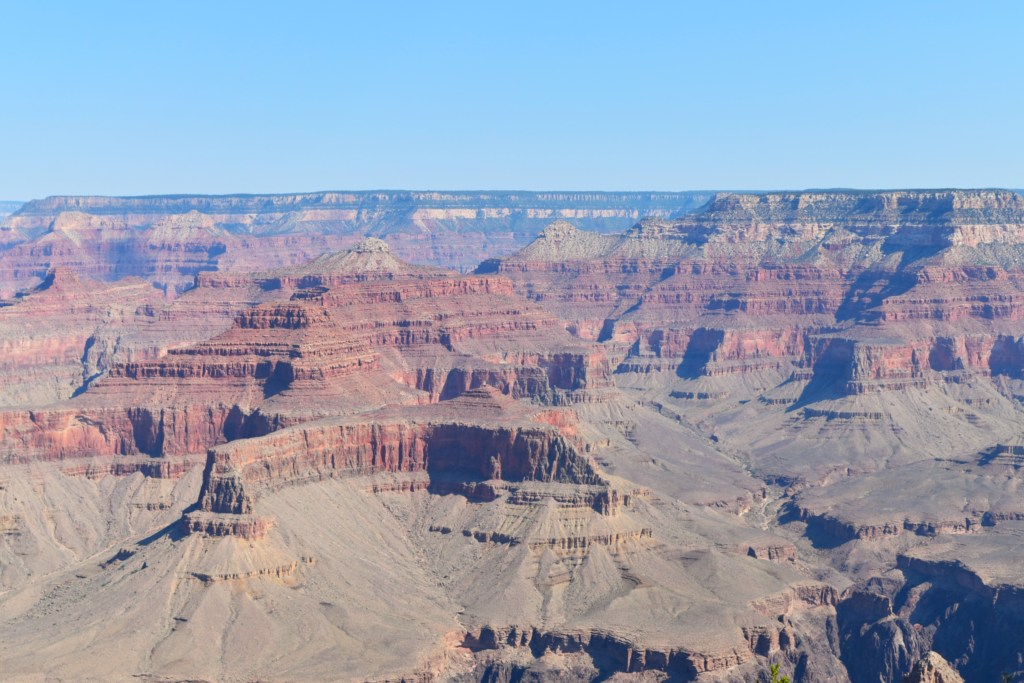
The Canyon Rim Trail is slightly longer (7.8 miles / 12.6 km), because it curves away from the road to the viewpoints. This section of the rim trail has both paved and dirt trails. Some parts of it are not exactly dangerous, but some people might find them uncomfortable because they run virtually along the very edge of the rim and don’t have any railings.
Hermit Road is closed to private vehicles between March 1 and November 30. Free shuttle bus (Red Route) offers transportation instead. The shuttle bus stops at all 9 viewpoints along the rim. But only on the way to Hermit’s Rest (the final stop). On its way back to the village, the bus has fewer stops.
We walked about 2 miles / 3 km of the Hermit Road trail and took a shuttle bus from Hopi Point to Hermit’s Rest (the final stop) and then back to the village.
We started the hike around 8 in the morning. If we’d started earlier, we might have covered more distance. But we went to see the sunrise that day, and then we needed some time to have breakfast and get from our hotel (Yavapai Lodge) to the beginning of the trail. Anyway, until around 10 am the trail was mostly empty, and we didn’t hurry, taking our time at every viewpoint. We also met small wildlife on the way, and we couldn’t but stop and look closer.
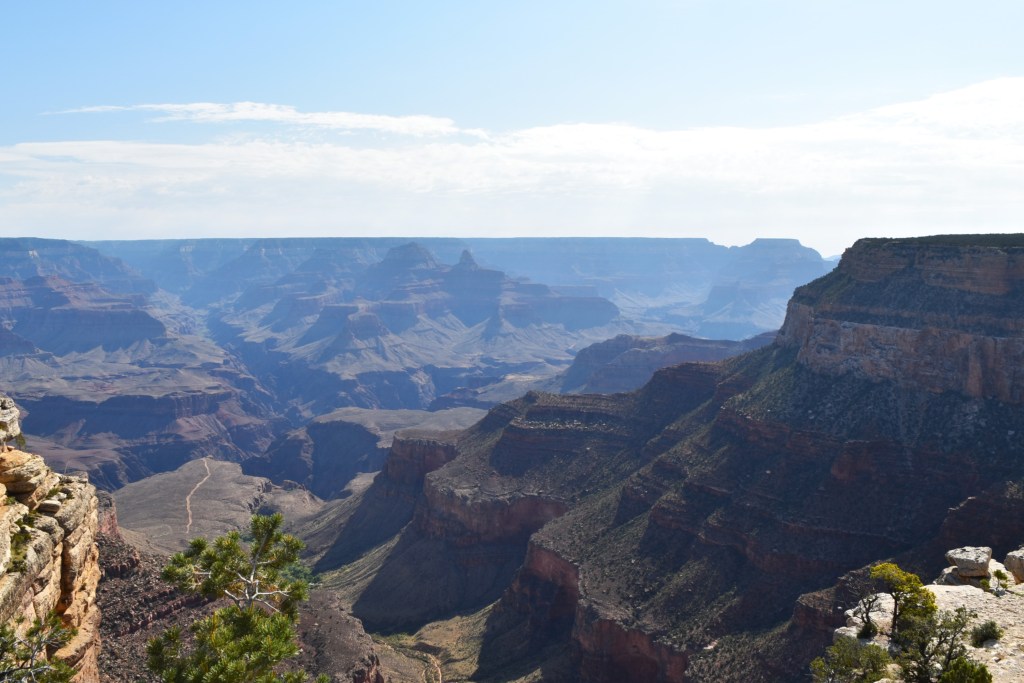
Hermit Road trail is for those who wish to experience the Grand Canyon for what it is. Unlike the section of the Rim Trail that runs in the village, it offers nothing but the views of the legendary American natural attraction. There still are some facilities along the route – public bathrooms at Hopi Point and Hermit’s Rest, where you can find also a café and a souvenir shop.
Out of 9 overlooks we stopped at five.
Trailview Overlook
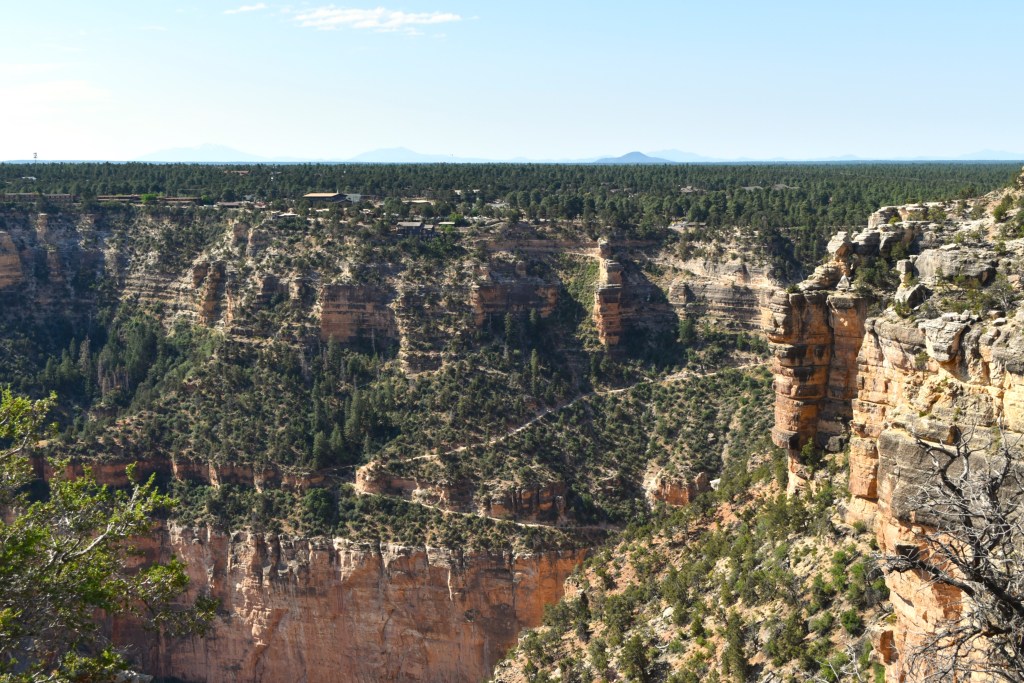
From here, the Bright Angel Trail is seen in all its switchbacking glory. We stayed here for quite a while, trying to imagine treading the trail the next day.
Maricopa Point

It offers breathtaking views, but one’s breath might get caught also at the realisation that standing at Maricopa Point one looks at the former Orphan Lode Mine, known as the place where uranium ore was being mined in the 50s and the 60s of the previous century. After the mine was closed, it took Grand Canyon National Park a while to buy it. And after it bought the potentially dangerous property in 1987, major environmental restoration activities in the area began only in 2008.
Powell Point
In addition to the views of the canyon vistas, there is the Powell Memorial here commemorating the 1869 and 1871-72 exploratory trips down the Colorado River led by Major John Wesley Powell.
Hopi Point

Here you can get a glimpse of the Colorado River. When we reached this overlook, it was already a busy time of the day. And still, it wasn’t as crowded as the Rim Trail in the village.
Hermits Rest
Hermits Rest, the building resembling an old miner’s cabin was built in 1914 by one of Grand Canyon’s most famous architects Mary Colter. She was one of the very few female American architects in her day.
It’s the final stop of the Rim Trail, with a snack bar and a gift shop. What I enjoyed most was ‘meeting’ a local celebrity – the crow, who shamelessly posed to everyone who wanted to take a picture of him, and a brave squirrel who similarly shamelessly sneaked among the arrived tourists asking for a treat.


Probably it is like this with any trip – you always leave something for the next time. For us, it was a hike down all the way into the canyon to the Colorado River. Most probably, this is something I will never be able to do. Even though I’m rather fit and used to regular long walks, an almost 20-mile / 30-km trip along the challenging trail isn’t something I would dare to try. Accommodation options at the bottom of the canyon are limited and complicated to book, so without an option to stay overnight, hiking down the canyon and back remains unfeasible for me.

But I don’t despair. The hike down the Bright Angel Trail, which we managed to do, already provided me with the impressions I craved. Our initial plan was to go to the Mile-and-a-Half Resthouse and back. This roundtrip is about 5 km long. But it was too hot, and we had limited time that day since we were leaving for Page in the afternoon. So, we walked a little further than the second tunnel, about a mile down, and then returned.
Bright Angel Trail is considered the most popular hiking trail in the Grand Canyon National Park. Although it is well-maintained, it isn’t easy. Understandably, walking up is much more difficult than walking down. The views from the trail are amazing, and it felt different to be looking at the canyon not from the rim.
During our hike, we met a park ranger who, having noticed that we had a child with us, stopped and asked if we had enough water with us and how far we planned to hike. It was very nice, and we had a great chat with him. He asked us where we were from and told us that he’d lived in Europe for many years.
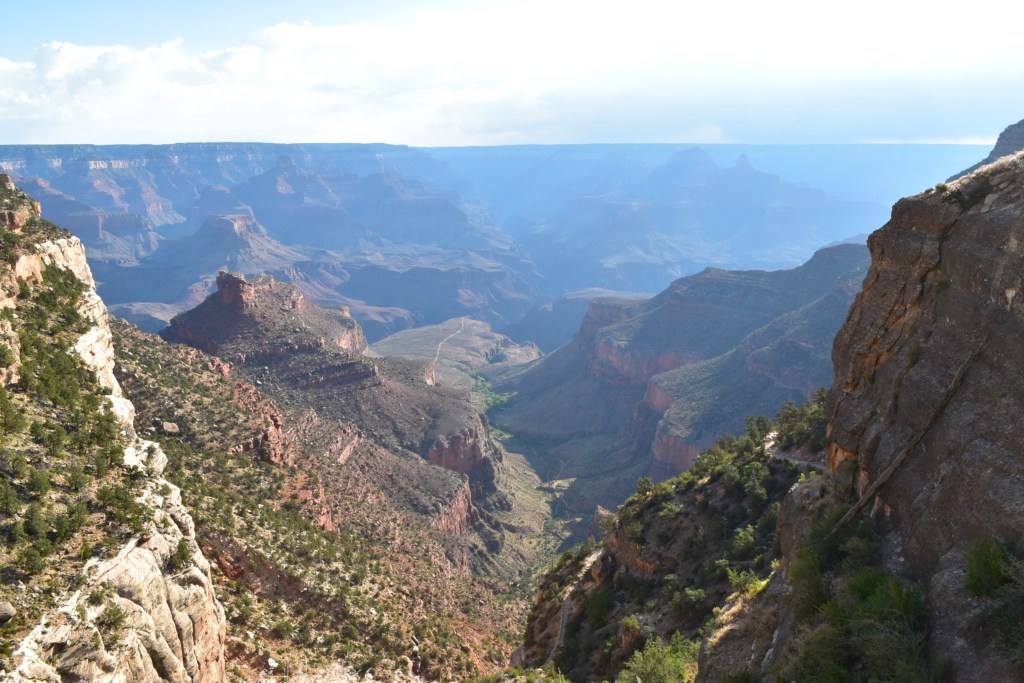
Even though I know that I might never venture as far down as the Colorado River, I still hope I’ll hike at least a few miles down the Bright Angel Trail someday. My dream to visit the Grand Canyon has come true, but it has led to another dream – to visit it again.
Page, Arizona
In the morning, after a hike down the Bright Angel Trail, we set out to our next destination – Page, Arizona. Our first impressions of it were – what an awful place! When we were entering the town, its outskirts looked the opposite of cute or welcoming. While the red Martian landscape was unusual for us and because of this unfamiliarity, it looked exciting rather than depressing, when the buildings appeared, it did start looking rather sad.
Anyway, the centre of Page looked more promising, and as we approached our motel, we felt our spirits rising. Someone might think we aren’t in our right mind feeling so excited about staying in a motel – the cheapest option available for travellers in the US. All I have to say to our defense, is that for us, it is something exotic, and thus, appealing. My husband and I are fans of ‘Supernatural’, and motels for us mean – brothers Winchesters! So I booked us a few motels for 1/2-night stays during our 3-week trip, so we could get that feeling of travelling like Sam and Dean.
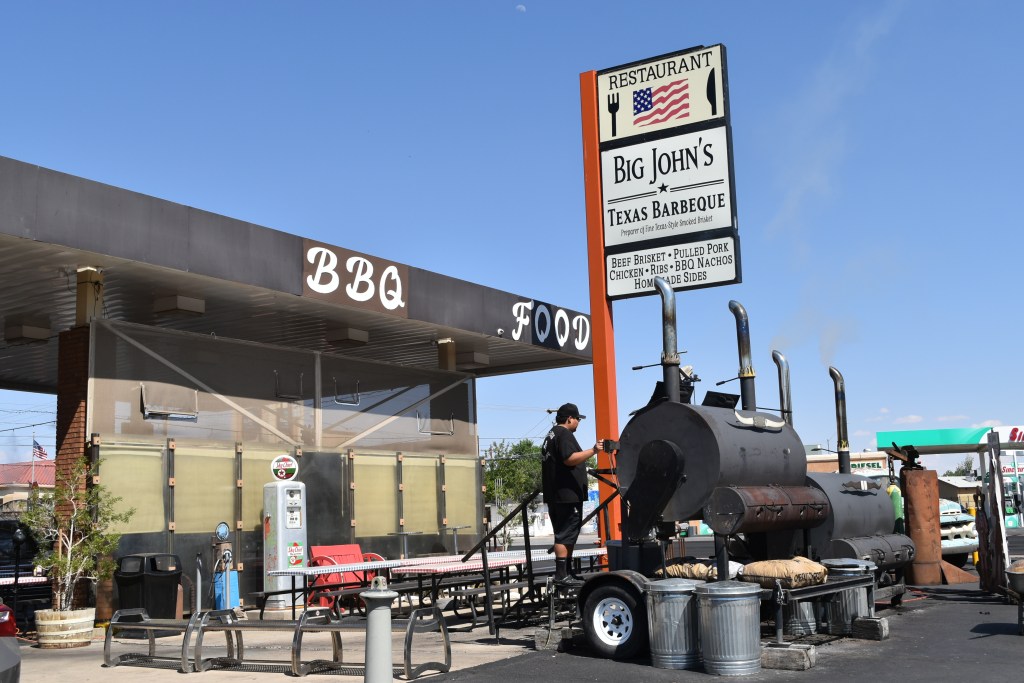
From the moment we’d parked by our motel in Page, things began to improve. My husband had chosen the place we were to go for lunch. If you knew him and his relationship with making travel plans, you’d appreciate how HUGE it is. So, the first thing we did in Page was stroll down the street from our motel to Big John’s Texas Barbeque. (Yes, we know Arizona isn’t Texas).
It wasn’t a particularly long drive from Grand Canyon Village to Page (215 km / 134 miles), but since we did a Bright Angel Trail hike down the Grand Canyon right before it in the morning, you can imagine that we weren’t feeling exactly fresh. And it was hot.
I was a little too exhausted to fully appreciate our lunch at Big John’s. Yet, I remember that the food was tasty and portions huge – like everywhere in America. The kindest waitress insisted on bringing us some water after we didn’t order any drinks. Warned by our friends before the trip, we always had water with us. The size of the water glasses so impressed us that I even took a photo of my husband with it to see the proportions.
So, what to do and see in Page, Arizona.
To take hundreds of pretty pictures of the Martian landscape. Red rocks rule. It’s a joke, of course.

As I mentioned, it was very hot when we were in Arizona in June. We had to be careful in selecting our outdoor activities. We spent 2 nights / one and a half day in Page and managed to visit the following places:
- Horseshoe Bend
- Upper Antelope Canyon
- Glen Dam
There are hiking areas close to Page, and we would have loved to do a long hike admiring the Martian landscape. Lake Powell also offers recreational opportunities. But again, it was too hot for that. Anyway, when leaving Page our box of impressions was pleasantly full.
After we rested in our motel we wanted to go to Horseshoe Bend to catch the sunset. But, when I checked the details online, I read on the official website that the popular place was closed due to an accident and subsequent police investigation. Can you imagine my surprise? Well, I know that things like this happen, I just didn’t expect it to happen exactly when we were there. We were lucky that Horseshoe Bend reopened the next day, and we drove there as early as we could to avoid the heat.
The view is impressive, well worth the ten dollars they ask you to pay for parking. I must say that after visiting it, I understand that accidents there happen solely due to people’s recklessness. We’ve seen people slip, trip, and fall on the rocks. And some were simply playing with fire, standing precariously close to the edge for the sake of taking a perfect Instagram shot. It’s impossible to take a shot of the iconic bend and yourself in one picture. At least, without putting your life in danger.

Antelope Canyon – a tourist trap or worth the trouble and the money
Well, what I want to say first is that I am totally happy that we visited it. Antelope Canyon is like nothing you can see anywhere in the world. I guess you can find similar slot canyons in Arizona, but as far as I understand from the research I’d done before our trip, they are not easily accessible.
Would you think that a nondescript crack in the rocks hides a stunning natural wonder? Someone might have had a vivid imagination and an adventurous spirit to check what was behind that narrow entrance – in the picture, to the left.
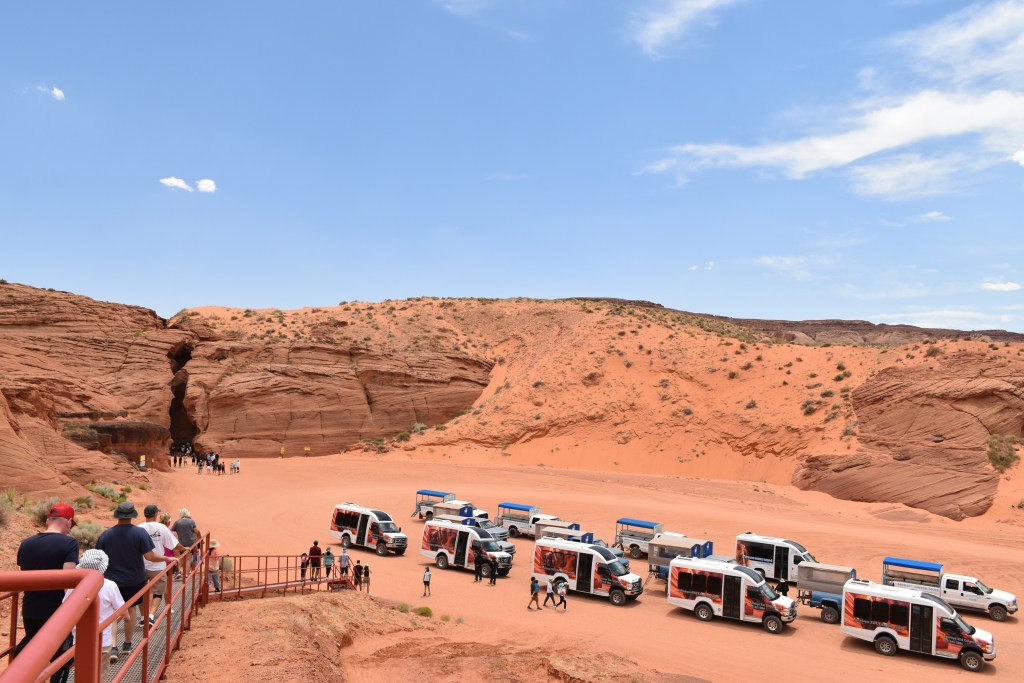
No one knows precisely who was the first person to discover Antelope Canyon. One of the versions is that it happened around the 1930s. A Navajo girl whose family lived near modern Page, Arizona wandered in the canyon by chance herding livestock.
There are legends about spiritual beings keeping watch over the area. Antelope Canyon is so unlike anything else created by nature that it is easy to believe it was created not without the intervention of magic and that it still dwells there.
We booked the most expensive excursion time so we could see sunbeams sneaking all the way from the ‘ceiling’ down into the canyon. We did get what we paid for!

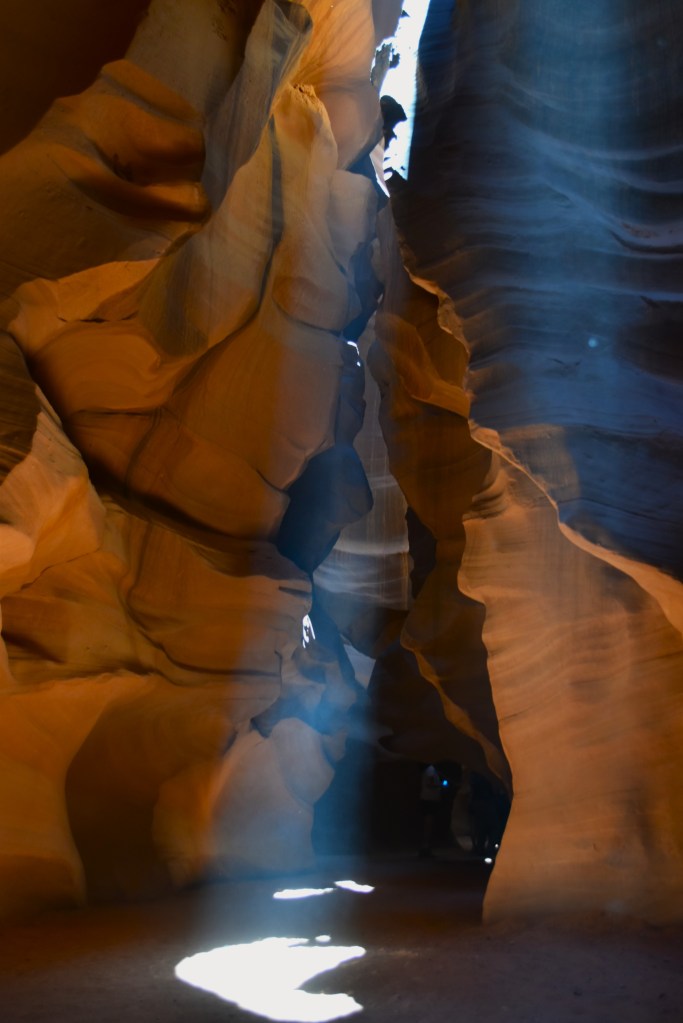
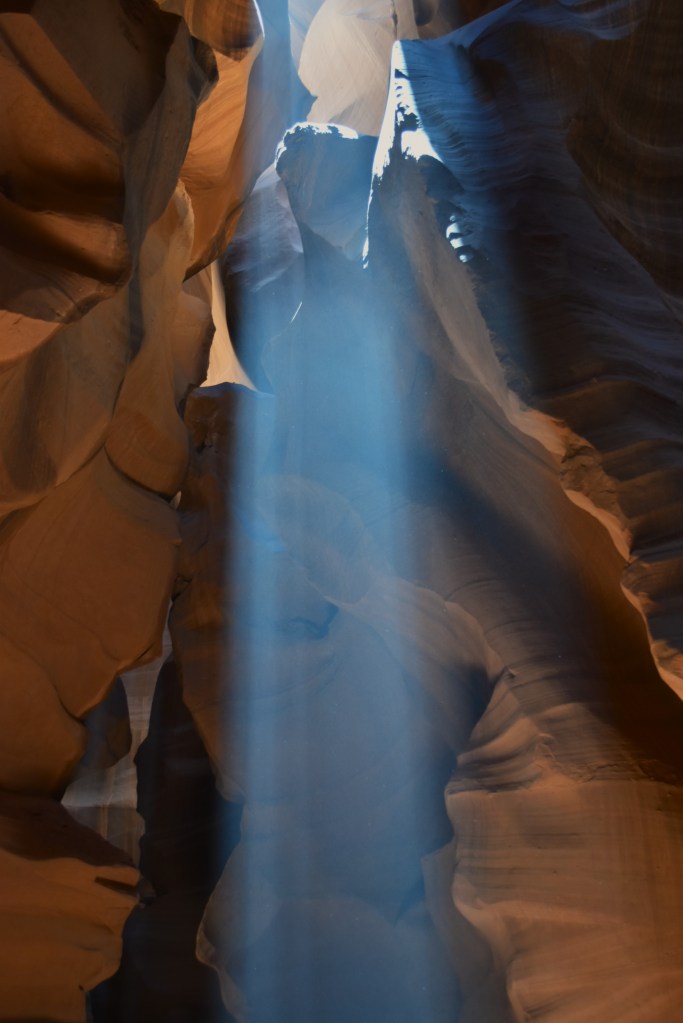
It was a lot of fun, and my son says that he liked the bumpy jeep ride the most. Yes, the ride is really and truly bumpy. So, if you plan a visit here, keep that in mind. And Navajo Tours jeeps don’t have safety belts or anything to hold on to.

The walking tour lasts approximately an hour. Be prepared for quite a few other groups walking the canyon at the same time with you. The canyon is narrow, so only short stops for taking pictures are allowed. That was a huge minus for me. With the Grand Canyon, it was different. You can sit there on the bench or at the edge and simply take in the scene, feel the atmosphere, the energy of the place. Here, all you can do is register the miracle Mother Nature created with your eyes – swiftly moving forward not to prevent others from doing the same thing.
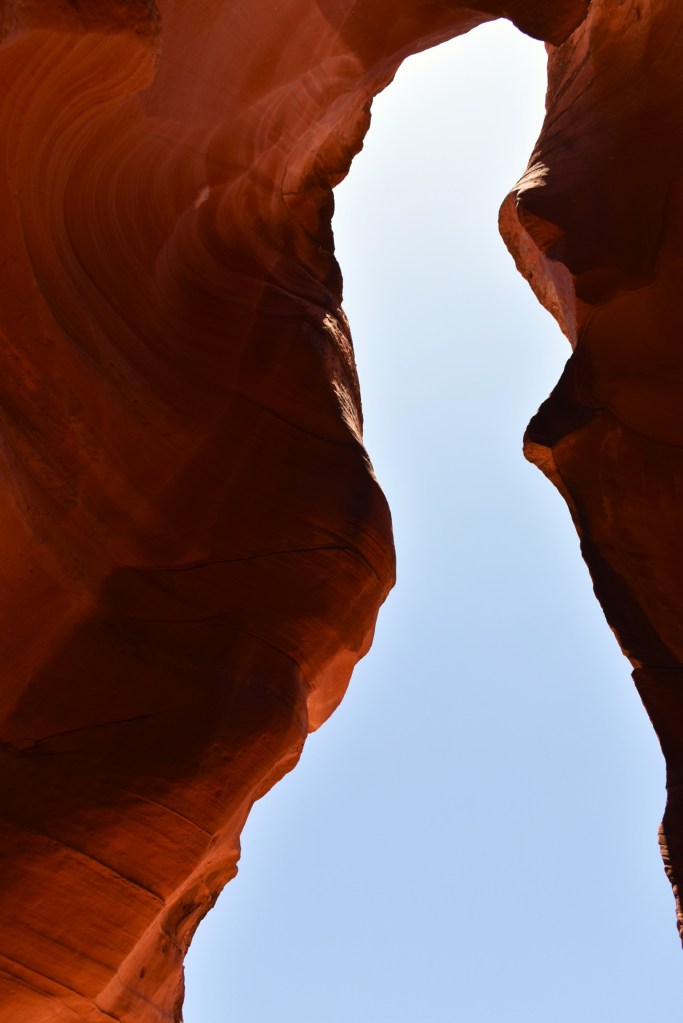


To sum up the Antelope Canyon tour – we did the Upper Antelope Canyon one. Beautiful? Yes, absolutely breathtaking. Expensive? Yes. Worth the money? I don’t regret doing it, but the facilities in the waiting area could be improved at least a little. Especially since it’s obvious that money from tourists – and not only, as the guide told us – are coming in in abundance.
Carl Hayden Visitor Center at Glen Canyon Dam
I can’t recommend this place enough. It is an architectural wonder, sitting atop a red cliff and providing breathtaking views of the dam and Lake Powell. The Visitor Center was built in 1963. It is named after a politician from Arizona Carl Trumbull Hayden. Overall, he served in congress for 56 years, and during his career, he consistently fought for water rights for his home state Arizona.
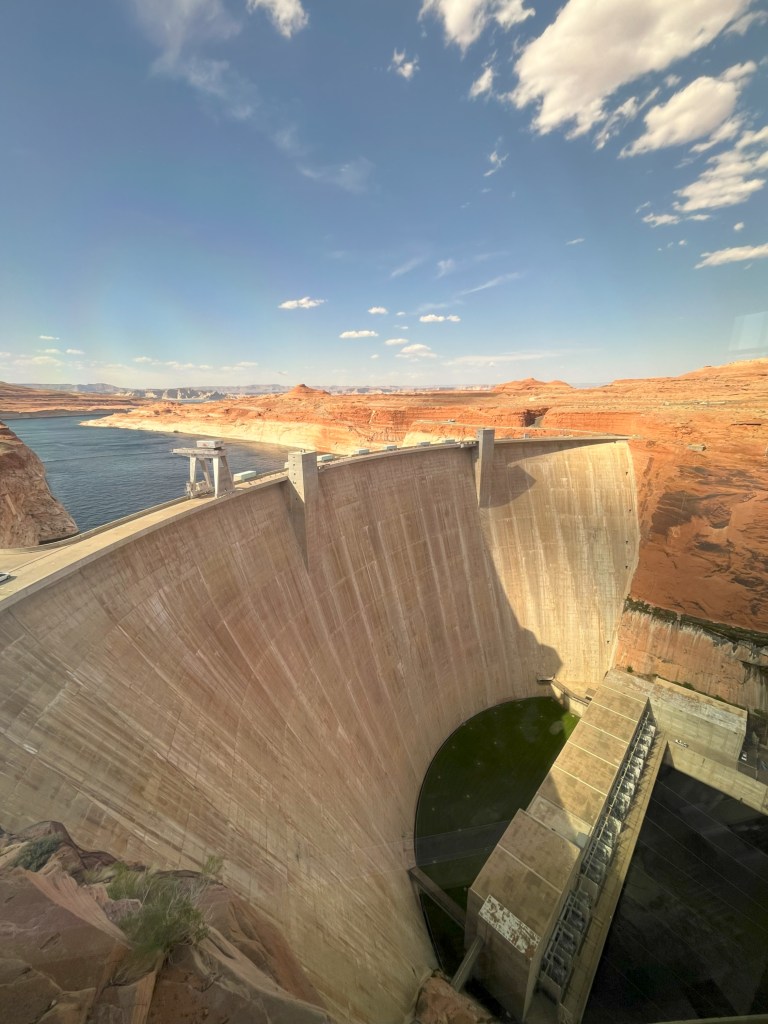
The Carl Hayden Visitor Center at Glen Canyon Dam annually greets more than a million tourists. I really liked its souvenir shop where we bought a few practical and memorable things which now remind us of Arizona. The museum in the Visitor Center is worth spending time in, reading about the history, geology, flora and fauna of the area. It also offers interactive options that my son appreciated. And I liked the features like the memorial fountain dedicated to the eight Bureau of Reclamation employees who died in a plane crash in 1997 and information plaques outside the center, on a terrace overlooking the dam.

Facts about the Glen Canyon Dam:
Location: Southwest U.S., on the Colorado River in northern Arizona, near the city of Page
Height: 220 m
Built between 1956 and 1966
Forms Lake Powell, one of the largest man-made reservoirs in the U.S.
The dam is named for Glen Canyon, a series of deep sandstone gorges now flooded by the reservoir.
Lake Powell is named for John Wesley Powell, who in 1869 led the first expedition to traverse the Colorado River’s Grand Canyon by boat.
An idea to build a dam here first appeared in 1924. But the Hoover Dam won this ‘battle’ and was built first, in 1936, twenty years before the works on the Glen Dam began.
Environmentalists had protested against the construction of the dam before it had been built. And these protests continue. Different organizations demand the dam to be dismantled and Lake Powell to be drained.
Just like Boulder City in Nevada would’ve not existed if the need for housing the workers of the Hoover Dam hadn’t been so acute, the town of Page in Arizona, named for former Reclamation Commissioner John C. Page, appeared solely because people building the Glen Canyon Dam needed somewhere to live. Besides, the design of the dam itself was based on that of Hoover Dam, with a few significant changes.
Glen Canyon Dam has earned several mentions in literature. For example, it is a target for a group of environmentalists who fight against industrial developers in the American Southwest in Edward Abbey’s novel “The Monkey Wrench Gang” (1975).
A historical stop on the way from Page to Flagstaff, Arizona
Before our trip, I read advice about supporting locals and buying Native American-crafted souvenirs from small stalls along the highway. I fully intended to do that. Alas, on Sunday morning, the stalls stood empty. Yet, in the end, we were happy that we made a stop at Cameron Trading Post. We bought all the gifts to bring home and souvenirs for ourselves there. I wanted to bring back dream catchers made in the land of their origin. And I must say, they do work – once we hung it in the bedroom, I started sleeping better.
More than a century ago – in 1911 – building a new bridge had changed the face of Cameron, a little place no one had an interest in visiting. But after a suspension bridge was built, allowing easy access over the gorge, the little place started to thrive.
Cameron Trading Post was established by two brothers, whose descendants still run this place. It ensures that the original philosophy of hospitality and respect still remains in Cameron Trading Post today.

The place, which used to be visited only by the Navajo & Hopi locals to barter their wool, blankets, and livestock for dry goods, gained popularity over the following decades. As the road system and tourism infrastructure, for example, in the Grand Canyon area, in this part of the US developed, more people started visiting Cameron.
Nowadays, the historic Cameron Trading Post provides everything for the tourists’ comfort. It has a hotel, a restaurant, an extensive gift shop, and a Native American Fine Art Gallery.
Bearizona Wildlife Park / Williams, Arizona
We wanted to go there on our way from Las Vegas to Grand Canyon Village, but decided against it since we wanted to spend more time enjoying the views of the canyon. When we arrived at Flagstaff, our friend offered to take us to Bearizona. We knew it was a sign and happily agreed.
The park was open in 2010 cost fifteen million dollars to create. Its location was chosen due to Williams’s proximity to the Grand Canyon National Part. It also has a good climate for the animals.
Bearizona is a member of several zoological associations and its mission is responsible wildlife management, conservation, and education.
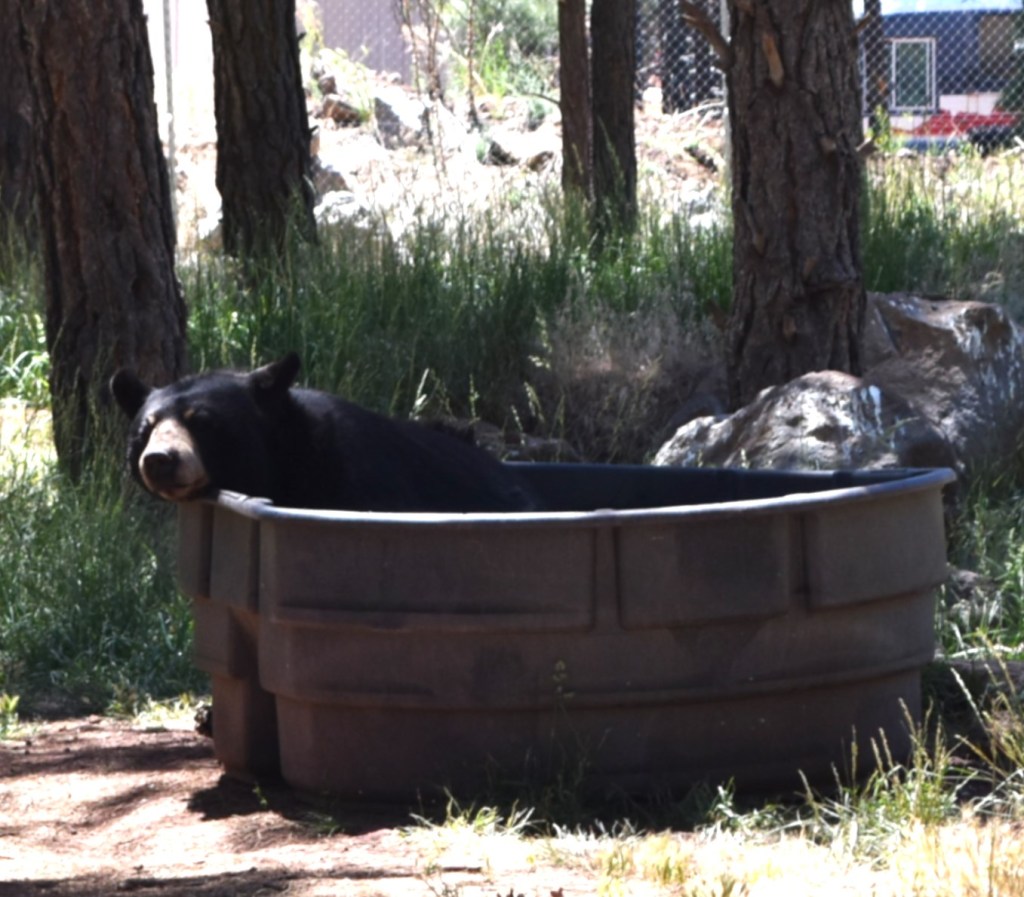
For the park visitors, there is a drive through area where North American animals can be watched in their natural habitats. There is also a zoo-type section called Fort Bearizona with more animals.
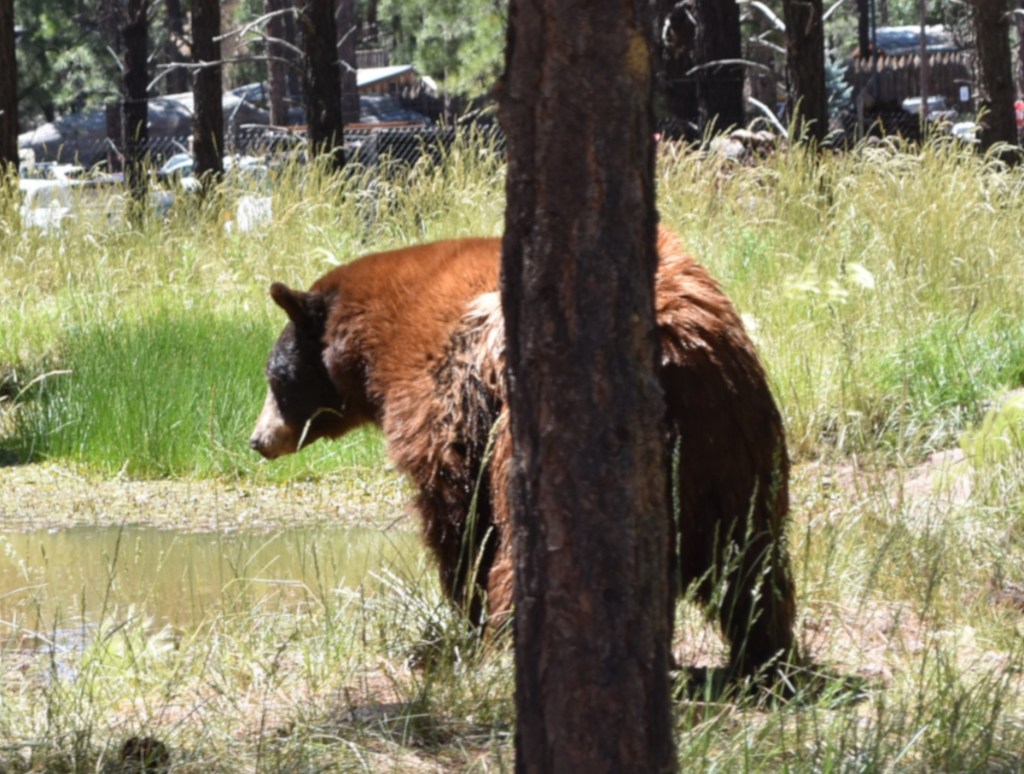
It was an exciting experience to see the wild animals so close, especially the huge bears. My son loved every minute of it, of course. He watched the show where the park’s staff told the stories of some of the orphaned animals who now live in the park and found it very educational.

Flagstaff, Arizona
We stayed in Flagstaff for two nights with our friends who invited us to stay with them while they had a short vacation there. They are from Phoenix, and Flagstaff offers milder temperatures in the summer. We did not explore the town, only ventured downtown for a quick stroll and a lunch. My subjective impressions were that Flagstaff is the most American town we’ve seen in Arizona so far in our trip. By ‘American’, I mean the way we imagine American towns after watching movies and shows.

Kingman, Arizona
We skipped a stop in Kingman on our way from Las Vegas to the Grand Canyon, even though initially it was in our plan. But we stopped there on our almost 450-mile/700-km-long drive from Flagstaff to San Bernardino. And we didn’t regret it! The town is full of history and well-kept places of interest.
A few curious facts about Kingman:
- Walt Disney’s banker Joseph Rosenberg used to work here;
- Legendary “Rhett Butler” Clark Gable married Carole Lombard at the rectory of Saint John’s Methodist Episcopal Church. In 1939, the pair eloped to Kingman during a break in the shooting of “Gone with the Wind”, right after Gable’s messy divorce was finalised;
- Scenes from the movies “Fear and Loathing in Las Vegas” and “Universal Soldier” were filmed here.
If you have time to visit only one landmark in Kingmam, choose Kingman’s Historic Powerhouse.

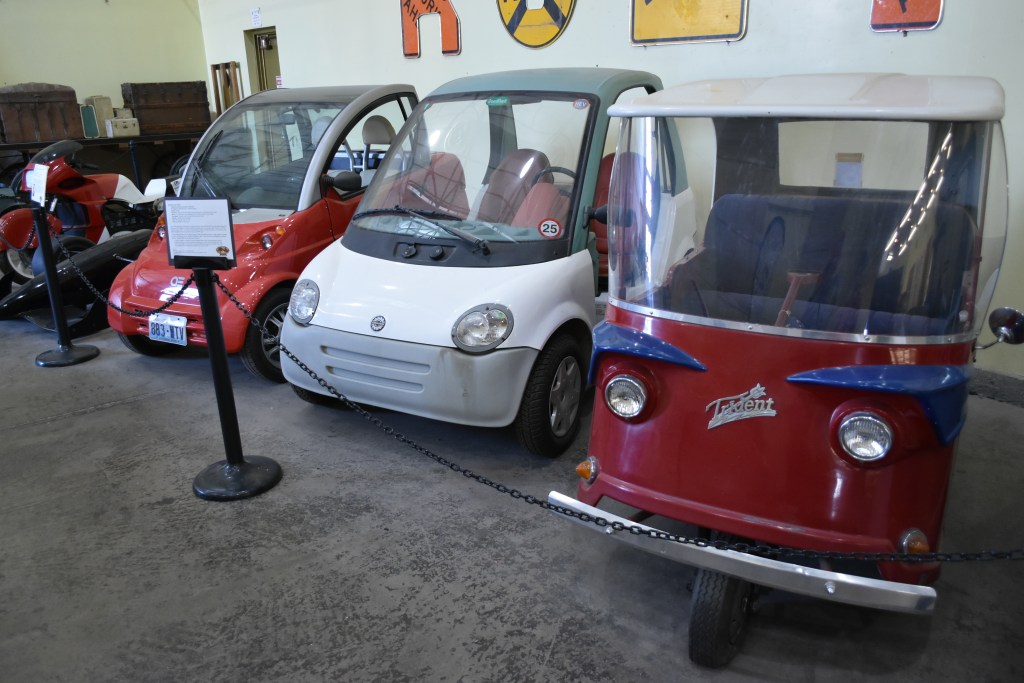
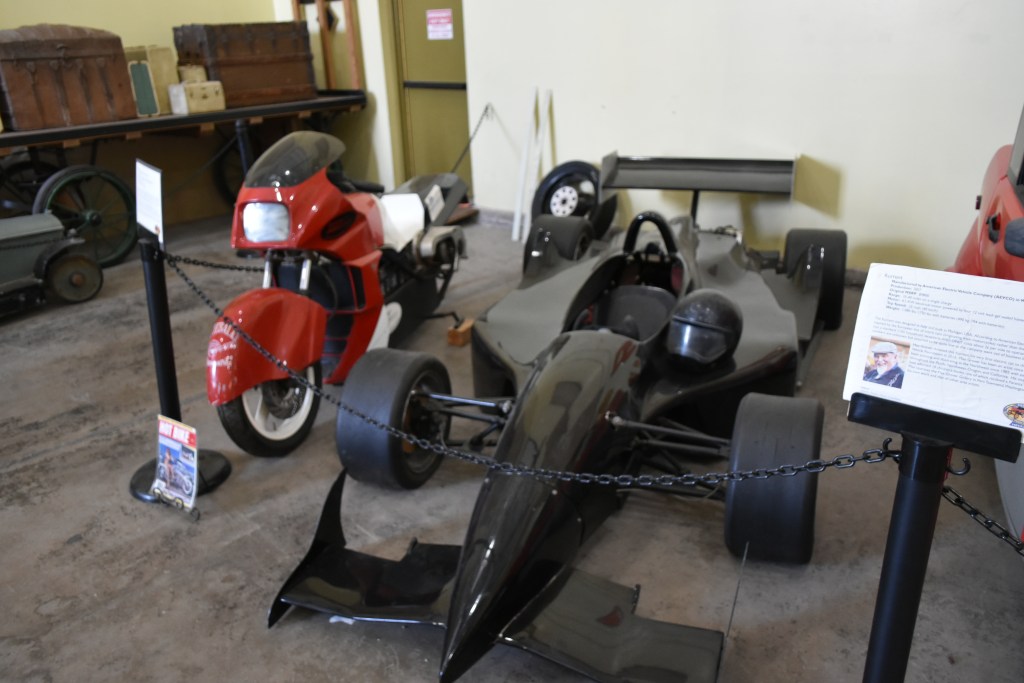
The Powerhouse Visitor Center opened its doors to visitors in 1997. A few million travellers have visited this unique place since then. In 2001, the Arizona Route 66 Museum was opened on the premises. And in 2014 the Route 66 Electric Vehicle Museum, the first of its kind anywhere, was added.
The Kingman Powerhouse operated from 1907 until 1938, when the newly opened Hoover Dam, for which construction the Kingman Powerhouse supplied power – ironic isn’t it? – with its cheaper hydroelectric power ‘threw it out of business.’
Only sixty years later after going out of service did the historical powerhouse building get a chance for a second life. A group of citizens, who didn’t want their town to lose the significant landmark, initiated the conversion of an old powerhouse into a tourist visitors’ centre.
We loved travelling back in time along the Mother Road – Route 66 – in the Arizona Route 66 Museum. Having read Steinbeck’s “The Grapes of Wrath” shortly before the trip, the dioramas depicting the life of those travelling along the famous road desperately hoping to find a better life in California, made a deep impression on me.


I also enjoyed the Electric Vehicle Museum. It displays really quirky electric vehicles made even back in the 19th century. But my son appreciated the movie shown in the small cinema that tells the story of the legendary Mother Road. I feel that, thanks to his curiosity, my husband and I also become more knowledgeable about the things we would have skipped paying attention to.

Next on our itinerary was the Sequoia National Park. 1000 km were waiting for us, so, after setting out from Kingman we stopped for the night in San Bernardino, California and the next morning, headed straight to Three Rivers, the town at the feet of the mountains, a gateway to the world of the most majestic trees in the world.
I post about our trip across the American Southwest on Instagram. If you want to read my posts about the Sequoia National Park before I make a big post here on my blog, you can follow me there. Eve Koguce Books on Instagram
 Eve's Book Diary