Nowadays they say that the first line of a book is very important. I always brush it away as I do most of the ‘must-have’ things, which can’t be roughly applicable to a piece of art, in my opinion. Yet, here I am, hooked from the very first lines of the book I downloaded but didn’t plan to read right away.
“The Salinas Valley is in Northern California. It is a long narrow swale between two ranges of mountains, and the Salinas River winds and twists up the center until it falls at last into Monterey Bay.”
Having just driven through the Salinas Valley, while taking in its green lushness and landscape diversity, and thinking about “The Grapes of Wrath” by John Steinbeck I read before that trip, I couldn’t resist. I had to “return” to these valleys and “see” the endless farm fields and the mountains, brightly lit by the sun in the morning and shrouded in the misty veil of low-hanging clouds in the evening.
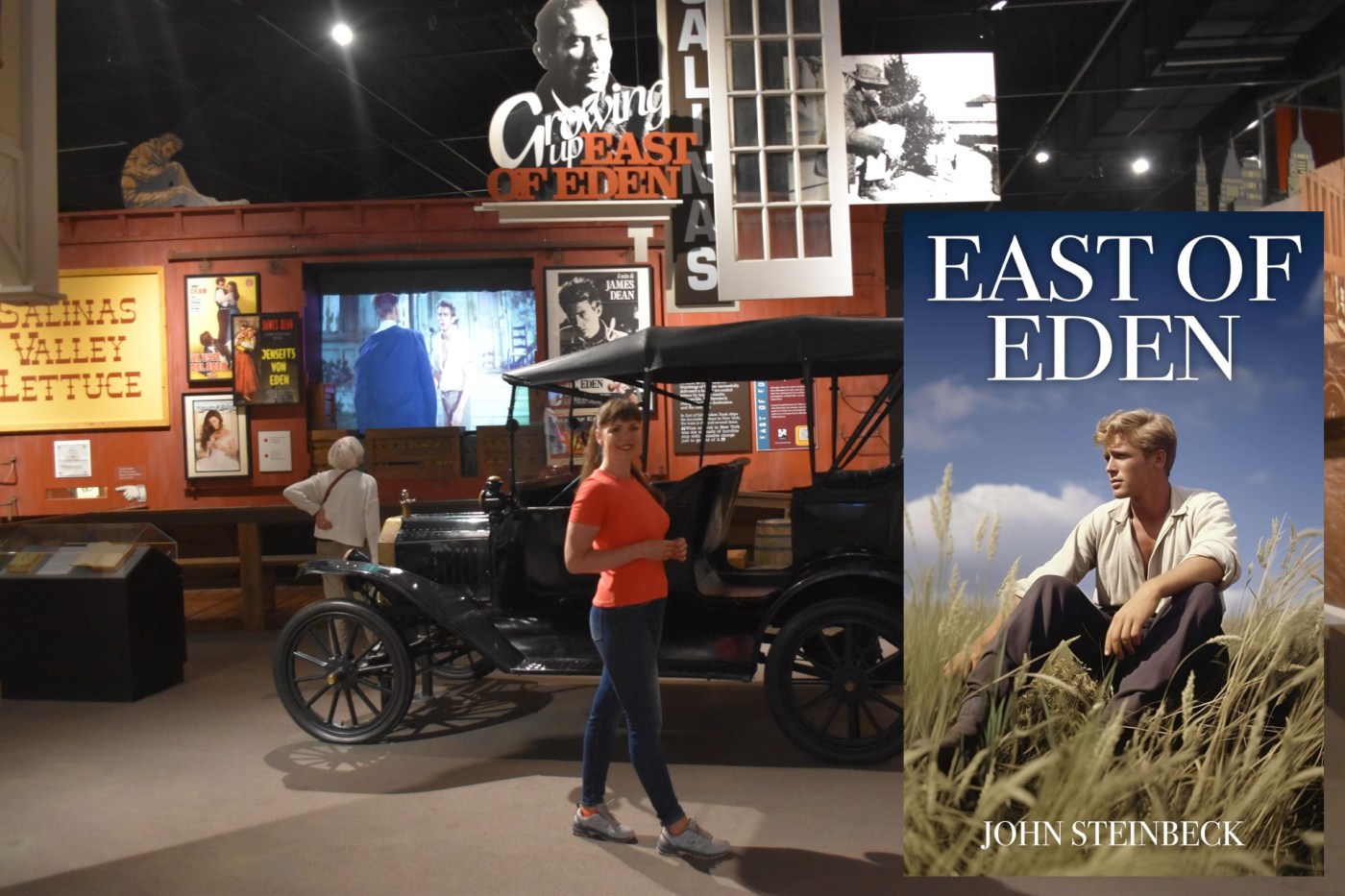
“East of Eden” takes a central place in National Steinbeck Center in Salinas. I look through the photos we took there and think that I’d love to return there someday. After reading the book, I’d see the exposition with different eyes.
“East of Eden” is a poignant portrayal of people’s lives in the Salinas Valley drawn with a generous brush on a vast canvas. It spans over towns dotting this part of California and generations of the families who settled in this beautiful part of the world and call it home.
With a deep understanding of human nature, Steinbeck writes, “And it never failed that during the dry years the people forgot about the rich years, and during the wet years they lost all memory of the dry years. It was always that way.”
And this is how the lives of the characters – and they are numerous – of this saga roll on among the fruit trees and the fields with all kinds of crops imaginable and the mountains. They trudge through the ‘dry’ years and indulge in plans and activities during ‘wet’ ones. And the ‘wet’ years for some can easily be the ‘driest’ for others.
All characters, even minor ones, are multi-dimensional and alive. Once you get to know them, they burst out of the pages and take a permanent place in your mind. Without lengthy descriptions, Steinbeck transforms them from characters into people.
“Her head was small and round and it held small round convictions.” Doesn’t this short sentence draw a wholesome picture? Or “He was a vicious male gossip, insatiably curious and vindictive without malice.”
It would be a futile and unnecessary attempt to retell the plot. This book is about people, the paths they take in life and the paths life forces them to take. It is about people’s dreams, plans, failures, and mistakes. It is about how some people learn from the lessons life and other people teach them and how others drift across the years as if they are in a boat without a sail or oars.
“You are one of the rare people who can separate your observation from your preconception. You see what is, where most people see what they expect,” says one of the characters. I think that this is true about Steinbeck himself. The way he writes about people belonging to different social classes shows how thorough his knowledge of human nature was and how sincerely curious he remained to learn more.
“East of Eden” is a masterful combination of an exciting story full of twists and unexpected turns and a profound exploration of Life and Man.
 Eve's Book Diary
Leave a comment